
Also shaping future-warfare policy and identifying advanced force requirements
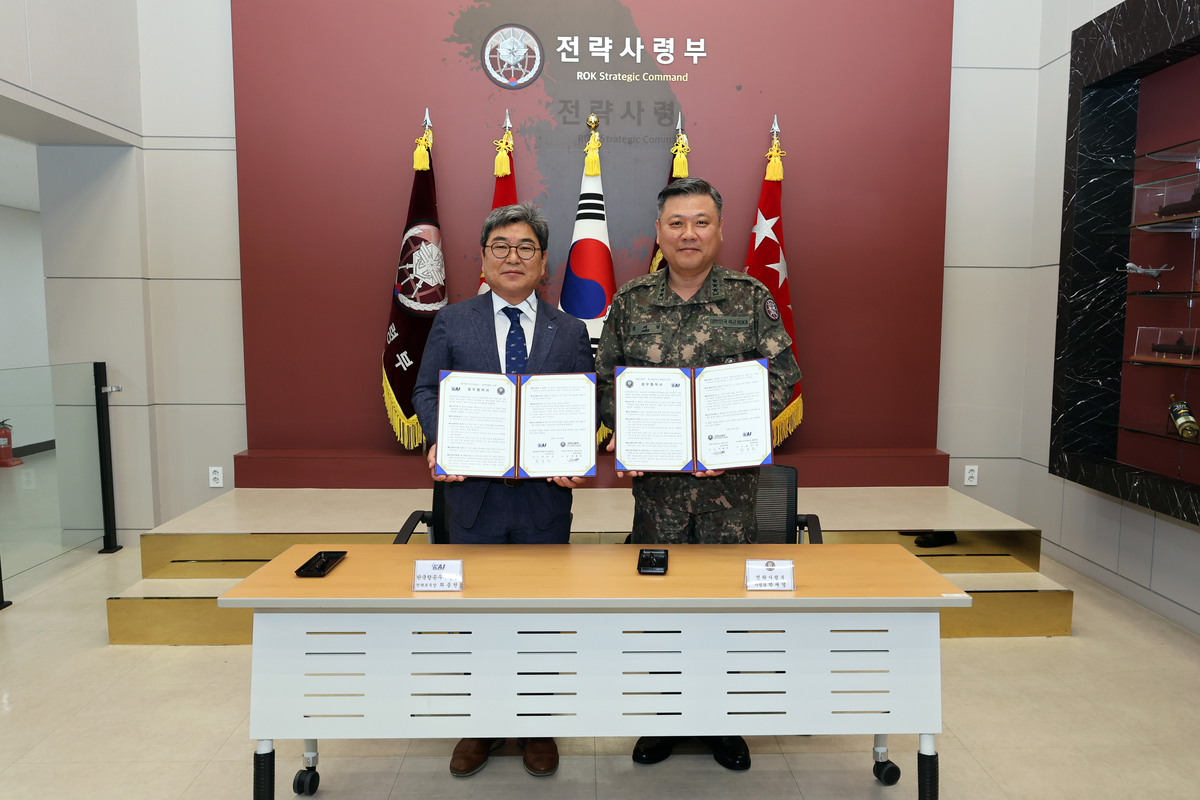 Korea Aerospace Industries (KAI) (047810) and South Korea’s Strategic Command will deepen cooperation to respond to shifting battlefield environments and to advance defense capabilities.
KAI said May 29 that it signed a memorandum of understanding (MOU) with the Strategic Command to establish a strategic partnership and broaden cooperation. Senior officials from both organizations attended the signing, including Choi Jong-won, head of KAI’s Strategy Division, and Lt. Gen. Park Jae-yeol, commander of the Strategic Command.
The MOU is intended to jointly define trajectories for future force development built on advanced technologies — artificial intelligence (AI), space, and unmanned systems — and to create a framework for strategic collaboration amid a fast-changing security environment. The two sides plan to expand cooperation across several areas: sharing information and policy on mutual priorities, holding regular expert seminars and forums, increasing personnel exchanges, and jointly identifying advanced force requirements for future battlefields.
Global security is shifting rapidly due to U.S.-China technological competition, the war in Ukraine and instability across the Middle East. Operational concepts are expanding into domains such as space, cyber and electronic warfare, heightening the importance of aerospace and defense capabilities and the acquisition of technology-based strategic assets.
As South Korea’s only integrated space and aerospace systems prime contractor, KAI is accelerating work on a domestic next-generation air-combat system following the rollout of the first KF-21 production aircraft in March. KAI envisions the KF-21 evolving beyond a conventional manned fighter into the central platform for future air combat — networking AI-enabled unmanned systems, low-Earth-orbit satellites and advanced sensors.
Since 2023, KAI has led development of the AI pilot K-AILOT and has driven key technology efforts for manned-unmanned teaming (MUM-T) and the Next-Generation Air Combat System (NACS) using AI, big data and autonomous control. The company is also speeding development of core battlefield capabilities, including multi-role unmanned aircraft (AAP), low-Earth-orbit satellite integration, and autonomous mission execution.
Under the “One Team Korea” banner, KAI has expanded cooperation among domestic defense firms, government, the military and research institutes to strengthen the competitiveness of South Korea’s defense industrial base. KAI expects its partnership with the Strategic Command to be an important step in broadening civil-military technology cooperation and advancing next-generation high-tech weapon systems.
Choi said, “This MOU with the Strategic Command marks a meaningful starting point for developing South Korea’s future strategic forces. We will actively share our aerospace technologies and operational experience preparing for future battlefields to help the military rapidly secure the capabilities needed to prevail.”















Most Commented