
Translation result
Training covers four K-weapons: K9 self-propelled howitzer, K2 tank, Chunmoo MLRS and Surion helicopter
Junior artillery officers assist in the field and cultural exchanges follow
This year 13 troops from Norway, Estonia and Poland received Chunmoo training
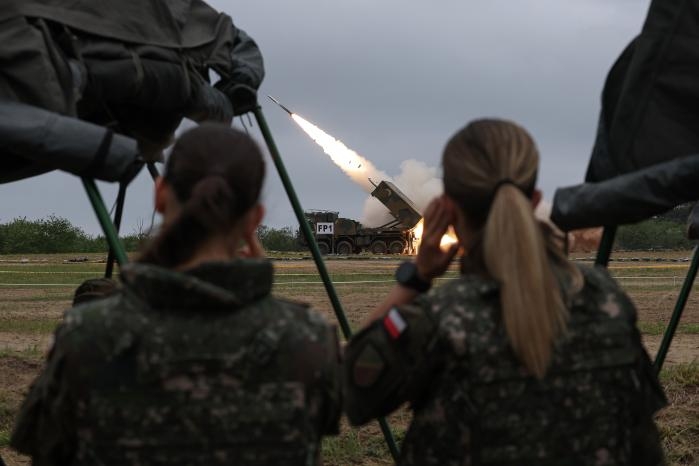 The Republic of Korea Army kicked off this year’s first session of the Army International Course (K-AIC) with Chunmoo MLRS training, part of an effort to share operational experience and know-how on Korea’s defense systems with partner nations. Launched in 2024, K-AIC is a global training program designed to support exports of K-defense systems by training foreign military personnel on systems such as the K9 howitzer, K2 tank and Chunmoo multiple-launch rocket system.
The Army said 13 service members from Poland, Norway and Estonia attended the opening course, which ran from May 8–27, where they learned Chunmoo operational procedures and training protocols.
According to the Army and Defense Daily on the 27th, foreign trainees who entered the Artillery School’s international course on May 18 completed hands-on Chunmoo operation and maintenance drills prepared by the school. Split into three teams, they inspected key components such as the launcher and chassis to grasp the system’s operating concepts, then performed maintenance tasks themselves. Trainees checked the launcher’s manual controller and actuators, practiced oil-change procedures and learned how to fit snow chains to deepen their familiarity with the Chunmoo.
Poland, Norway and Estonia share two notable traits: all three are NATO members and each has decided to acquire the Chunmoo. Poland has already fielded a Polish export variant, the HOMAR-K. Estonia and Norway signed Chunmoo supply contracts with Korea in December and January, respectively.
Training was intense and focused. Trainees followed technical briefings in English, absorbing a wide range of Chunmoo-related knowledge. When a concept was unclear, they raised questions immediately. Hands-on sessions saw strong participation across the board, though officers, NCOs and enlisted personnel emphasized different priorities: officers focused on tactical employment, while NCOs and enlisted soldiers concentrated on maintenance and firing procedures.
Master Sgt. Kwon Tae-geun, a Chunmoo instructor at the Artillery School, said, “We prepared the international course thoroughly, and the foreign trainees’ active participation helped us achieve solid results. It’s rewarding and a source of pride to demonstrate the quality of K-defense systems.”
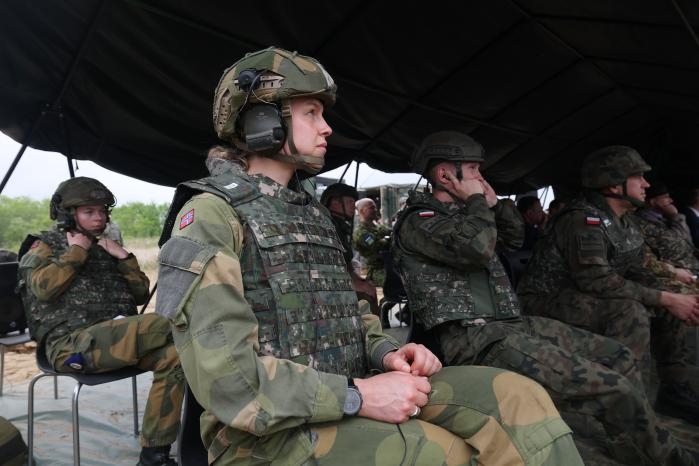 The course’s highlight was a live-fire demonstration that let participants witness Chunmoo’s long-range strike capability. On the 21st, foreign troops attended a live-fire exercise at Ungcheon Range on Korea’s west coast, observing the full sequence from target acquisition and fire-control solution to launch.
The exercise engaged a distant target roughly 55.6 km (about 34.6 miles) from the range using 230 mm-class high-explosive guided rockets. As the rockets left the launcher and climbed, trainees cheered when the warheads struck the target with precision. For many, it was a stark demonstration of the Chunmoo’s ability to surgically engage enemy firing points and critical targets.
By training foreign forces on Chunmoo and other K-systems, the Army International Course has positioned itself as the ROK’s flagship global military education program. Through K-AIC, the Army shares operational practices and training frameworks for K-defense exports, helps partner countries improve their system-handling capabilities and expands avenues for military exchange and defense cooperation.
Since 2024, the course has covered four systems: the K9 self-propelled howitzer, the K2 main battle tank, Chunmoo and the Surion (KUH-1) helicopter. To date, 166 foreign service members from eight countries have participated. Notably, Poland joined last year’s newly added Chunmoo curriculum and reported high satisfaction with Korea’s organized instruction and practical operational lessons. Building on that success, trainees from Norway and Estonia—both anticipated Chunmoo buyers—participated in this year’s Chunmoo class.
The Army also assigned junior artillery officers serving in field units to the international course to help foreign trainees adapt, to share each nation’s military culture and to strengthen the junior officers’ global competencies.
1st Lt. Shin Seung-min of the Capital Mechanized Infantry Division, who took part in the course, said, “Studying Chunmoo alongside foreign soldiers reaffirmed the excellence of our weapon systems and training methods. Interacting with international trainees also boosted my pride in the ROK Army.”
To maximize training effectiveness, the Army linked classroom instruction at branch schools with field-centered exercises. After building Chunmoo fundamentals at the Artillery School, foreign personnel observed live-fire drills to validate the system’s firepower and operational impact. Near the program’s end, trainees toured defense contractors’ production and maintenance facilities and visited units that operate Chunmoo to exchange lessons learned from field operations.
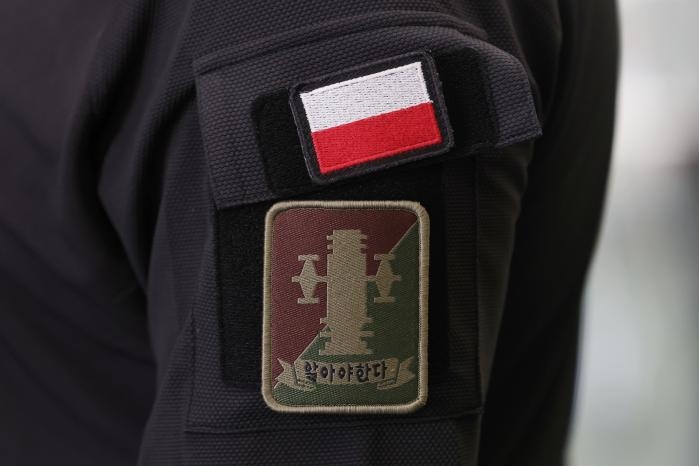 The itinerary also included Korean cultural experiences and battlefield site visits to help foreign soldiers deepen their understanding of the country and build trust in the ROK Army.
The Army plans to continue international courses in July and November across three branch schools, including the Artillery School, offering K2 tank and K9 howitzer operation-and-maintenance training. Taking participants’ experience levels into account, the Army will run a basic course in July and an advanced course in November.
An Army official said, “Aligned with the government’s defense-industry development policy, we will expand the Army International Course using the Army’s global infrastructure and actively promote the quality of Korea’s weapon systems. These efforts will help reinforce South Korea’s standing among the world’s top defense exporters.”









Most Commented