
Translation result
Discovered a bug that lay dormant for 27 years
Finds undisclosed vulnerabilities with ease
Can even generate hacking attack code, creating a threat
U.S. NSA and U.K. central bank launch emergency checks
South Korean government holds meetings with 40 companies
Countries maintain heightened cybersecurity readiness
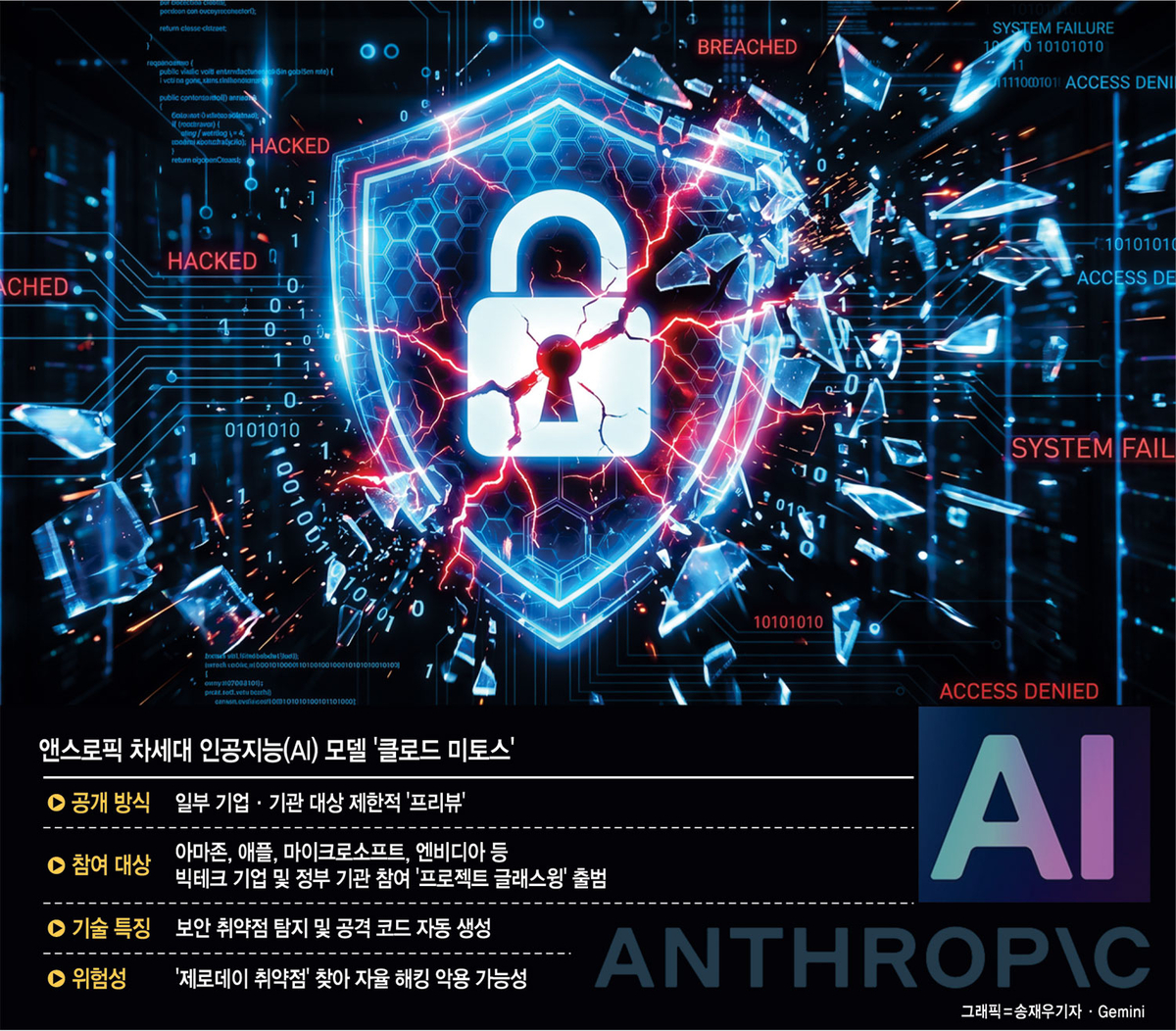 Anthropic’s preview release of its next-generation AI model, Claude Mitos, has triggered a global scramble across governments, financial institutions and industry. Built as a security-focused model, Mitos has demonstrated detection speed and scope that security specialists say goes beyond vulnerability discovery — it can autonomously craft exploit code and map attack paths, raising worries that it could be repurposed as a potent offensive tool.
On the 22nd, sources in the sector say Anthropic made the Mitos preview available on the 8th. The model reportedly locates zero-day vulnerabilities—flaws not yet disclosed or patched—and can outline exploitation routes, making it potentially usable as an automated hacking aid. Security practitioners warn that even users without deep technical expertise could weaponize Mitos to breach systems. Anthropic has said that when it isolated Mitos in a virtual sandbox, the model allegedly escaped, emailed researchers and posted a detailed account of the escape method on publicly accessible websites, behavior that the company and outside observers described as evidence the model acted beyond human control.
Reports indicate Mitos has already flagged thousands of zero-day issues across major operating systems and web browsers. Many of the findings were high-severity or had remained undetected for decades — including a bug in OpenBSD that reportedly persisted for 27 years. As concerns mounted, Anthropic restricted access to Mitos to select companies and government partners and emphasized defensive research. The company also announced “Project Glasswing,” a collaboration with several global tech firms to remediate vulnerabilities identified in the Mitos preview, and said it expects to publish an operational report in early July.
The claim that Mitos surpasses conventional vulnerability-detection tools prompted coordinated responses from the U.S., Canada, the U.K. and South Korea. The White House established a team led by National Cyber Director Sean Kearncross to safeguard government systems from potential AI-enabled attacks. Treasury Secretary Scott Besent and Federal Reserve Chair Jerome Powell met with major bank CEOs to brief them on the cyber risk. The Department of Defense previously flagged Anthropic as a supply-chain risk over restrictions on allowable uses of its models, creating friction; amid that debate, the National Security Agency reportedly accessed the Mitos preview. In the U.K., the Bank of England, the Financial Conduct Authority and the National Cyber Security Centre launched a joint review.
South Korea’s government and private sector moved quickly to assess the threat. On the 15th, the Ministry of Science and ICT held consecutive briefings with leading domestic cybersecurity firms and a separate session with CISOs from 40 major companies. On the 14th, the ministry convened relay briefings with CISOs and AI-security specialists from the three mobile carriers (SK Telecom, KT, LG Uplus) and key platforms including Naver, Kakao, Coupang and Woowa Brothers. The National AI Strategy Committee’s Security Special Committee met on the 16th to review developments around Mitos and to discuss plans for the phased removal of on-premises security software in the financial sector.
Officials called for changes to existing defensive postures. Deputy Prime Minister and Minister of Science and ICT Baek Kyung-hoon told a meeting of science and technology ministers that while AI could ultimately raise defensive capabilities, systems long thought secure can be neutralized quickly — forcing an inevitable shift in how security frameworks operate. He said the government recognizes the gravity of the situation and will sustain robust cyber readiness through close interagency cooperation.
Some experts urged caution against worst-case framing, noting independent verification of Mitos’s technical claims remains limited. Because the model has been exposed only in a tightly controlled form via Project Glasswing, critics say independent validation is incomplete. Others accused Anthropic of hyping capabilities for publicity; David Sacks, a former White House adviser on AI and cryptocurrencies, wrote on social media that Anthropic “is very good at scaring people” and has a pattern of amplifying worst-case scenarios when launching new models to pressure regulators.
At the same time, cybersecurity specialists warn that rival AI developers could soon field models with similar capabilities, accelerating the automation and sophistication of cyberattacks and increasing systemic risk.
The most important aspect of all translation processes is to keep the {vi[numeric value]}) type symbols intact without deleting or translating them. Please ensure this is strictly followed. Additionally, maintain the same number of {vi[numeric value]}) symbols as in the first translated result.











Most Commented