
Translation result.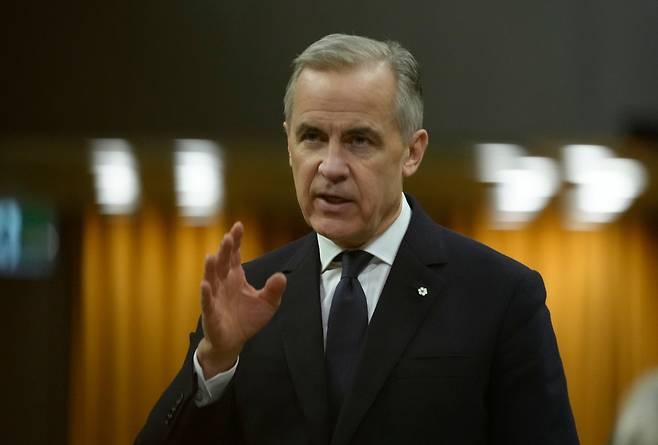 [Herald Business=Reporter Seo Ji-yeon] A dispute between U.S. President Donald Trump and Canadian Prime Minister Mark Carney has moved into the military-security arena. The U.S. government said it would suspend the activities of a bilateral defense coordination body, a step that has raised tensions across North America’s security architecture.
On the 18th (local time), The Hill reported that Elbridge Colby, the U.S. deputy assistant secretary of defense for policy, announced on X (formerly Twitter) that the U.S. would suspend activities of the U.S.-Canada Permanent Joint Board on Defense (PJBD).
The PJBD is the forum where U.S. and Canadian military leaders and civilian officials coordinate joint defense policy and military cooperation. The two neighbors have traditionally met twice a year to discuss North American defense strategy.
Colby said the suspension was prompted by what he described as Canada’s failure to demonstrate reliable progress on its defense commitments and said the U.S. will reassess how the PJBD contributes to continental defense.
He also reposted video of Prime Minister Mark Carney’s January speech at the World Economic Forum in Davos, Switzerland.
In that address, Carney urged middle powers to cooperate in countering the influence of superpowers such as the United States and China. Diplomats interpreted the remarks as a critique of President Trump’s tendency to downplay alliances.
Analysts say Colby’s public resharing of the Davos speech signaled an open expression of displeasure with Carney’s comments.
The bilateral rift has extended into the defense-industry sphere. The Trump administration has reacted strongly to growing calls within Canada to scale back purchases of U.S.-made weaponry.
Ottawa had planned to buy 88 F-35 fighters from Lockheed Martin, but the program is now under review.
U.S. Ambassador to Canada Pete Hoekstra warned that if Canada abandons the F-35 purchase, it could have implications for the North American Aerospace Defense Command (NORAD).
NORAD, established in 1958 during the Cold War to counter the Soviet threat, is the binational missile-warning and air-defense system operated by the United States and Canada. It is both a practical and symbolic cornerstone of North American security cooperation.
Analysts say tensions between Washington and Ottawa have grown as the Trump administration tightens pressure on allies following the president’s return to power, and as Canada moves to reduce its dependence on the United States.















Most Commented