
Is the KF-21 the Future of Defense? Explore Its Cutting-Edge Features and Export Challenges
Daniel Kim Views
Translation result
U.S. Government Approval Required Even If a Single U.S. Component Is Included
“If Exports to Third Countries Are Pursued, ROK and U.S. Will Cooperate
to Ensure Export Implementation Faces No Disruption”
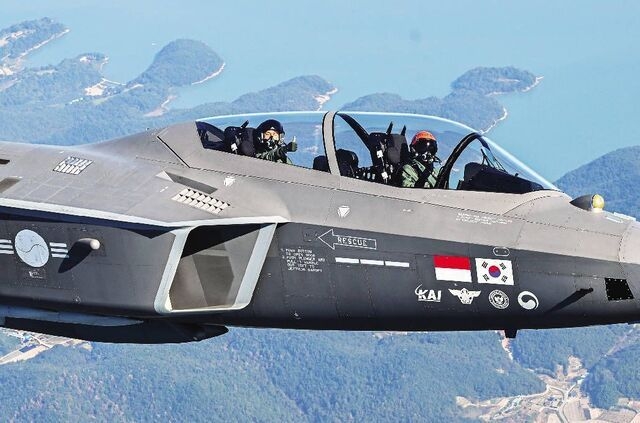 The KF-21 is South Korea’s first fighter built with extensive domestic technology. On March 25, Korea Aerospace Industries (KAI) in Sacheon, South Gyeongsang, held a rollout ceremony for the first production KF-21. Developed since 2015, the supersonic KF-21 completed flight testing and other trials and has entered serial production. The Air Force could receive the first aircraft as early as September.
According to the Defense Acquisition Program Administration (DAPA), the government will invest roughly 10 trillion KRW (about $7.5 billion) to deliver 40 initial-production aircraft (two-seat and single-seat variants) to the Air Force by 2028. The Air Force plans to follow that with 80 Block-II aircraft—upgraded with enhanced air-to-ground capabilities—bringing the total to 120 jets, which the service aims to deploy to the 16th and 18th Fighter Wings by 2032.
South Korea is the eighth country or consortium to develop a 4.5-generation supersonic fighter, following the U.S., Russia, China, France, Japan, Sweden and the European consortium (UK, Germany, Italy, Spain). The KF-21 reaches a top speed of Mach 1.81 (about 2,200 km/h) and a maximum range of 2,900 km. It can carry a weapons load of 7.7 tons. Unlike the single-seat F-35, the KF-21 is also available in a two-seat configuration.
The initial KF-21 model’s domestic content is estimated at roughly 65%. South Korean firms developed four core avionics suites domestically: an active electronically scanned array (AESA) radar, an infrared search-and-track (IRST) system, an electro-optical target tracker, and an integrated electronic warfare suite. In short, Seoul has indigenized the advanced sensors—AESA and IRST—that serve as a fighter’s brain and eyes for detection, tracking and strike.
Those capabilities have positioned the KF-21 as a next-generation pillar of South Korea’s defense industry exports. But a significant obstacle remains for overseas sales: the engine, sourced from the United States. The KF-21 is powered by the F414-GE-400K engine manufactured by U.S. firm General Electric (GE) and produced under a technology-transfer arrangement by Hanwha Aerospace.
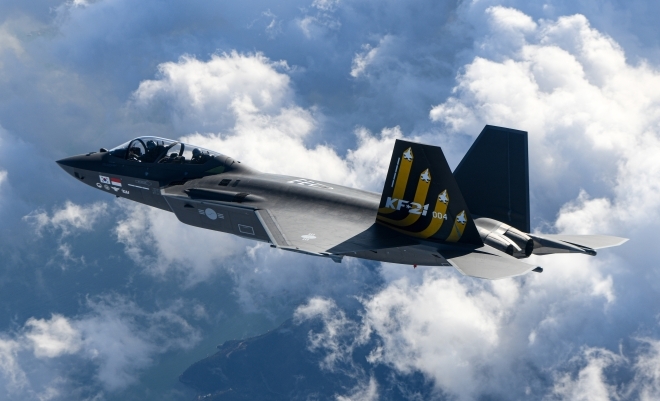 The issue is that the engine is controlled under the U.S. State Department’s International Traffic in Arms Regulations (ITAR). Any export to a third country requires a U.S. export license (EL). Under ITAR’s retransfer rules, if an item contains even one critical U.S. component, the U.S. government’s approval is required. That reality is driving calls for national-level investment in domestic aircraft-engine capabilities.
A DAPA official said, “In past similar cases, close cooperation among the Korean and U.S. governments and industry enabled smooth exports. If third-country sales of KF-21s equipped with engines subject to ITAR are pursued, we will manage them through the Korea-U.S. cooperation framework to ensure export implementation proceeds without disruption.”
Fully acquiring the technology from the U.S. is not a practical fallback. The global aircraft-engine market is effectively dominated by three companies—U.S. GE and Pratt & Whitney, and the U.K.’s Rolls-Royce. These firms restrict overseas technology transfers while consolidating market power. That raises the risk that the KF-21’s third-country sales could be constrained by its engine.
An industry official said, “Gas-turbine engines used in aircraft closely resemble missile propulsion systems, so international agreements limit trade and proliferation. Countries that hold the related technology strictly control leaks. It will be difficult for Hanwha Aerospace to secure a complete transfer of GE’s engine technology, so achieving technical independence in aircraft engines is urgent.”
In 2022, the government identified “12 national strategic technologies” and 50 prioritized sub-technologies. One of the priorities is “advanced aero gas-turbine engines and components.” The government pledged active, state-level investment to develop the aircraft-engine sector. An official at the Agency for Defense Development said, “Engine self-reliance can become a new growth driver, producing strong manufacturing multipliers and high added value.”

- Iran Plays a ‘Three-Stage Card’ Despite Hormuz Blockade…Trump: “No Meeting Without Nuclear Abandonment” [Global Morning Briefing]
- Families of the Dec. 29 Disaster Victims Say “Boeing Defect Is the Root Cause”…Call for Full Investigation [Incident Plus]
- “OpenAI Fell Short of Revenue Targets”…Red Flags over Its Ability to Cover Investment Costs
- Cut Plastic Made from Oil by 30% by 2030…“Expand Use of Recycled Feedstock” [Pick Economy]
- Jensen Huang’s Daughter Located, Stock Jumps 7.7%…NVIDIA Physical-AI Partnership Draws Attention [ZupZup Report]
- Trump Rejects ‘Three-Stage Peace Plan’…Iran Opens Strait Toll Account [Global Morning Briefing]
- EV Charging Fees: Lower Slow-Charge, Raise Fast-Charge Rates…Post Prices Like Gas Stations [Pick Economy]
- UAE Turns From Saudi, Draws Closer to U.S.…China Courts the Global South [Global Morning Briefing]
- Migrant Worker Tied to Forklift and Mocked…Perpetrator Faces One-Year Prison Term Request [Incident Plus]
- Elon Musk’s Nine-Hour Testimony Rocks the Case: “The Tail Wagged the Dog,” Sparking OpenAI Betrayal Claims















Most Commented