
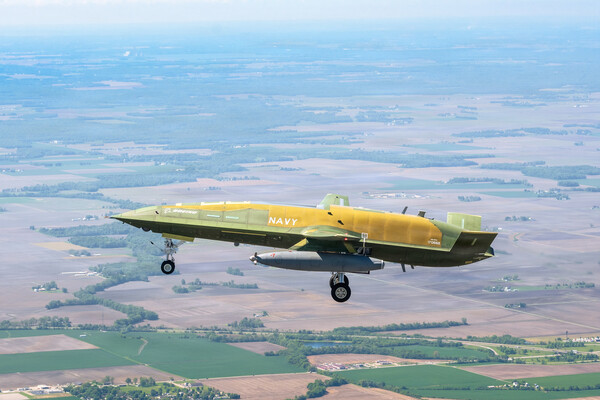
By Yang Won-mo, The Public — The U.S. Navy’s carrier-based unmanned tanker, the MQ-25A Stingray, completed its first test flight, a milestone that analysts say lays the groundwork for carriers to support air operations without moving into the enemy’s threat envelope.
The Navy Times reported April 28 that the Navy and Boeing flew the MQ-25A at MidAmerica St. Louis Airport in Mascoutah, Illinois, on April 25. The jet followed earlier low-speed taxi tests conducted in January and, for the first time, transitioned to takeoff and sustained airborne flight during this trial.
The flight was conducted under ground-remote control. Operators in an unmanned carrier-based aircraft mission control system (UACS) ground station controlled the aircraft rather than pilots onboard. Teams evaluated core systems, including flight controls, engine response and airframe stability.
Video released by Boeing shows the MQ-25A accelerating down the runway and lifting off. Boeing said the aircraft conducted roughly two hours of flight over southern Illinois and executed taxi, takeoff, flight and landing sequences autonomously under ground controller commands. Industry estimates put the unit cost at about 200 million USD (approximately 266.7 billion KRW) each.
Designed strictly for aerial refueling rather than strike missions, the MQ-25A’s primary role is extending the operational range of carrier-based fighters by delivering fuel. The airframe is about 15.5 m long with a 22.9 m wingspan and can offload roughly 6.8 metric tons of fuel (about 15,000 pounds).
Fielding the MQ-25A will reshape carrier employment. Historically, carriers have had to close on the front to keep fighters within range, increasing vulnerability. Once operational, the MQ-25A would allow carriers to remain farther seaward while still supporting combat air patrols and strike missions.
The platform is reported to be able to operate and refuel aircraft up to roughly 925 km (about 575 miles) from a carrier. That reach could nearly double the effective radius of carrier air wings. Naval officials characterize the program as a major advance in air wing capability and see the MQ-25A as a core asset for future carrier power projection.
Its unmanned architecture also opens the door to mission expansion. Analysts say the Stingray could evolve into a multi-mission platform for ISR, communications relay and potentially weapons carriage. If those upgrades materialize, the MQ-25A could become a force multiplier—simultaneously increasing carrier strike group survivability and extending its offensive reach.













Most Commented