
K-Defense Revolution: Hanwha Aerospace Unveils Homegrown Missile Technology by 2036
Daniel Kim Views
Translation result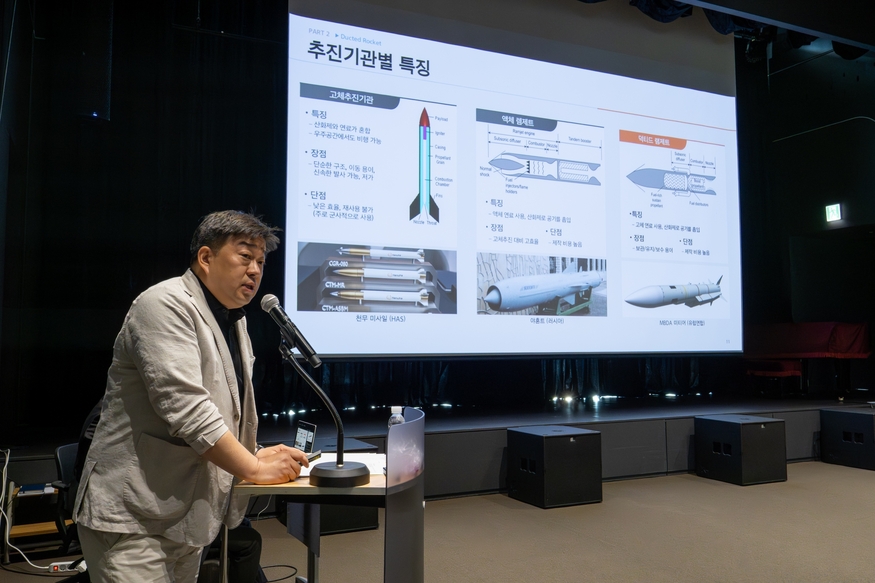
By Jeong Ye-rin, The Guru — Hanwha Aerospace outlined an independent development plan for key weapons systems, from propulsion units for long‑range air‑to‑air missiles to precision‑guided rounds for the K9 self‑propelled howitzer. The company said it aims to fully domesticize advanced defense technologies that currently depend on foreign suppliers, boosting the global export competitiveness of its K‑Defense packages.
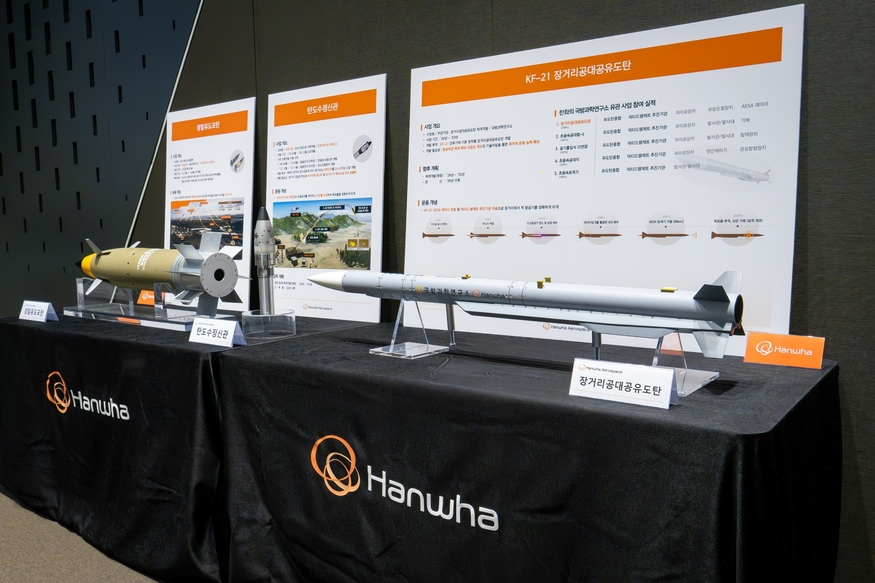
On April 29, Hanwha Aerospace held “Hanwha Tech Academy 2026” at the Hanwha Building in Jung‑gu, Seoul, where it unveiled a roadmap for advanced defense technologies, including a long‑range air‑to‑air missile intended for the domestically developed KF‑21 fighter. The event highlighted precision‑strike solutions designed to shape future battlefields, building on the company’s work with the Agency for Defense Development (ADD) to localize aerial munitions.
Cho Bok‑gi, head of Systems Integration Team 1 at the PGM Research Institute, said Hanwha Aerospace is developing the country’s first ducted ramjet system for air‑launched munitions under a government program. He added that the company, together with Hanwha Systems, will pursue nine government projects, including a long‑range air‑to‑air system. Hanwha plans to complete domestic development by 2033 and begin equipping the KF‑21 after 2036.
The ducted ramjet—dubbed the “Korean Meteor”—extends a weapon’s range by using ambient air drawn in during flight as the oxidizer. Eliminating a separate oxidizer tank allows sustained supersonic flight from beyond enemy engagement ranges, and the design is intended to operate reliably in extreme conditions, from −55°C up to temperatures of several thousand degrees.
Since 2005, Hanwha Aerospace has researched core propulsion components such as nozzle‑less boosters and gas generators, building an indigenous infrastructure. The company is the only domestic manufacturer of the oxidizer and operates a single Daejeon facility that handles production, filling and non‑destructive testing. Notably, it achieved better than 99% operational reliability in the port‑cover opening mechanism that deploys the air intake at supersonic speeds, underscoring technical maturity.
Cho Jeong‑tae, head of Propulsion Munitions Team 1 at the PGM Research Institute, said a ducted ramjet combines the low‑maintenance traits of a solid motor with the extended range of a liquid system. He added that Hanwha’s 40 years of solid‑propellant development will serve as a platform to secure a technological edge in the global defense market.
Work to convert 155mm K9 howitzer rounds into precision‑guided munitions is also progressing. A ballistic‑correction fuze and precision‑guided projectile that combine GPS and an inertial navigation system (INS) can hold impact dispersion to roughly 50 meters at ranges up to 50 km, enabling precision strikes against critical enemy assets.
To counter the electronic‑warfare and jamming threats highlighted in the Ukraine conflict, the system incorporates proprietary anti‑jamming technology. The company also improved operational efficiency with a modular charge system that adjusts range by combining standardized charge units.
Kim Jeong‑hoon, head of Propulsion Munitions Team 2 at the PGM Research Institute, said the design and production of all components were completed using purely domestic technology, allowing rapid response to military requirements. He noted the solution can be applied to conventional ammunition simply by swapping the fuze, and that performance will be validated soon through live‑fire testing.












Most Commented