
Translation result
|
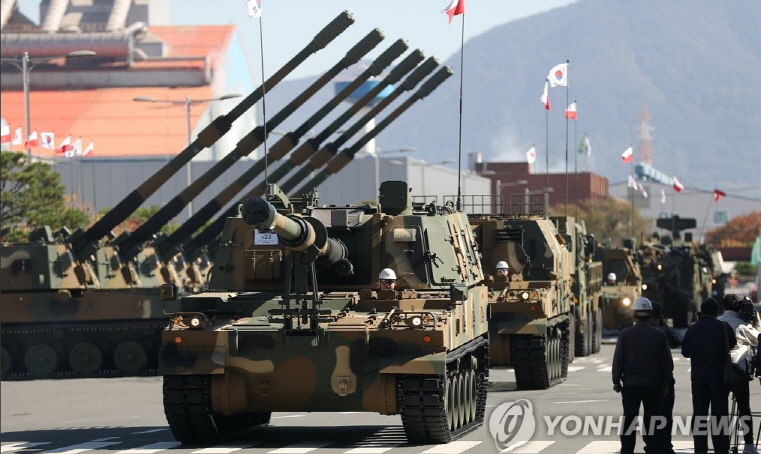
South Korea’s defense industry (K‑defense) is setting export records and earning international praise. Behind that success, however, is a stark reality: a string of losses in global procurement contests.
Political and diplomatic barriers that technology alone cannot overcome have put the brakes on K‑defense’s overseas expansion.
What’s going wrong?…..
After interviews with current and former K‑defense experts across the armed forces, research institutes, law firms and defense firms, reporters concluded that the current structure of the Defense Acquisition Program Administration (DAPA) is ill‑equipped to navigate a rapidly shifting global security environment and a changing defense market.
More setbacks… Did technology fail them?
Recent moves in the global defense market have been a blow to K‑defense insiders.
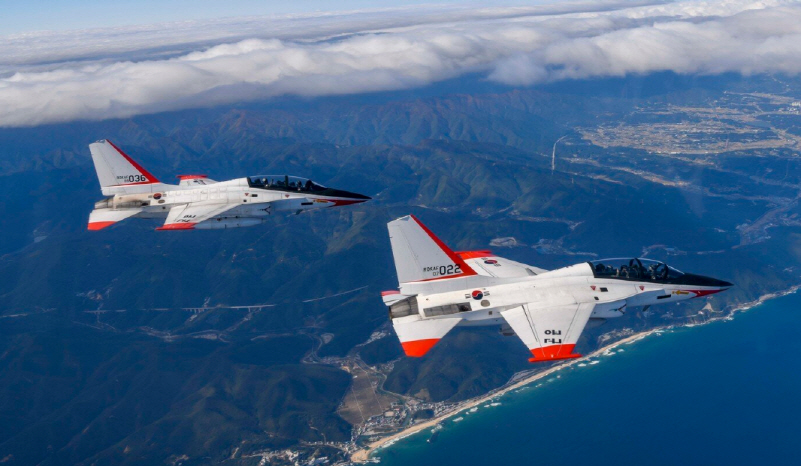
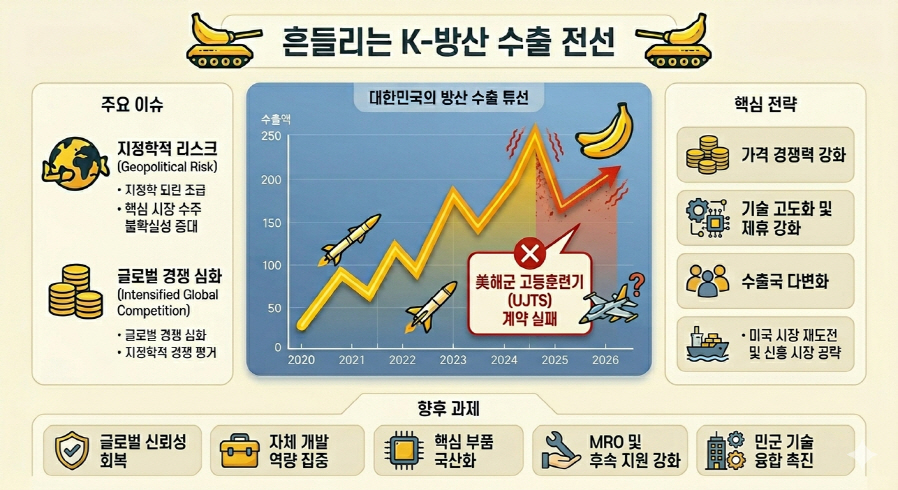
The Lockheed Martin–Korea Aerospace Industries (KAI) consortium, once a leading contender for the U.S. Navy’s advanced trainer (UJTS) procurement—an effort tied to a program valued at 60 trillion KRW (approximately 45 billion USD)—abruptly withdrew from the competition. The reason was not a shortfall in technology but a shift in the rules of the game.
When the U.S. Navy removed the core requirement for arrested‑landing capability, KAI’s T‑50 lost its distinguishing advantage. That change strengthened Boeing’s price‑centered position. Analysts also point to difficulty meeting the Buy American Act’s 75% U.S. content threshold and reduced price competitiveness as key factors.
Experts say the outcome reflects U.S. political dynamics and a deliberate policy decision to favor domestic industry.
These contract setbacks aren’t confined to North America.
△ Australian frigate program: Korea, once a top contender, lost to Japan’s Mitsubishi Heavy Industries, which benefited from full government backing—a clear signal that Japan has emerged as K‑defense’s main rival after lifting its weapons export ban.
△ Indian submarine program: Germany’s TKMS secured preferred status by offering aggressive financing and technology transfer, displacing Korean bidders.
△ Poland’s ORKA program: After an initial export milestone, Hanwha Ocean failed to secure the contract amid NATO cohesion dynamics, continuing a string of struggles.
The common thread in these setbacks is strategic—not technological—defeat.
|
K‑defense experts: DAPA must evolve beyond a 20‑year procurement‑agency model
K‑defense’s leap forward during the crisis sparked by Russia’s invasion of Ukraine in February 2022 relied on two strengths: value for money and rapid delivery. Behind that success, DAPA’s two‑decade role as a procurement agency focused on domestic demand—ensuring efficient, transparent supply—was crucial.
Alongside DAPA, three research institutions provided integrated execution capability: the Agency for Defense Development (ADD), which designs and develops core systems from missiles to tanks; the Defense Technology Quality Assurance (DTaQ), which certifies system reliability; and the Korea Research Institute of Defense Technology Promotion (KRIT), which supports strategic planning and exports.
But as K‑defense becomes a strategic national industry, experts argue the roles and responsibilities for defense acquisition must be redefined.
△ Link force development and industry from the start (R&D innovation)
Historically, DAPA concentrated on delivering the equipment the military requested on schedule. Experts now say the starting point for defense R&D must change. From initial concept, planners should weigh industrial spillovers and export competitiveness alongside military utility. For advanced domains such as AI, unmanned systems and space, integrated military–civil management from R&D through export is essential.
△ Fuse defense diplomacy with policy finance
Defense exports are government‑to‑government commitments. Korea needs the capacity to predesign bold policy‑finance packages and industrial cooperation offers—approaches already used by Germany and France. Experts say DAPA should act as a hub linking the foreign ministry, industry ministry and finance ministry. After K‑defense’s breakthrough with Poland, the ability to craft national‑level package deals has become a core competitive edge beyond product performance.
△ Japan’s rise—without a control tower, everyone loses
Japan’s rapid capture of the Australian market after lifting export restrictions is instructive. Tokyo’s prime minister’s office leads the effort and marshals cross‑ministry power. K‑defense experts argue DAPA must exercise practical authority over defense R&D planning, industrial‑ecosystem design and export strategy.
|

A concrete blueprint for an expanded, whole‑of‑government K‑defense body
Experts stress DAPA must boost in‑country, mission‑focused intelligence. They recommend expanding technical attachés from ADD and KRIT at diplomatic missions in key export countries to monitor political shifts in real time. This would strengthen an intelligence command function able to spot and respond to variables like sudden changes in U.S. Navy procurement requirements.
They also call for structural reforms to remove unfair barriers so small and medium enterprises and startups—not only large conglomerates—can compete and grow. That work is aimed at strengthening the ecosystem and preserving K‑defense’s competitive edge for the long term.
K‑defense stands at a critical crossroads. Early gains built on cost‑effective platforms are reaching their limits. Critics warn that successes in Poland, the UAE and Saudi Arabia may have bred complacency, leaving Korea unprepared for U.S. protectionism and the digital transformation in the world’s largest defense market. Now the U.S., Japan and European powers are deploying political and economic tools to check Korea’s rise.
Redefining DAPA’s mission as a global defense‑export control tower is not just about enlarging an organization. It means building the “muscles and nerves” that will determine whether K‑defense can be reborn as a strategic national industry.
If DAPA leads in breaking down interagency silos and forges a powerful spear and shield—marrying private IT companies’ capabilities with defense contractors’ technology—K‑defense can move beyond a temporary surge and become a lasting pillar of national industrial strength.
|











Most Commented