
How America’s Military Spending on Missiles Affects Asian Security: Insights from the Iran Conflict
Daniel Kim Views
Sanctions on Chinese refiner; Iranian crypto frozen
 The United States, working to choke off Iran’s war financing, has moved to sanction a Chinese refinery that imports Iranian oil, putting pressure on both Tehran and Beijing. But U.S. forces have also expended a large share of their advanced long‑range missiles in strikes on Iran — a depletion that raises concerns about Washington’s ability to deter China.
On the 26th, the New York Times, citing U.S. administration and congressional officials, reported that since the start of Operation “Grand Anger” in February, U.S. stocks of the long‑range stealth cruise missile Joint Air‑to‑Surface Standoff Missile—Extended Range (JASSM‑ER) have dropped to roughly 1,500 rounds. The military used about 1,100 of those — roughly 40% of the inventory — in strikes on Iran. The JASSM‑ER has an approximate range of 1,000 km (about 620 miles) and costs roughly $1.1 million per missile (approximately 1.6 billion KRW). The NYT notes the JASSM‑ER was developed with a potential conflict with China in mind.
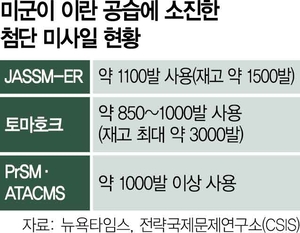 During the campaign the U.S. military fired more than 1,000 Tomahawk long‑range cruise missiles, each valued at about $3.6 million (approximately 5.3 billion KRW) — a sortie rate roughly ten times the U.S. annual procurement volume. Earlier, the Center for Strategic and International Studies estimated in a March 27 report, prior to a ceasefire, that roughly 850 Tomahawks had been used in Operation Grand Anger and that remaining stocks likely numbered in the low 3,000s.
The military also expended more than 1,000 rounds of the Precision Strike Missile (PrSM) and ATACMS surface‑to‑surface missiles, sharply reducing those inventories as well. With global munitions strained by the Iran campaign, the Pentagon rushed missiles and bombs from U.S. stockpiles in Asia and Europe to the Middle East.
At the same time, the U.S. Treasury and State Departments imposed sanctions on Hengli Group, a major Chinese refiner that imports Iranian crude, saying Hengli is one of the largest purchasers of Iranian oil worth billions of dollars. Hengli processes roughly 400,000 barrels of crude per day, making it one of China’s largest single refiners. U.S. officials also froze approximately $344 million in cryptocurrency linked to Iran (about 508.2 billion KRW). Treasury Secretary Scott Bessent said, “We will track funds Tehran desperately tries to move abroad and target every financial lifeline connected to the regime.”
- Think it’s too late? Change just this after 60 to help prevent dementia [Workplace Wake‑Up]
- “Are you free, Neugoo?”…Escaped animals become memes — is the safety net holding up?
- “Chemo or not?” It was unclear — new clues found for young women with breast cancer [Healthy Time]
- “They say you’re dumb if you go to med school now”…Majors that shook admissions: Samsung Electronics’ ‘employment fast‑track’ programs
- To avoid being a ‘transient client’ in the U.S.…use Korean law firms as wholesale partners [Leading Tactics]
- U.S. negotiating team cancels Pakistan trip…Trump: “Call me if you want to talk” [U.S.-Iran War]
- Will the Samsung strike end in tens of trillions in losses?…A chilling warning of “irreparable damage”
- “Even ‘expertise’ gets taken”…The tacit‑knowledge debate begins in the AI era [Yang Jong‑gon’s Labor Look]
- Samsung, the only one of the top four groups to hold open hiring, creates jobs again this year…GSAT held at 18 affiliates
- South Korea’s real economy reflects the Middle East war…U.S., Japan, Eurozone face a ‘rate week’ [Han Dong‑hoon’s Weekly Outlook]















Most Commented