
Translation result.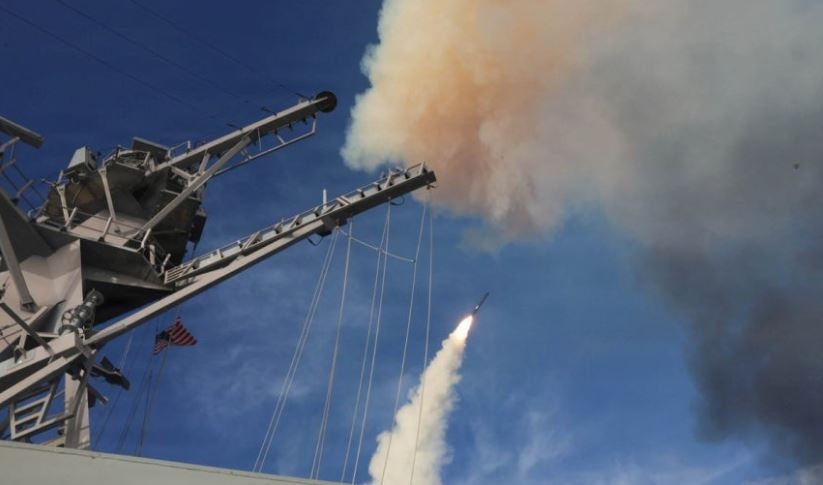 [Herald Economy reporter Juri Kim] The New York Times reported on April 23 that U.S. stocks of advanced precision munitions have plunged because of the Iran war, forcing the Pentagon to shift missiles and bombs from Asia and Europe to the Middle East and degrading readiness against potential adversaries such as China and Russia.
According to a Yonhap report on April 25, the U.S. military has expended roughly 1,100 Joint Air-to-Surface Standoff Missiles—Extended Range (JASSM-ER)—since launching the operation dubbed “Grand Fury,” leaving only about 1,500 in inventory.
The JASSM-ER has a range of about 1,000 km (roughly 620 miles) and costs about 1.6 billion KRW (about $1.1 million) per round. It was developed to penetrate hardened targets outside enemy air-defense coverage, a capability prioritized for any potential conflict with China.
U.S. forces also launched more than 1,000 Tomahawk long-range cruise missiles, at roughly 5.3 billion KRW (about $3.6 million) apiece. That expenditure is roughly ten times the U.S. annual procurement rate for the weapon.
The Iran war began when the U.S. and Israel launched unexpected strikes on Iran on Feb. 28. A cease-fire was announced in the early hours of April 8, and hostilities ceased.
Before the cease-fire, Washington, D.C.–based think tank the Center for Strategic and International Studies (CSIS) reported on March 27, citing the Washington Post, that the military had fired about 850 Tomahawks in “Grand Fury” and estimated remaining Tomahawk stocks were in the low thousands.
CSIS warned that, while munitions were sufficient to prosecute the campaign, heavy expenditure on Tomahawks and other missiles increased U.S. vulnerability in other theaters—especially the Western Pacific.
The Tomahawk has been a U.S. workhorse since the First Gulf War in 1991.
The U.S. has also used more than 1,200 Patriot interceptor missiles, which cost nearly 5.9 billion KRW (nearly $4 million) each. That consumption is about twice last year’s Patriot production, which was roughly 600 missiles.
Precision Strike Missiles (PrSM) and ATACMS ground-to-ground missiles have seen usage exceeding 1,000 rounds as well, pushing inventories to worrying lows.
With global U.S. munitions stockpiles sharply drawn down by the Iran war, the Pentagon rushed missiles and bombs stationed in Asia and Europe to the Middle East.
The fiscal cost of the Iran war has been staggering.
The White House has not released an official tally, but independent think tanks CSIS and the American Enterprise Institute estimated in early April that the war had cost 41 trillion–52 trillion KRW (about $28 billion–$35 billion) so far, with daily costs approaching 1.5 trillion KRW (about $1 billion).
Pentagon officials told members of Congress that the ammunition used in the first two days of the war cost 8.3 trillion KRW (about $5.6 billion).
The New York Times concluded that restoring U.S. munitions stockpiles to prewar levels will force difficult choices about force posture and readiness across regions.
“At current production rates, it could take years to replace what we’ve spent,” said Sen. Jack Reed (D–R.I.), the top Democrat on the Senate Armed Services Committee.
Mark F. Cancian, a senior adviser at CSIS and a retired Marine colonel, said the U.S. still maintains adequate stocks of many munitions, but that some key ground-attack and missile-defense munitions were in short supply before the war and are now even scarcer.
The pullback of forces and materiel from Asia has been particularly pronounced.
The U.S. moved the aircraft carrier strike group USS Abraham Lincoln from the South China Sea to the Middle East and redeployed roughly 4,400 Marines from two Marine Expeditionary Units that had been staged in the Pacific.
The U.S. also transferred interceptors from the THAAD (Terminal High Altitude Area Defense) battery deployed in South Korea to the Middle East.
White House spokeswoman Karine Jean-Pierre dismissed the NYT article’s premise as false, saying, “The United States has the world’s most capable military, and the weapons and munitions stockpiled at home and abroad are more than sufficient to defend the homeland and execute any military operation the commander in chief orders.”
Pentagon principal deputy spokeswoman Sabrina Singh said she could not discuss operational security details about specific theater requirements or global asset capabilities.















Most Commented