
HD Hyundai and Hanwha Team Up for US Navy’s Game-Changing Unmanned Vessels: What You Need to Know
Daniel Kim Views
HD Hyundai to build prototype with Anduril
Built in Ulsan for trials, then produced locally in the U.S.
Hanwha and Magnet to supply 38m-class vessels to the U.S.
Cooperation expands from maintenance to combat capability
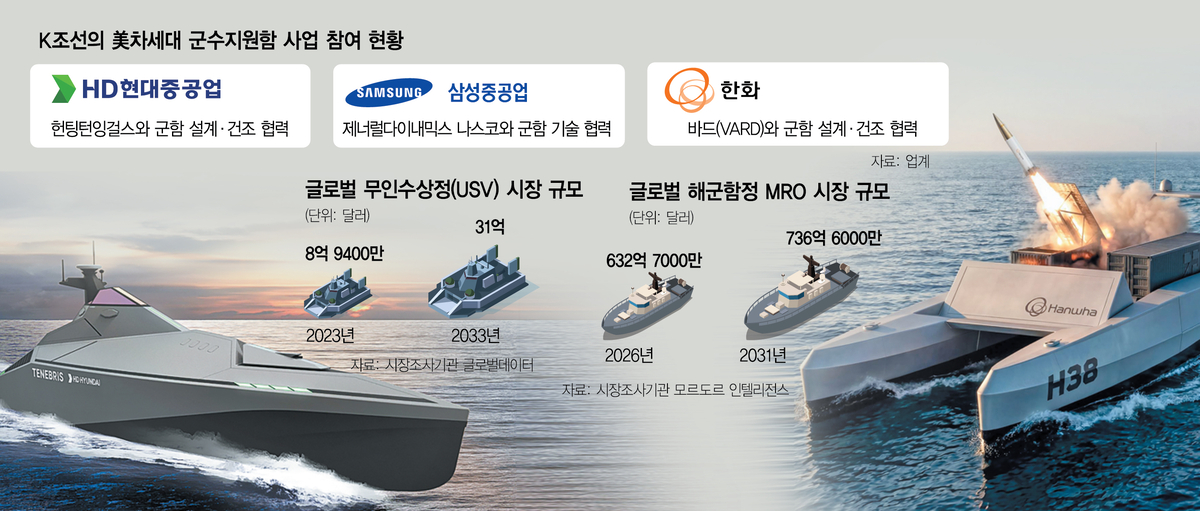 HD Hyundai (267250) and the Hanwha (000880) Group have teamed with U.S. firms to develop and produce unmanned surface vessels (USVs) for the U.S. Navy. The Korea‑U.S. shipbuilding cooperation project known as MASGA has broadened from ship maintenance, repair and overhaul (MRO) and commercial shipbuilding into building military capability, expanding both economic and security ties. Unmanned surface vessels are being touted as a potential game‑changer in future naval combat.
Industry sources said on the 21st that HD Hyundai and U.S. defense company Anduril have begun joint construction of a prototype autonomous USV. The prototype is expected to be completed in October and will undergo sea trials off the U.S. coast. Anduril said, “After successfully completing core design reviews, we have moved into prototype production. Once construction is finished, we will load the maritime datasets we have collected for autonomous navigation and mission execution.”
The first prototype will be built at HD Hyundai Heavy Industries (329180)’s Ulsan shipyard. After trials, mass production will take place at Edison Chouest Offshore’s U.S. yards. HD Hyundai and Anduril plan to use the autonomous USV as an entry point to compete for the U.S. Department of Defense’s next‑generation unmanned maritime program.
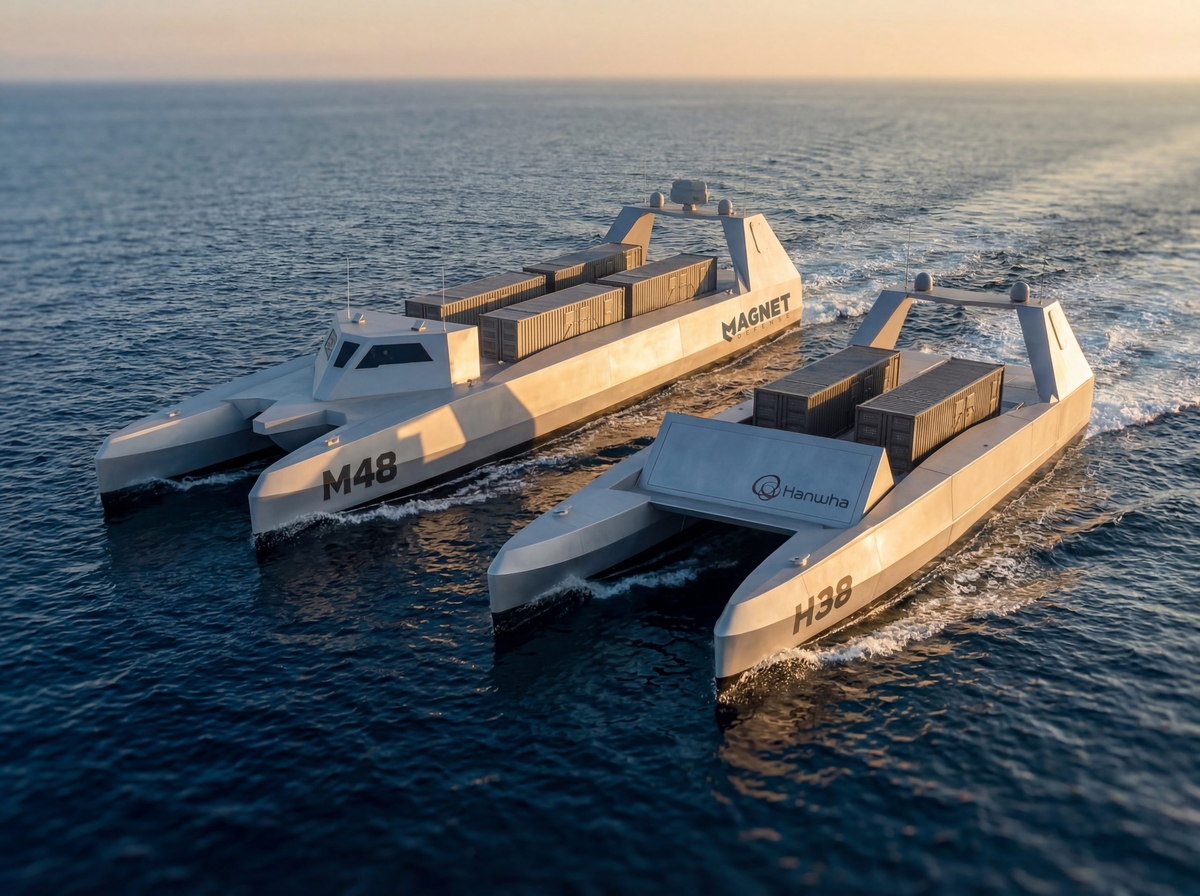
Hanwha is also targeting U.S. defense customers through a partnership with U.S. autonomy specialist Magnet Defense. Hanwha Defense USA will integrate Hanwha missile systems and manufacturing expertise with Magnet’s M48 platform to co‑produce a 38‑meter medium unmanned surface vessel (MUSV), the “H38,” in the U.S. (38 m ≈ 125 ft).
These moves by HD Hyundai and Hanwha show MASGA expanding in the U.S. from ship production and MRO into force‑generation roles. Faced with shrinking manpower and concerns about China’s maritime assertiveness, the U.S. has found capable partners in South Korean firms.
Patrick Cronin, senior director for Asia‑Pacific security at the Hudson Institute, said, “To blunt China’s maritime advantage, the United States needs a long‑term shipbuilding ecosystem across the Indo‑Pacific. Korea’s ship design and construction capabilities will be central to the U.S. effort to field a larger surface fleet.”
■ HD Hyundai, Hanwha join unmanned vessel programs
HD Hyundai to deploy integrated autonomous navigation suite
Hanwha to collaborate on robotic shipyards and software development
Samsung Heavy joins design phase of naval logistics support ship
Targeting a $73.66 billion MRO market by 2031
South Korean maritime and defense companies are deepening partnerships with U.S. firms and increasingly joining core U.S. Navy programs. As MASGA’s scope widens, the U.S.–Korea alliance strengthens and bilateral industrial ties could reduce trade frictions seen under prior administrations.
HD Hyundai has been building its U.S. presence by deepening ties with Anduril. After signing an MOU in April to develop and commercialize USVs, the companies expanded cooperation in November with contracts to design and build an autonomous USV prototype and to supply AI solutions.
Anduril, a tech firm known for AI‑driven battlefield networking and sensor systems, is a key DoD partner. To lead in maritime defense, Anduril needed a shipbuilder with proven construction expertise — a role HD Hyundai fills.
Anduril said, “What the U.S. Navy needs is scale — a single unmanned vessel won’t change the calculus. You must produce reliable ships efficiently, on time, and on budget. That’s why we chose HD Hyundai.” The companies are also moving to secure U.S. production capacity through cooperation with Edison Chouest Offshore.
HD Hyundai plans to equip the USV with an autonomous navigation solution developed by its autonomy unit Avikus. An HD Hyundai official said, “The solution integrates AI across functions from basic navigation assistance to engine automation.”
 HD Hyundai and Anduril intend to compete for the U.S. Department of Defense’s project to field the Navy’s next‑generation unmanned maritime force, starting with the newly announced Medium Unmanned Surface Vessel (MUSV) program. The U.S. government has allocated about $2.1 billion for MUSV procurement.
Hanwha opted to add advanced weapons and manufacturing capability to Magnet’s proven platform. Magnet’s M48 already claims the longest range among current USVs — 17,000 nautical miles. In 2024, it completed operational verification covering 32,000 nautical miles, including a Miami‑to‑American Samoa round trip, Panama Canal transit, and operations in sea states up to level 9.
Hanwha will integrate advanced missile systems, manufacturing capacity, and robotic technologies into Magnet’s platform. Michael Coulter, CEO of Hanwha Defense USA, said, “By combining Hanwha’s manufacturing and robotic expertise with Magnet Defense’s proven autonomous navigation, we will field the most capable and lethal unmanned surface vessels to support U.S. forces and allies in conflict.” The partners will also collaborate on AI‑driven robotic shipyards and software development.
Trust and collaboration between Korean and U.S. shipbuilders and tech firms extend into MRO and design work. HD Hyundai Heavy Industries and Hanwha Ocean (042660) each won two U.S. Navy MRO contracts in the first quarter of this year, surpassing last year’s totals (HD Hyundai Heavy Industries: 1, Hanwha Ocean: 2). Market researcher Mordor Intelligence projects the global naval ship MRO market will grow from $63.27 billion this year to $73.66 billion by 2031, marking it as a key growth sector.
South Korean companies are also entering U.S. naval design work. Hanwha’s Philippine shipyard and Samsung Heavy Industries (010140) recently joined U.S. partners on the concept design for the Navy’s next‑generation logistics support ship (NGLS). The long‑term program aims to replace at least 10 aging Navy supply vessels. This is the first time Korean firms have participated in a U.S. Navy ship program from the design phase.
Cronin of the Hudson Institute reiterated, “Korea’s shipbuilding capabilities make it a central partner in the U.S. strategy to expand naval power. The U.S. alone cannot match China’s production output.”
As Korean firms expand in the U.S. maritime defense market, they are stepping up local engagement. LIG D&A set up a joint booth with HD Hyundai Heavy Industries at the U.S. maritime defense expo in Maryland through the 22nd, showcasing a loitering USV and the 130 mm anti‑ship guided rocket ‘Biryong.’
As MASGA extends from naval MRO into ship design, defense systems and unmanned capabilities, analysts say the Korea‑U.S. maritime defense partnership has reached a pivotal moment that could shape future naval warfare.
- “If you just lend your bank account, they’ll take the money” — consumer watchdog warns of virtual account scams
- Long wait times at always‑busy Incheon Airport drag down its “speed” rating
- “Getting my son into medical school is so hard”—this year’s medical school admission thresholds hit a three‑year high
- [Trump Stocker] How long will the tug‑of‑war over ocean freight enrich futures speculators?
- Digimodal mortgage lending down 40%…speculative demand cooled but real buyers still struggle
- “I thought AI would take everything”—actually only about 10% of jobs may disappear
- Earned 4.5 billion KRW (approximately $3.38 million) selling pumpkins, then said “I can’t pay taxes”…court rules
- As the briquette era ends…prices may rise by 100 KRW (approximately $0.075) as soon as next month [Pickonomics]
- Blue House: “President Lee’s persistence + Korean firms’ capabilities”…“Korea–India relations are changing”
- From 50 billion KRW (approximately $37.5 million) → 900 billion KRW (approximately $675 million) in a month…which accounts did retail investors dump U.S. stocks from en masse?















Most Commented