
South Korea’s National Defense Space Law: What You Need to Know About Space Security in 2026
Daniel Kim Views
Translation result. 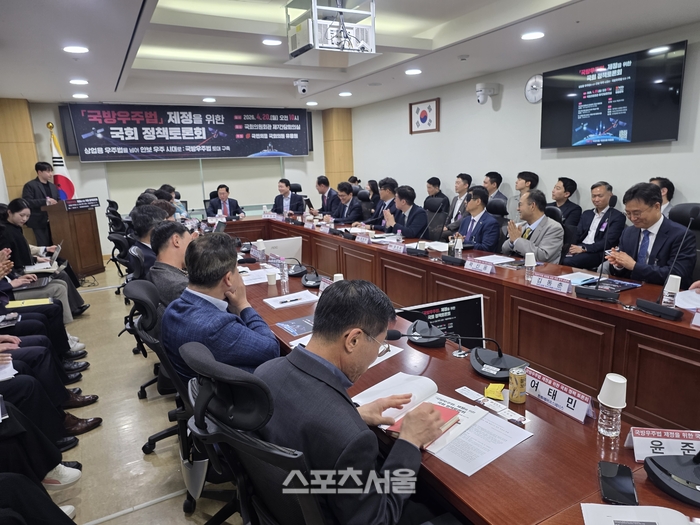
[Sports Seoul | Senior Reporter Lee Sang-bae] As global competition for space dominance accelerates, the National Assembly has begun serious debate on a Defense Space Act to safeguard South Korea’s space sovereignty.
On the morning of the 20th, Rep. Yoo Yong-won of the People Power Party, a member of the National Assembly’s Defense Committee, convened a policy forum in the National Assembly Members’ Office Building titled From Commercial Space Law to the Security Space Era: Building the Foundation for a Defense Space Act. The forum aimed to fast-track the legal and institutional framework needed to support a national space security strategy as threats in orbit become more concrete.
Panelists examined key challenges that arise as space emerges as a new battlefield. Discussion focused on legal standards for justifiable defense and response models for space threats; defining legal liability and the state’s role when satellites are attacked or other space assets are infringed; and legislative directions for building civil-military integrated space infrastructure.
Experts who presented and debated agreed that the current legal framework is inadequate to address emerging space security threats. “Threats in outer space are becoming real, but we still lack clear legal standards and response systems to govern them,” one expert said. “We urgently need comprehensive national laws and institutions that account for scenarios up to and including combat in space.”
The threat is not hypothetical. Documents Rep. Yoo obtained from the Defense Ministry indicate North Korean forces carried out multiple radio-frequency attacks against South Korean satellites from the early 2010s through mid-2024. Analysts characterize those incidents as attempts to disrupt the normal operations of military synthetic aperture radar (SAR) and electro-optical/infrared (EO/IR) reconnaissance satellites, communications satellites, and even civilian satellites.
Kim Ki-won, a senior research fellow at KIDA who chaired the forum, said recent advances in science and technology mark a turning point for humanity and for space. “The Defense Space Act under discussion will do more than legislate,” he said. “It can become a central driver for national security and for public-private-military cooperation.”
Kim Kwon-il, a research fellow at the Science and Technology Policy Institute, warned that space is a domain where electronic warfare and information warfare can play out. “Existing legal systems fall short of addressing these new threats,” he said. “We urgently need standards to systematically protect and operate space assets.”
Professor Jung Young-jin of the Korea National Defense University said the international focus in space centers on safety and sustainability. He called for a nationwide governance system for collecting and analyzing operational data on space assets to prepare effectively for threats.
Professor Jeong Heon-joo of Yonsei University urged that law should explicitly define space infrastructure and civil-military integrated space infrastructure, and codify the state’s roles and responsibilities in building them. “Building civil-military integrated space infrastructure is not optional—it’s essential,” he said.
Rep. Yoo warned that space is rapidly shifting from a sector of future industry into a core national-security battlefield. “We must now treat space not as a realm of potential but as one of responsibility and preparedness,” he said, calling for a national strategic response commensurate with that reality.
Citing North Korea’s radio-frequency attacks as tangible provocation, Rep. Yoo pledged to swiftly draft a Defense Space Act based on the forum’s recommendations so the military can assert operational leadership in space and protect the public.
The policy proposals presented at the forum are expected to serve as core legislative reference material during the drafting of the Defense Space Act. sangbae0302@sportsseoul.com











Most Commented