
Military Integration: Will Combining Korea’s Army, Navy, and Air Force Enhance Joint Operations?
Daniel Kim Views
Translation result. 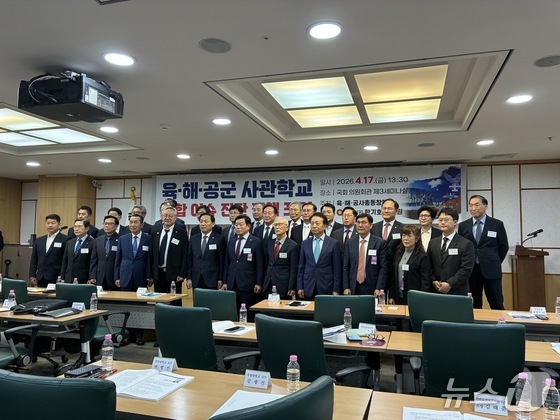
As battlefields extend into space and cyberspace, debate has intensified over merging the Army, Navy and Air Force academies to bolster joint capabilities. Experts at a Seoul forum, however, warned that physically combining the three service academies won’t by itself produce true jointness; each service must first preserve and deepen its core professional expertise for effective joint operations to follow.
They also cautioned that the socioeconomic costs of a merger and the inevitable training and security gaps during any transition make expanding and strengthening existing joint programs a more practical near-term option.
On April 17, the People Power Party offices of lawmakers Han Ki-ho and Yoo Yong-won—both members of the National Assembly’s Defense Committee—co-hosted a policy forum titled “Diagnosing the Issue of Integrating Army, Navy and Air Force Academies” with the combined alumni association in Seminar Room 3 of the National Assembly Members’ Office Building in Yeouido, Seoul.
The event drew lawmakers Han and Yoo, Deputy Defense Minister Lee Doo-hee, Defense Committee Chair Seong Il-jong and other officials.
Joo Eun-sik, director of the Korea Institute for Strategic Studies and a graduate of the Army Academy’s 36th class, opened the forum. He criticized merger arguments that claim a unified academy would quickly instill interservice cooperation and improve resource efficiency, calling such claims disconnected from the nature of jointness and the way military power develops.
Joo said joint capability emerges when each service’s highest-level expertise is combined with force structure, command arrangements and operational concepts. Education institutions are downstream in that chain: shifts in the strategic environment shape force structure, which then determines command and operational concepts and ultimately informs how officers are trained.
He pointed to the Joint Military University, created in 2011 by merging the Army, Navy and Air Force colleges to strengthen jointness at the field-officer level. The experiment weakened service tactical specialization, reduced student satisfaction and introduced administrative inefficiencies; the institution was dissolved in 2020 and the services returned to separate colleges.
Joo argued that jointness isn’t achieved simply by co-locating cadets. Policies should first secure service-specific expertise, then gradually expand joint training, joint-duty systems and integrated command arrangements to build authentic joint capability.
He warned that differences in operational concepts and decision-making across services can’t be resolved by classroom instruction alone; they require experience and deep professional competence. Integrating institutions before that expertise exists, he said, risks poor judgments and organizational friction.
In the second presentation, Kim Se-jin, a senior researcher at the Taejae Research Foundation and a graduate of the Army Academy’s 67th class, argued that many problems cited by a joint civilian-military advisory committee—declining officer career appeal, low education satisfaction, strict lifestyle controls and falling cadet entrance scores—stem from harsh job conditions for junior and midgrade officers, not the academy system. He said merging academies won’t fix those root causes and predicted continued declines in entrance scores, commissioning rates and satisfaction.
Kim noted that only about 30 percent of officers come from the three service academies. The remaining 70 percent are commissioned through other paths—such as the Army’s Third Military Academy, ROTC, college-commissioned officers and special officer tracks—which a merger would not affect. Therefore, a unified academy alone cannot guarantee jointness across the entire officer corps.
He added that basic professional curricula differ from the first year across the services. There is no clear plan for what a two-year common curriculum after a merger would teach, and relying on third- and fourth-year instruction would leave graduates short on service-specific expertise.
Kim pointed to Japan’s National Defense Academy—often compared to a unified service academy—which operates on a 2+2 model but has seen freshman attrition rise into the 20 percent range and applications fall roughly 40 percent over the past decade.
Given the economic cost of merging campuses, the unavoidable training gaps during a transition and the resulting security risks, Kim argued it would be more efficient to revise the current system—for example, by redesigning joint education programs—rather than pursue full integration.
He said consolidating or rebuilding three campuses would require massive funding, that redesigning curricula and reorganizing faculty would take at least five years, and that legal and institutional changes—such as amending the Academy Act—would be required. He warned the transition’s educational gaps could persist for a decade or more, once preparation and stabilization are included.
As alternatives to a full merger, Kim proposed measures to boost joint capability: establish joint courses at institutions like the National Defense University; require exchange programs among the three service academies; introduce joint war-gaming for cadets to build early operational experience; and add joint-capability assessment items to cadet evaluations.
In the discussion that followed, Park Beom-jin, a professor at Kyung Hee University’s Graduate School of Management, warned that hiring civilian professors after a merger could undermine the military’s political neutrality.
Professor Park cautioned against proposals to elevate civilian academy faculty to the status and compensation of national university professors and to increase the civilian faculty share to 60 percent. He said granting civilian professors the same freedom for political activity as national-university faculty would raise the risk that cadets could be exposed to individual professors’ political views or ideological biases.
Deputy Minister Lee Doo-hee acknowledged that Korea faces demographic shifts and a sweeping technological transition. He said two imperatives now coexist: preserving each service’s traditions and identity, and strengthening joint capability and reforming education to meet future conflicts. Lee pledged to listen to the forum’s proposals and criticisms and to craft thoughtful policy, describing tradition and innovative integration as complementary pillars for a stronger military.










Most Commented