
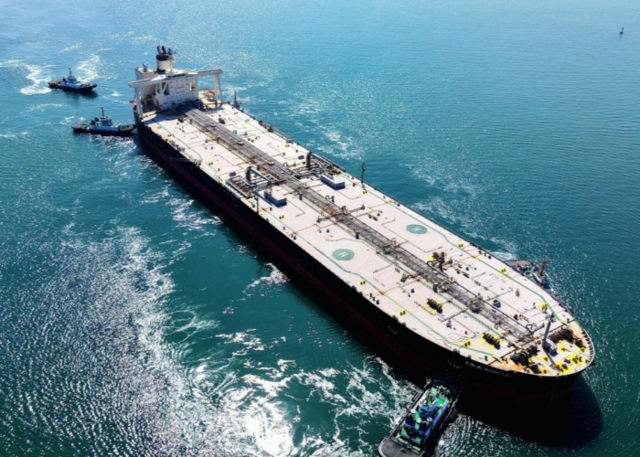
Russian state news agency TASS reported that Iran will reopen the Strait of Hormuz under cease-fire terms agreed with the United States but will cap daily transits at a maximum of 15 vessels.
On April 9, a senior Iranian official told TASS that, under the cease-fire agreement with the United States, Tehran will permit no more than 15 vessels per day to pass through the Strait of Hormuz. The official said all vessel movements will require Iranian authorization and adherence to specified protocols.
The transit protocols appear to encompass an alternative corridor disclosed the previous day and a policy placing control of transits under the Islamic Revolutionary Guard Corps (IRGC). The proposed route runs close to Iran’s Larak Island, which hosts a military base, rather than the traditional lane that lies mostly in Omani territorial waters.
A nautical chart circulated by Iranian media labeled the traditional route a “danger zone.”
TASS reported that the Iranian government has already formally notified key regional capitals of the policy.
The Strait of Hormuz, a 34 km (about 21 miles) chokepoint between Iran and Oman, handles roughly one-fifth of the world’s oil shipments. It also serves as a critical conduit for essential goods, including fertilizer, bound for the Indian Ocean.
Since the conflict began in late February, Iran has effectively sealed the strait, pushing global oil prices sharply higher.
Analysts say the move appears designed to maximize Tehran’s leverage ahead of cease-fire talks scheduled to take place in Pakistan.
Tehran has insisted that Lebanon be included in any cease-fire after Israel’s continued airstrikes against Hezbollah in Lebanon. The United States and Israel, however, maintain that Lebanon was not part of the agreement and have continued their strikes.












Most Commented