
How AI is Revolutionizing South Korea’s Defense: Insights from the National AI Strategy Committee
Daniel Kim Views
Translation result.
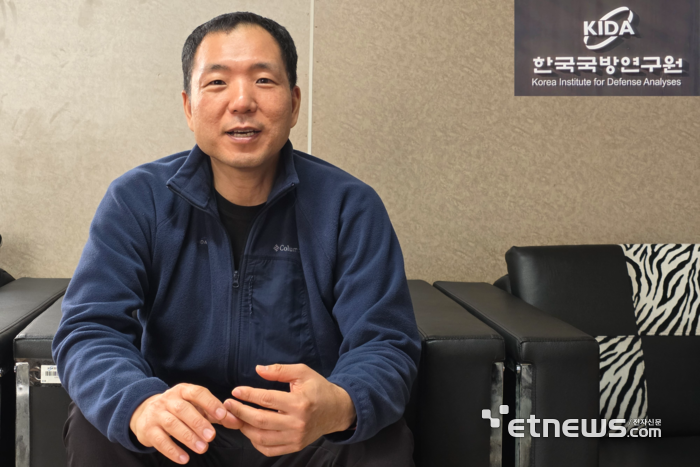
The use of artificial intelligence (AI) in defense is already underway, as seen in the U.S.-Iran conflict. \”We should actively involve domestic firms in defense AI transformation (AX) and turn this into an opportunity to develop globally competitive defense companies — a ‘K-Palantir,’\” Shim Seung-bae said.
Shim Seung-bae, head of the Defense and Security Subcommittee at the National AI Strategy Committee and director of the AI & Informatization Research Office at the Korea Institute for Defense Analyses, told Electronic Times that Korea should pursue AX via two tracks: opening certain defense data to private industry and deploying sovereign AI in restricted environments.
Pointing to the U.S. Department of Defense, Shim noted that AI is already being used for routine administration and in military operations. He argued that Korea must advance defense AX, accelerate technology adoption through public-private collaboration, and create pathways for domestic firms to grow into global defense players like Palantir.
The committee, he said, is focused on updating defense AI laws and creating operational defense AX hubs that can provide data to private companies. A top priority is to classify defense data by sensitivity — covering military administration, procurement and logistics, and operational forces — and set access levels accordingly.
By establishing graded access based on classification and improving data quality, defense authorities can build AI-driven systems that enhance administrative efficiency and support training and operational decision-making.
Shim emphasized that the most highly classified military data must be trained and used on sovereign AI developed domestically, as exemplified by the indigenous foundation model ‘독파모.’
\”AI is needed to strengthen military deterrence and preserve peace, not to start or win wars,\” he said. To reach the performance levels of models used by U.S. forces — such as those from Anthropic — foundation models must be trained on classified defense datasets.
Shim proposed developing defense-specialized models by fine-tuning sovereign foundation models like 독파모. He also called for lightweight edge models for front-line and field use and on-device AI that can operate without an internet connection.
Noting U.S. practice, Shim said the Pentagon has institutionalized 30-day update cycles so the military can use the latest AI. Korea, where weapons acquisition cycles can stretch to 10 years, must drastically shorten those timelines and create conditions for timely AI adoption to respond to a fast-changing security environment.
He urged lawmakers to provide the legal and institutional backing needed to promote AI adoption in defense and security, including passing the Defense Artificial Intelligence Act currently pending in the National Assembly.
\”The government cannot easily implement policy without legal authority,\” Shim said. Because the Basic AI Act does not cover defense, lawmakers should enact dedicated legislation quickly, and the government must invest in the infrastructure and ecosystem — including data centers — to support defense AX.
Park Jong-jin












Most Commented