
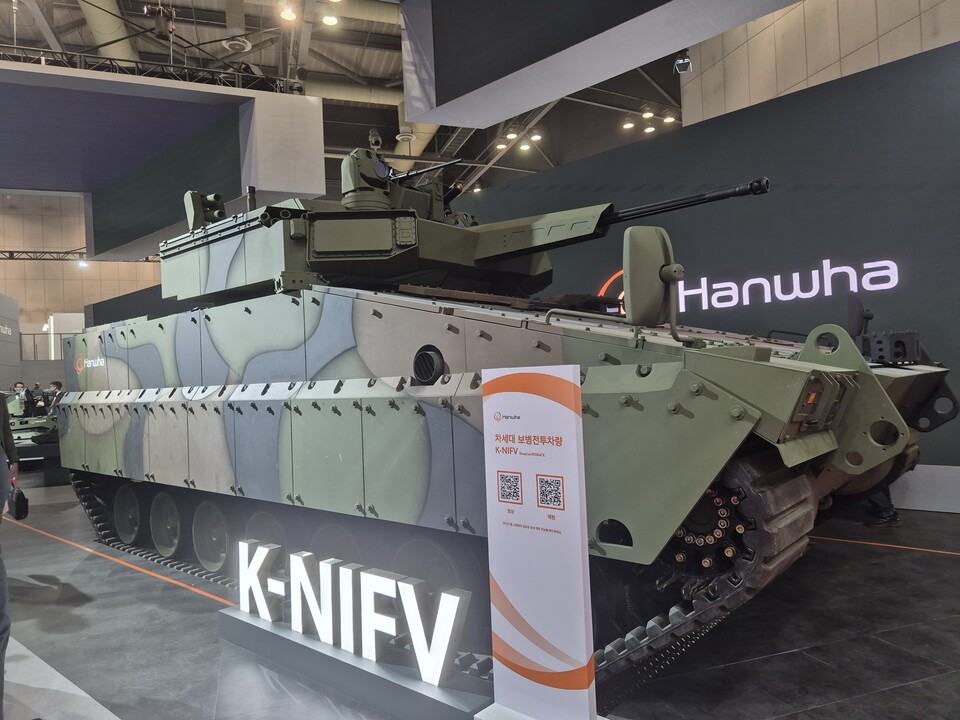
| Seoul – By Lim Jun-hyuk, Hans Economic | South Korea’s “Big Four” defense contractors – Hanwha Aerospace, Hyundai Rotem, LIG Nex1, and Korea Aerospace Industries (KAI) – posted record-breaking figures in sales, operating profits, and order backlogs last year. Industry analysts project this robust performance to continue, with the combined operating profit of these four powerhouses potentially surpassing 6 trillion KRW (4.5 billion USD) in 2024.
However, defense experts caution against premature celebration. They argue that K-defense must address hidden sustainability risks and external variables lurking behind these impressive numbers.
Financial data released on the 10th by South Korea’s Financial Supervisory Service reveals that the Big Four’s combined sales reached 40.4526 trillion KRW (30.3 billion USD), with operating profits hitting 4.6324 trillion KRW (3.4 billion USD). These figures represent staggering year-over-year increases of 79.6% and 74.2%, respectively.
Financial information provider FnGuide recently projected the four firms’ combined 2023 sales between 40.9 trillion KRW and 41 trillion KRW (30.5-30.7 billion USD), with operating profits estimated at 5.2 trillion KRW to 5.3 trillion KRW (3.9-4 billion USD). While Hanwha Aerospace’s 2025 performance disclosure closely matched sales projections, it fell slightly short of the anticipated 5 trillion KRW (3.7 billion USD) operating profit.
◆ Hanwha Aerospace Leads the Charge with Third Consecutive Record-Breaking Year
Despite the minor shortfall, industry insiders view surpassing 40 trillion KRW (29.8 billion USD) in sales and 4.6 trillion KRW (3.4 billion USD) in operating profit as an impressive feat. Analysts attribute this success to previously secured international orders now entering the delivery phase, significantly boosting financial performance.
The future looks equally promising, with ample work on the horizon. As of year-end 2023, the combined order backlog for these defense giants reached a staggering 117.7472 trillion KRW (88.2 billion USD), shattering the 100 trillion KRW (74.5 billion USD) threshold for the first time in history.
Hanwha Aerospace, the undisputed leader in South Korea’s defense sector, spearheaded this growth. The company reported 26.6078 trillion KRW (19.7 billion USD) in sales and 3.345 trillion KRW (2.3 billion USD) in operating profit, marking year-over-year increases of 137% and 75%, respectively.
This marks Hanwha Aerospace’s third consecutive year of record-breaking performance. Their ground defense division’s operating profit exceeded 2 trillion KRW (1.5 billion USD) for the first time, while steady growth in aerospace and the full integration of subsidiary Hanwha Ocean’s financials significantly expanded the company’s overall scale. By the end of 2023, Hanwha Aerospace’s ground defense backlog stood at an impressive 37.2 trillion KRW (27.8 billion USD).
◆ Hyundai Rotem Breaks 1 Trillion KRW (740 Million USD) Operating Profit Barrier
Hyundai Rotem achieved a historic milestone, surpassing 1 trillion KRW (740 million USD) in operating profit for the first time since its founding. The company’s 2023 sales reached 5.839 trillion KRW (4.3 billion USD), a 33.4% year-over-year increase, while operating profit skyrocketed 120.3% to 1.056 trillion KRW (740 million USD). Growth was primarily driven by K2 tank deliveries to Poland in the defense solutions sector and expanded overseas orders and sales in rail solutions. The company’s backlog surged 58.7% to 29.7735 trillion KRW (22 billion USD).
LIG Nex1 reported 4.3094 trillion KRW (3.2 billion USD) in sales and 323.1 billion KRW (240 million USD) in operating profit for 2023, representing increases of 31.5% and 40.6%, respectively. Expanded missile exports to the Middle East bolstered profitability. As of Q3 2023, the company’s backlog stood at 23.43 trillion KRW (17.4 billion USD).
KAI posted 3.6964 trillion KRW (2.7 billion USD) in sales and 269.2 billion KRW (200 million USD) in operating profit last year, with 1.7% and 11.8% increases respectively, maintaining profitability. As the KF-21 fighter jet program transitions to mass production in 2024, KAI projects a 58.1% surge in sales to 5.7306 trillion KRW (4.2 billion USD) and a 63% jump in new orders to 10.4383 trillion KRW (7.7 billion USD) compared to 2023 standalone figures. The company’s backlog grew over 10% to 27.3437 trillion KRW (20.3 billion USD).
The outlook for 2024 remains bullish. Analysts forecast operating profits of 4.6 trillion KRW (3.4 billion USD) for Hanwha Aerospace, 1.2 trillion KRW (890 million USD) for Hyundai Rotem, 450 billion KRW (330 million USD) for LIG Nex1, and 460 billion KRW (340 million USD) for KAI. If these projections materialize, the Big Four’s combined annual operating profit could reach a staggering 6.7 trillion KRW (5 billion USD).
However, experts warn that K-defense must proactively address potential challenges stemming from increased workloads, including workforce strain, profit distribution issues, financial support limitations, and intensified scrutiny from established global defense players.
The surge in orders could create significant hurdles if there’s a shortage of skilled personnel to manufacture weapons and conduct research and design. The Korea Defense Industry Promotion Agency and the Korea Institute for Industrial Economics & Trade report an urgent need to fill over 3,000 positions across design, R&D, and production roles. Of particular concern is the talent drain and aging workforce in regional defense hubs like Changwon, potentially jeopardizing K-defense’s competitive edge in rapid delivery.
◆ Current Boom Driven by Cost-Effectiveness, Speedy Delivery, and Geopolitical Factors
Labor disputes pose another potential risk. As exemplified by LIG Nex1’s internal conflicts last year, workers are increasingly demanding higher compensation in line with improved company performance. The recently passed “Yellow Envelope Law” further empowers labor’s bargaining position.
The financial burden of supporting increased exports, coupled with importing countries’ demands for localized production, presents additional challenges. The massive K2 tank deal with Poland, worth billions of dollars, requires support from institutions like the Export-Import Bank of Korea. However, current regulations limit the extent of support from national financial institutions, complicating future deals of similar scale.
As seen in the recent Canadian submarine project bid, heightened demands for technology transfer and local production from importing nations could lead to reduced domestic factory utilization, technology leakage risks, and potential job losses in South Korea.
The “Buy European” policy emerging as a major obstacle to K-defense’s European expansion adds another layer of complexity. This is compounded by traditional defense powerhouses like Germany and France ramping up production capabilities for shells, self-propelled artillery, and missiles, while also strengthening joint weapons development initiatives.
An industry insider cautioned, “The current boom stems from K-defense’s cost-effectiveness, rapid delivery capabilities, and geopolitical factors triggered by the Russia-Ukraine conflict. If the war de-escalates this year, Europe’s surging demand for Korean weapon systems could rapidly decline. We must prepare contingencies by diversifying markets and enhancing our global supply chain management.”










Most Commented