
Quick access to main page (top) Direct access to main contents Quick access to main page (bottom)

AH-1S Cobra: Should the Aging Military Helicopter Be Retired? Insights into Economic Lifespan and Safety

Daniel Kim Views  
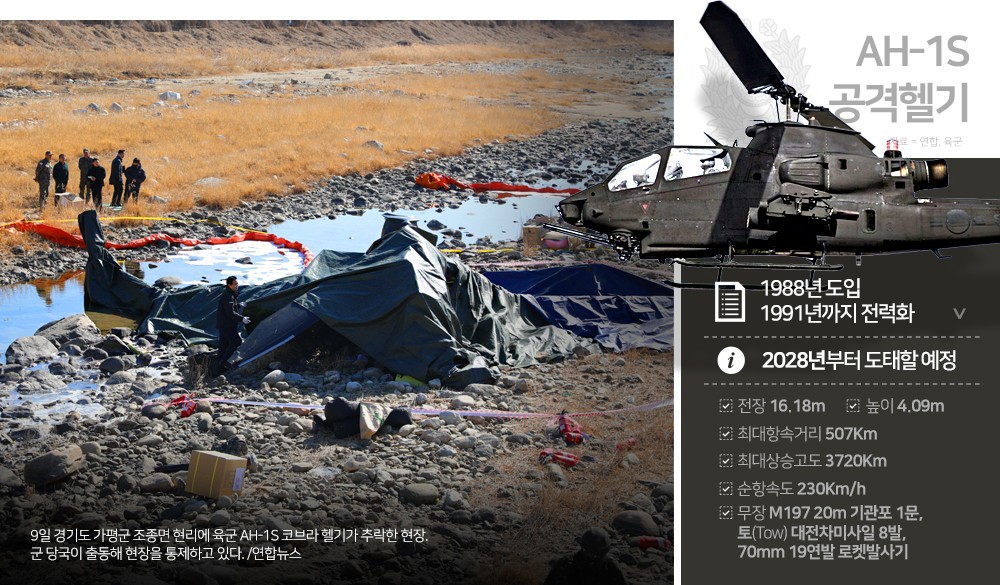
Source: Yonhap News Agency / Graphic by Park Jong-gyu

The military determines whether to continue operating equipment and when to replace it based on a comprehensive assessment of the aircraft’s condition, maintenance history, operational necessity, and maintenance costs, rather than the year of introduction. However, following the crash of an Army AH-1S Cobra attack helicopter on the 9th, which resulted in the deaths of two pilots, there are growing calls for a thorough review of the military’s decision-making process for replacing aging assets.

The AH-1S Cobra attack helicopter involved in the accident was first introduced in 1988 and fully integrated into service by 1991. It has been in service for well over 30 years. The helicopter that crashed had undergone pre-flight checks that morning. Regular and periodic inspections had been carried out according to the manual, and no issues were reported. However, the Central Accident Investigation Committee is currently investigating the specific circumstances of the crash, including communication details, altitude, and engine power status.

The Army had planned to phase out this model by 2028. However, considering that military equipment is typically expected to have a 30-year service life, the replacement process should have begun in 2018. The Army initially aimed for retirement between 2021 and 2027, but delays in the Light Armed Helicopter (LAH) program, which is set to replace the Cobra, pushed back the entire timeline. Regarding the retirement of aging assets, the Army stated that the decision to retire an aircraft is based on its overall condition rather than cumulative flight hours.

The lifespan of military equipment is not a fixed concept. It is divided into required lifespan, design lifespan, operational lifespan, and economic lifespan, all of which are adjusted during operation. The military evaluates maintenance records, failure trends, parts replacement history, remaining lifespan, and mission deployment necessity to determine whether to continue operating aging assets.

‘Economic lifespan’ is often cited as a key criterion for equipment replacement decisions. This concept suggests that equipment should be retired and replaced when maintenance costs exceed its residual value. Even older equipment may continue to be operated if maintenance costs and operational value remain within acceptable ranges. The economic lifespan approach is favored because it allows for clear decision-making based on quantifiable comparisons of maintenance costs, residual value, and replacement costs.

A recent example of this decision-making process is the Navy’s choice to decommission the landing ship Hyangrobong (LST-683). Although commissioned in August 1999 and potentially having years left in its 30-year service life, a fire in July last year damaged over half the ship, including the bridge, engine control room, and crew quarters. The Navy concluded that restoration costs would outweigh the ship’s post-repair value, necessitating its retirement.

The AH-1S fleet must continue operating alongside new assets for about five years until the replacement force is fully established. While this approach minimizes capability gaps, it has led to extended service for aging aircraft.

Critics argue that economic lifespan shouldn’t be applied uniformly across all military assets. Kim Yong-min, a senior researcher at the Korea Institute for Defense Analyses (KIDA), notes that while the economic lifespan model provides quantifiable data for decision-making, it has limitations when applied to weapon systems directly linked to operations and survival. He suggests that non-economic factors such as mission capability and safety must be considered for weapon systems, whereas support equipment may be more amenable to economic criteria.

Kim emphasizes the importance of predictability in replacement criteria and consistency in field application. He points out that while lifespan information is managed internally, field units may interpret it as a flexible guideline for extending operations. Kim recommends considering an “absolute criterion” that would mandate the cessation of operations after a certain point, regardless of recommended lifespan. This approach, he argues, would also ensure timely procurement of replacement assets.


Daniel Kim
content@tenbizt.com

[Military] Latest Stories

  • 30 of 33 Iran Missile Bases Still Active: Intelligence Defies Trump Claims
    30 of 33 Iran Missile Bases Still Active: Intelligence Defies Trump Claims
  • US Javelin Missiles Deployed in Taiwan’s High-Stakes Live-Fire Drill
    US Javelin Missiles Deployed in Taiwan's High-Stakes Live-Fire Drill
  • North Korea’s 10-Year Nuclear Threat: Is a Limited Strike Imminent?
    North Korea's 10-Year Nuclear Threat: Is a Limited Strike Imminent?
  • AI vs. Video Compression: How RMX is Redefining Tactical Edge Tech
    AI vs. Video Compression: How RMX is Redefining Tactical Edge Tech
  • US-South Korea Security Meeting Sparks Tension Over Military Control
    US-South Korea Security Meeting Sparks Tension Over Military Control
  • Iran Claims Missile Strikes on U.S. Military Bases: Did They Hit?
    Iran Claims Missile Strikes on U.S. Military Bases: Did They Hit?

Weekly Best Articles

  • Choi Dong-seok’s Family Bond: How a Simple Engraving Reveals Deep Love for His Children
  • Kwak Sun-hee’s Stunning Wedding Photos: A Celebration of Love and Courage
  • Is ‘I Am a Natural Person’ Just a Big Lie? Comedian Yoon-taek Reveals Shocking Secrets!
  • Health Scare: Why Fans Are Worried About Go Ji Yong’s Dramatic Weight Loss
  • Discover the Winter Gongju Chestnut Festival: A Taste of Korea at H-Mart in the USA!
  • 2026 Spring Wildfire Prevention: How Gyeryong City is Cutting Response Time to 30 Minutes!

You May Also Like

  • 1
    Trump Slashes AI Review Window to 30 Days Amid National Security Debate

    Politics 

    Trump Slashes AI Review Window to 30 Days Amid National Security Debate
  • 2
    Ukraine’s EU Bid Surges as Hungary Drops Opposition Amid Russian Attacks

    Politics 

    Ukraine’s EU Bid Surges as Hungary Drops Opposition Amid Russian Attacks
  • 3
    Trump Backs Colombia's 'El Tigre' — What It Means for U.S. Relations

    Politics 

    Trump Backs Colombia’s ‘El Tigre’ — What It Means for U.S. Relations
  • 4
    Trump Backs Colombia's Far-Right Outsider—What's at Stake?

    Politics 

    Trump Backs Colombia’s Far-Right Outsider—What’s at Stake?
  • 5
    12.5% Tariff Hit: South Korea Faces New U.S. Trade Penalties

    Politics 

    12.5% Tariff Hit: South Korea Faces New U.S. Trade Penalties

Popular Now

  • 1
    12.5% Tariff Alert: Why the U.S. Is Targeting South Korean Imports

    Politics 

  • 2
    Marta Kostyuk Makes History at French Open Amid Ukraine Crisis

    Politics 

  • 3
    37 Years in Exile: The Tiananmen Leader Who Just Wants to Go Home

    Politics 

  • 4
    South Korea's Cheongju Airport Faces Crisis as Passenger Numbers Explode

    Politics 

  • 5
    Nuclear Submarine Race: South Korea's High-Stakes Bid for U.S. Fuel

    Politics 

Weekly Best Articles

  • Choi Dong-seok’s Family Bond: How a Simple Engraving Reveals Deep Love for His Children
  • Kwak Sun-hee’s Stunning Wedding Photos: A Celebration of Love and Courage
  • Is ‘I Am a Natural Person’ Just a Big Lie? Comedian Yoon-taek Reveals Shocking Secrets!
  • Health Scare: Why Fans Are Worried About Go Ji Yong’s Dramatic Weight Loss
  • Discover the Winter Gongju Chestnut Festival: A Taste of Korea at H-Mart in the USA!
  • 2026 Spring Wildfire Prevention: How Gyeryong City is Cutting Response Time to 30 Minutes!

Must-Reads

  • 1
    Trump Slashes AI Review Window to 30 Days Amid National Security Debate

    Politics 

    Trump Slashes AI Review Window to 30 Days Amid National Security Debate
  • 2
    Ukraine’s EU Bid Surges as Hungary Drops Opposition Amid Russian Attacks

    Politics 

    Ukraine’s EU Bid Surges as Hungary Drops Opposition Amid Russian Attacks
  • 3
    Trump Backs Colombia's 'El Tigre' — What It Means for U.S. Relations

    Politics 

    Trump Backs Colombia’s ‘El Tigre’ — What It Means for U.S. Relations
  • 4
    Trump Backs Colombia's Far-Right Outsider—What's at Stake?

    Politics 

    Trump Backs Colombia’s Far-Right Outsider—What’s at Stake?
  • 5
    12.5% Tariff Hit: South Korea Faces New U.S. Trade Penalties

    Politics 

    12.5% Tariff Hit: South Korea Faces New U.S. Trade Penalties

Popular Now

  • 1
    12.5% Tariff Alert: Why the U.S. Is Targeting South Korean Imports

    Politics 

  • 2
    Marta Kostyuk Makes History at French Open Amid Ukraine Crisis

    Politics 

  • 3
    37 Years in Exile: The Tiananmen Leader Who Just Wants to Go Home

    Politics 

  • 4
    South Korea's Cheongju Airport Faces Crisis as Passenger Numbers Explode

    Politics 

  • 5
    Nuclear Submarine Race: South Korea's High-Stakes Bid for U.S. Fuel

    Politics 

Share it on...









