
UHD Broadcasting Crisis: Are MBC and SBS Falling Short on Their Investment Promises?
Daniel Kim Views
Translation result.
Korea Communications Commission Chairman Lee Hyo-seong acknowledged that terrestrial broadcasters drew up overly ambitious UHD investment plans to secure frequency allocations.
On the 11th, Rep. Kim Jong-hoon of the Minjung Party told the National Assembly’s Science, ICT and Broadcasting and Communications Committee during the KCC audit, “Terrestrial UHD broadcasting is the product of excessive demands by broadcasters and an overzealous push by the government under the Park Geun-hye administration,” and called for an audit to determine whether the decision was appropriate.
Earlier, Media Today reported that MBC and SBS completed only 64% and 50%, respectively, of the UHD facility investments they promised when they received licenses. MBC had pledged to invest 15.8 billion KRW (approximately 11.85 million USD) but put in only 10 billion KRW (7.5 million USD), while SBS pledged 15.5 billion KRW (approximately 11.63 million USD) but invested just 7.9 billion KRW (approximately 5.93 million USD).
[Related article: Terrestrial UHD was unprepared; broadcasters failed to meet facility investment promises]
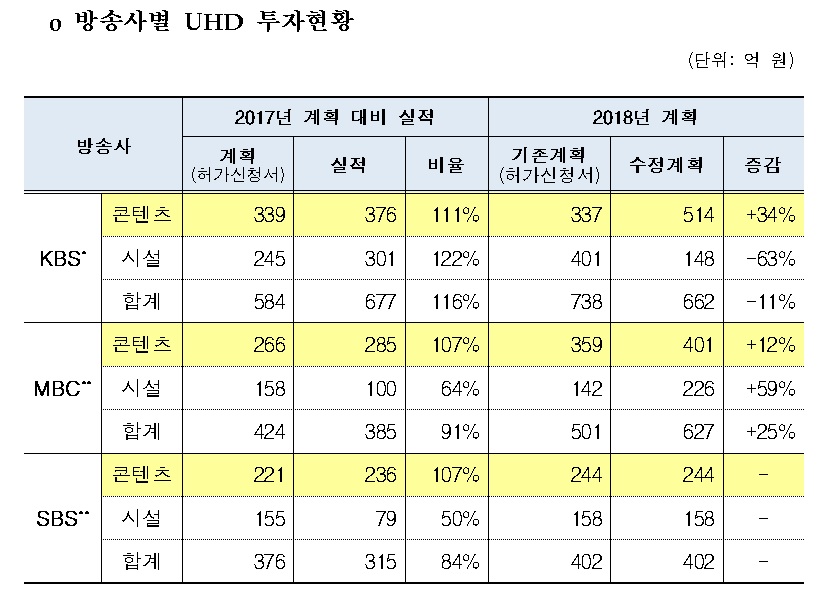
Broadcasters were required to schedule 5% of all programming in UHD by 2017. After licensing, however, the KCC began counting HD remasters that had been reprocessed as UHD, so in practice broadcasters have fallen short of the 5% target.
Terrestrial UHD offers roughly four times the image clarity of HD. To receive it, viewers need a UHD TV that uses the U.S.-style transmission standard or a UHD converter, and must pick up the terrestrial signal directly by antenna without subscribing to cable or IPTV.
Rep. Kim pointed out that broadcasters’ investment plans shrank from 2 trillion KRW (1.5 billion USD) in 2014 to 1.3 trillion KRW (975 million USD) in 2015 and 1.25 trillion KRW (937.5 million USD) in 2016. “Had the review been rigorous, these unrealistic plans could have been rejected,” he said, asking, “Why does this project keep moving forward?”
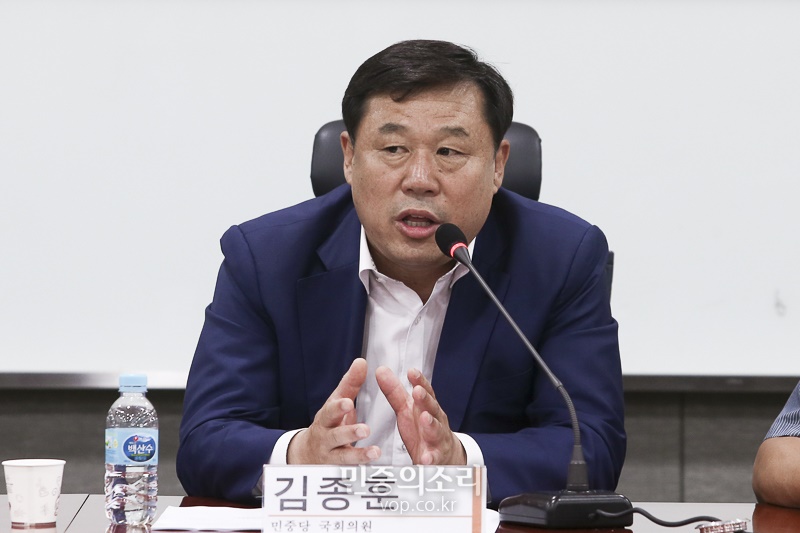
Chairman Lee responded, “We showed leniency because terrestrial broadcasters lacked the capacity to make the investments,” adding, “We should have reviewed their plans more closely, but the broadcasters were overly ambitious from the start. It appears they drew up unrealistic plans to secure frequencies.” Under the Park Geun-hye administration, the Ministry of Science, ICT and Future Planning originally planned to allocate the 700 MHz band to communications, but in 2015 it set aside part of that band for terrestrial UHD at the request of broadcasters and the National Assembly.
On the need for UHD, Chairman Lee said, “Existing HD broadcasts are adequate for most viewers,” but added, “Still, being the world’s first to adopt UHD has national significance that cannot be ignored.”















Most Commented