
‘Performance TV’ and AI-driven product placement rise; unified metrics needed to compete with global platforms
Generative artificial intelligence is rapidly reshaping the broadcast-advertising landscape, and industry experts say South Korean media companies must urgently form strategic alliances and build a data-driven, integrated ecosystem. They argue that a shift to “Performance TV”—which blends digital targeting precision with television’s broad reach—offers the most viable path forward.
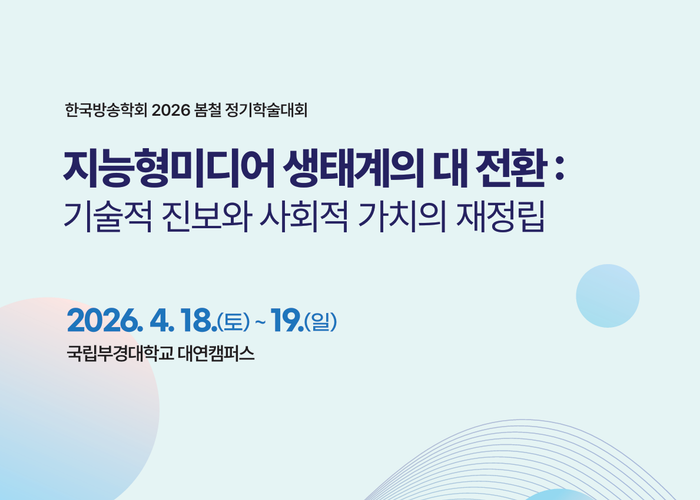
Seong Yoon-taek, chief research fellow at the Media Advertising Research Institute of the Korea Broadcast Advertising Corporation (KOBACO), made the remarks April 18 at the Korean Broadcasting Society’s spring conference at Pukyong National University in Busan.
He said generative AI now permeates every stage of ad production—planning, design, shooting, editing and transmission—ushering in an era when many versions can be produced quickly and at low cost.
He pointed to AI video-processing tools, including AI-driven product placement (AI PPL) that inserts products seamlessly into content, and systems that analyze a video’s context to match the most suitable ad. Such technologies, he said, could sharply improve broadcast-ad efficiency. For example, a system might intelligently match a Porsche or Ray-Ban sunglasses ad to a specific scene in Top Gun: Maverick.
TV's evolution: From the 'idiot box' to on-device AI
Once dismissed as the “idiot box,” television has evolved into a smart device equipped with on-device AI. Examples include Samsung’s Perplexity and KT’s Genie TV Tab 4 (powered by Gemini). TVs are now interactive devices that generate viewer data and function as central nodes in the media ecosystem.
Seong invoked the concept of “Performance TV” to describe the convergence of TV’s persuasive power with the targeting accuracy of digital marketing. He said AI enables advertisers to optimize campaigns and measure real business outcomes in real time.
Unite to survive: Britain's CFlight model draws attention
His primary recommendation was that domestic media companies form strategic alliances. He warned that individual firms face limits when responding alone to the aggressive expansion of global digital platforms such as YouTube and Netflix.
Citing Britain’s CFlight initiative and the BARB Ads Hub, he urged rival broadcasters to collaborate and establish unified audience-measurement standards—so-called Multi-Currency metrics.
From technical feasibility to social acceptance
Seong said data-driven personalization and hyper-personalization are the inevitable future of broadcast advertising. But he cautioned that technical advances must be accompanied by efforts to secure social acceptance—through aligning stakeholder interests and ensuring sustainable funding—so the technology does not produce harmful side effects. He invoked the classical proverb that “things change with their environment” to underscore the risk.
He added that while it is not yet too late, action is urgently needed. He urged domestic broadcasters and telecom companies to move proactively to build a shared, data-driven ecosystem that will help them survive in a shifting market.
© Dailian Co., Ltd. Unauthorized reproduction and redistribution prohibited
- Oh Se-hoon confirmed as People Power Party’s Seoul mayoral nominee — seeks a third straight term and a fifth overall
- People Power Party attacks Kim Yong’s bid, saying he belongs behind bars, not on the campaign trail
- Controversial ad labeled indecent — how explicit was it?
- President Lee and Hong Joon-pyo hold private makgeolli luncheon as rumors of Hong becoming prime minister resurface
- [Exclusive] AWS supply-chain chief and battery lead met with Samsung SDI; talks of cooperation draw attention














Most Commented