
What Makes ‘Hongdo’ a Must-See? Explore the 2026 Revival’s Unique Take on Love and Sacrifice
Daniel Kim Views
Translation result.
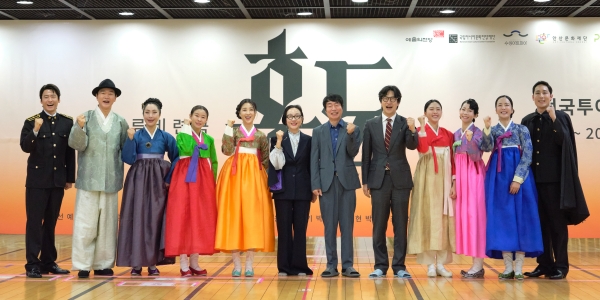 |
| Press conference for the play ‘Hongdo’ / Photo provided by YellowBam |
[Sports Today reporter Song O-jung] The play ‘Hongdo’ returns after a decade, offering three distinct takes on its title role.
On the afternoon of April 1, a press conference for ‘Hongdo’ was held at Sungshin Women’s University’s Unjeong Green Campus. After a delayed highlight scene, the Q&A panel included artistic director Go Seon-woong, National Asia Culture Center Foundation president Kim Myung-kyu, costume designer Cha Ikim (Kim Young-jin), and actors Park Ha-sun, Ye Ji-won, Choi Ha-yoon, Jung Bo-seok and Hong Ui-jun.
‘Hongdo’ reinterprets universal themes of tragic love and sacrifice through the story of Hongdo, who becomes a gisaeng to support her brother’s education, and Gwang-ho, the heir of a prominent family. The production revives the 1930s melodrama ‘Deceived by Love, Wept for Money’ with a modern sensibility and restrained mise-en-scène.
First staged in 2016, the play returns as part of theatre company Mabangjin’s 20th-anniversary season. Director Go said he has long believed popular theater matters. “I wanted an accessible play with a captivating theme that reaches the heart of theater,” he said. “For our 20th anniversary, I felt we could express the themes and mise-en-scène more clearly and concisely, so we chose ‘Hongdo.’”
This season is produced in partnership with the National Asia Culture Center Foundation. Kim Myung-kyu criticized the challenges facing private theatre groups: “It’s difficult for private companies to mount productions and turn a profit. Mabangjin has reached its 20th year, and Director Go told me they didn’t receive any guarantee payments for their previous two shows. That’s regrettable,” he said, calling attention to the industry’s realities.
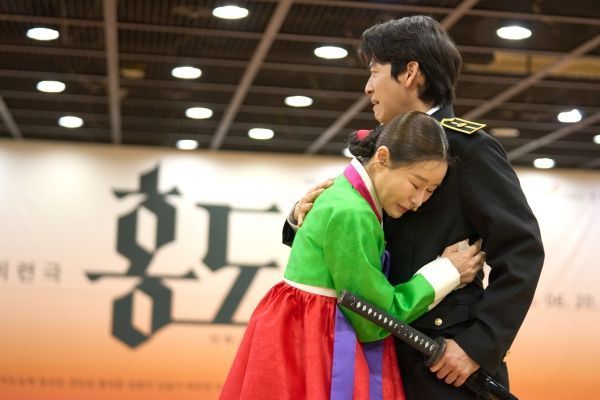 |
| Press conference for the play ‘Hongdo’ / Photo provided by YellowBam |
Kim said the foundation has been exploring ways to address that gap. “Many institutions simply fund projects as a courtesy and then step back. Our foundation uniquely handles distribution in Korea. Until now we mostly distributed works we produced ourselves, but this year we decided to collaborate with private companies to offer more meaningful support. As part of that initiative, we actively joined the production of ‘Hongdo.’ We hope other organizations will follow this model to support the private performing arts sector,” he said.
For this season, internationally recognized designer Cha Ikim (Kim Young-jin) has created hanbok costumes that amplify the play’s Korean mise-en-scène. Cha described the design approach: “I based the costumes on Hongdo’s signature red. Because this is a story of pleasure and sorrow, I wanted the garments to be ornate but to carry a melancholic message.”
Both Ye Ji-won and Hong Ui-jun appeared in the original production; Hong, returning for this season, said he’s delighted to share the stage with the three actresses who play Hongdo. “I approached this season wanting to be a water-like presence in the piece,” he said.
Veteran actor Jung Bo-seok joins the cast as Gwang-ho’s father. A longtime admirer of ‘Hongdo’ and Mabangjin, Jung described the play’s rhythm: “It packs a lot into a brisk tempo. It’s playful and rhythmic, but by the end you feel a poignant twinge. In these gloomy times, I hope this production offers audiences a cleansing of the heart.”
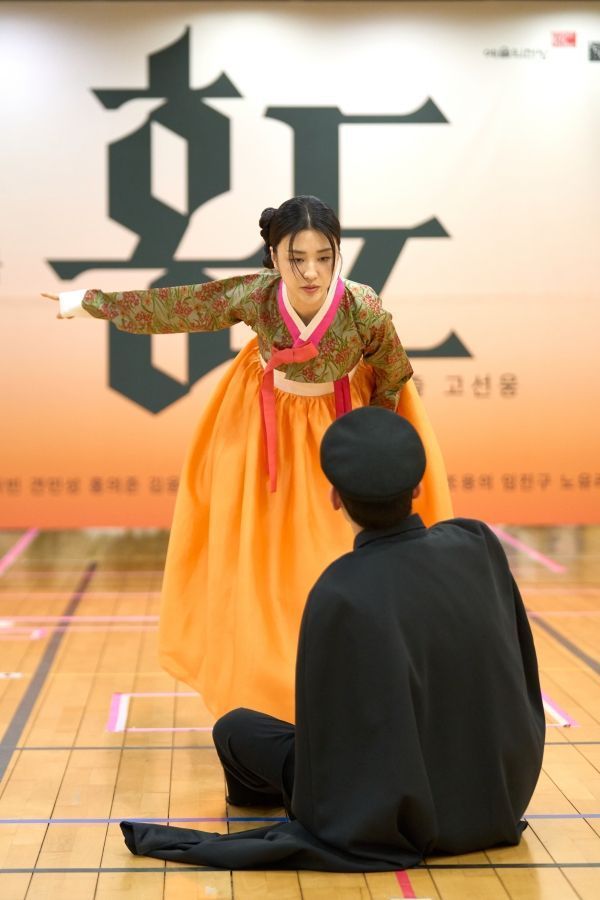 |
| Press conference for the play ‘Hongdo’ / Photo provided by YellowBam |
This season’s casting of three distinct Hongdos is meant to add texture and variety. The youngest of the trio, Mabangjin actor Choi Ha-yoon, said she’s focused less on standing out and more on syncing her energy with the ensemble. “I’m trying to become one cog of the family unit onstage,” she said.
Park Ha-sun, who joked she feels like a newborn, admitted that internalizing Mabangjin’s and Director Go’s distinctive style took a physical toll—she experienced nosebleeds and chapped lips during rehearsals. Still, she said the joy of learning and the anticipation of artistic growth kept her motivated.
“I’m 39 this year, and people called me ‘cute,’” she laughed. “I’ll hold onto that and, despite the challenges, build my own Hongdo.”
The process wasn’t without cost. Park developed vocal cord inflammation while adapting to Mabangjin’s and Director Go’s demanding approach. Even so, she said her husband, actor Ryu Soo-young, encouraged her to take the role. “He asked, ‘Are you even an actor? Why are you hesitating?’” she recalled, expressing strong trust in Mabangjin and Director Go.
Casting three different Hongdos presented an intriguing directorial challenge. Go said, “They have different personalities and voices, yet somehow each one truly embodies Hongdo. It’s been an amazing experience. By shaping movement and vocal identity for each performer, we aimed to create a more distinctive, character-driven trio.”
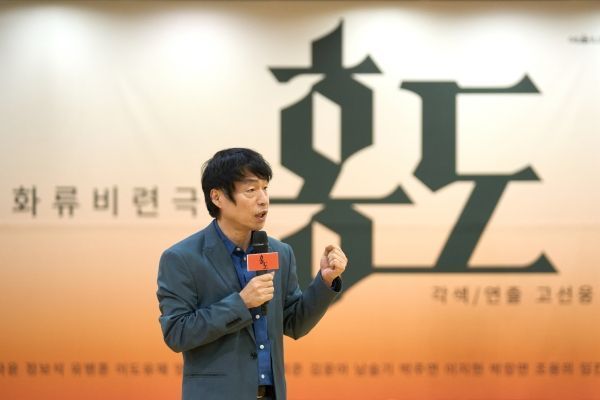 |
| Press conference for the play ‘Hongdo’ / Photo provided by YellowBam |
Returning after a decade prompted the team to dig deeper into the play’s context and themes. “Reviving a work makes you more sensitive and self-critical,” Director Go said. “At first I assumed the original atmosphere would suffice, but we needed to sharpen many elements. The more you work, the more you learn. I once thought the characters were simple, but digging deeper revealed much to explore. Our process feels like mining—extracting and polishing hidden gems.”
While classic melodrama may feel unfamiliar to millennial and Gen Z audiences, ‘Hongdo’ has been updated with a contemporary sensibility to reach viewers across generations. Ye Ji-won noted, “The play depicts devotion reminiscent of how our mothers, grandmothers and ancestors lived. That legacy lives within us. Parents will find it moving, and younger audiences can gain an indirect sense of how previous generations lived. It may sound heavy, but the production is restrained and accessible, with plenty of humor.”
Director Go acknowledged the contemporary sensitivity around depictions of gisaeng and the potential for linguistic or gendered offense. “We examined those issues carefully,” he said. “We won’t overdo it, but we also can’t whitewash the realities of the era. We tried to strike a delicate balance and clarify the dialogue so audiences familiar with the play from a decade ago and new viewers can both understand it.”
‘Hongdo’ runs at Seoul Arts Center’s CJ Towol Theater from April 10 to 26, with 22 performances, then tours seven cities nationwide: the National Asia Culture Center in Gwangju, Suseong Artpia in Daegu, Ansan Arts Center, Pohang Cultural & Arts Center, Miryang Arirang Arts Center, Busan Citizen Hall, and Anseong Matchum Art Hall.
[Sports Today reporter Song O-jung ent@stoo.com]
「The closest, most fun news ⓒ Sports Today」














Most Commented