
Translation result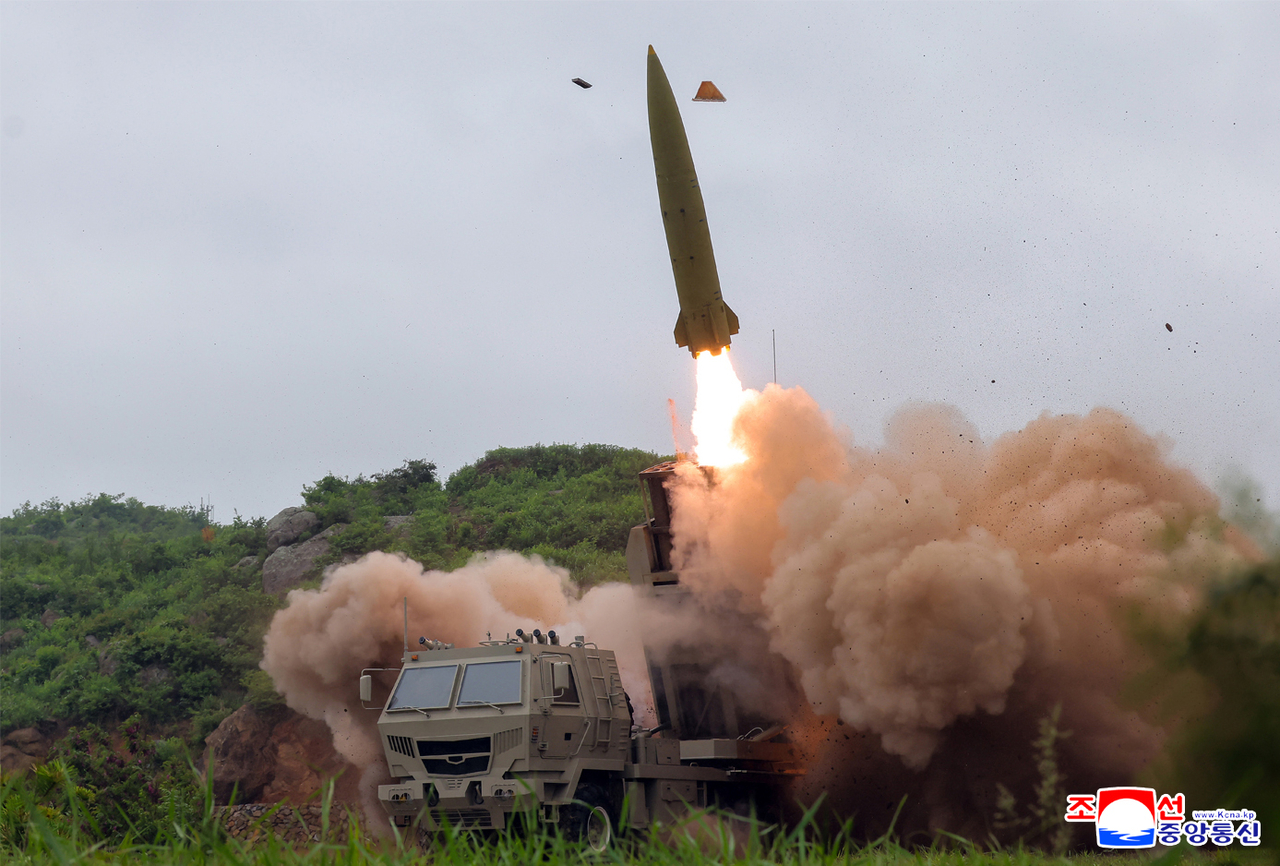 By Yoon Ho, Herald Economy — North Korea said May 27 that it tested a newly developed lightweight, multi-purpose missile-launch system and a multiple-launch tactical cruise missile system the day before. Analysts view the tests as a likely provocation in response to Seoul’s announcement of plans to develop nuclear-powered submarines.
The Korean Central News Agency (KCNA) reported that Kim Jong Un observed the weapons launches, which were carried out by the country’s Missile Bureau and the National Defense Science Institute.
KCNA said officials evaluated the destructive power of a tactical ballistic missile’s “special-mission” warhead, the reliability of an ultra-precision autonomous guidance and navigation system for a 240 mm guided rocket round with extended range, and the AI-driven terminal-guidance accuracy of the tactical cruise missiles.
North Korea’s simultaneous firing of different missile types and rocket artillery appears intended to demonstrate its ability to evade and defeat air defenses through a “mixed firing” tactic.
KCNA described the “tactical cruise warhead” as a system that pairs an ultra-precision autonomous navigation suite with terrain-matching guidance and an AI terminal-guidance function. It said the weapon uses a glide-and-boost flight profile to strike targets at about 100 km with high precision and that Pyongyang plans to deploy the tactical cruise missiles to long-range artillery brigades near the southern border.
Kim said, “The current situation urges continuous military modernization,” and added that building “the most modern and most powerful artillery force, unmatched by anyone,” is the top priority in force development.
Hong Min, a senior research fellow at the Korea Institute for National Unification, said the tests aim to cement the military demarcation line as an international border and to degrade U.S.-ROK rear-area assets early in any conflict through preemptive, rapid precision fires.
Yu Ji-hoon, a research fellow at the Korea Institute for Defense Analyses, described the launches as a low‑intensity provocation that combines a response and check on South Korea’s nuclear‑powered submarine plan, a probe of the new administration’s security-policy orientation, and a demonstration of tactical missile capability — not merely a weapons performance trial.
He added that because Seoul tied the need for nuclear-powered submarines to counter North Korea’s submarine-based nuclear and missile threats, Pyongyang is underscoring that its nuclear and missile capabilities remain credible and is trying to preserve strategic initiative over peninsula security dynamics.
President Lee Jae‑myung told a cabinet meeting the day before that “an independent defense posture wins respect from friends and strengthens alliances,” reaffirming a commitment to autonomous defense. On the same day, Defense Minister Ahn Gyu‑baek briefed the president and others at the first Future Defense Strategy Committee on the “Jangbogo N” project related to nuclear submarines.
Shin Jong‑woo, secretary general of the Korea Defense & Security Forum, noted that the short‑range tactical cruise missile launch system was first shown at last year’s 80th Workers’ Party military parade. He said Pyongyang appears to be preparing to field a 100 km tactical cruise missile capable of precision strikes with corps‑level artillery units along the front.










Most Commented