
Translation result
China cannot shake the security of the U.S. and its allies through hegemony…reaffirms commitment to defend Taiwan
Applause for South Korea’s pragmatism and leadership…praises plan to raise defense spending to 3.5% of GDP
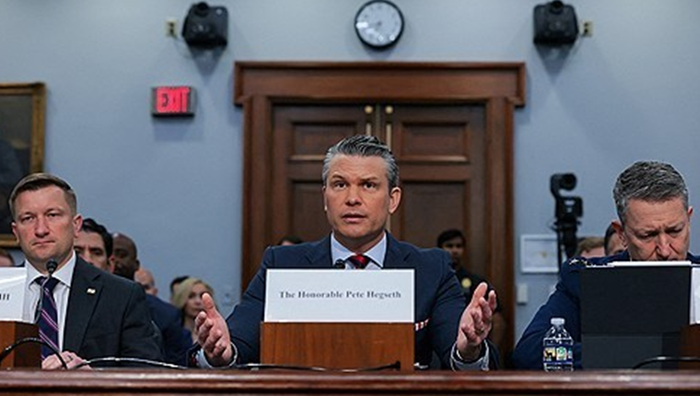
U.S. Secretary of Defense Pete Hegseth said on the 30th (local time) that it is “a breath of fresh air” to see allies such as South Korea move more quickly to assume operational control of military missions.
He also warned that no country, including China, can destabilize the security of the United States and its allies through hegemonic actions, signaling a commitment to check attempts at dominance in the Asia‑Pacific.
According to Yonhap News Agency, Hegseth told the Shangri‑La Dialogue in Singapore there is legitimate concern over China’s historic military buildup and its expanding operations across the Asia‑Pacific and beyond.
He warned that if any single power came to dominate the Pacific, it would upset the region’s balance. “What we seek is a genuinely stable balance that benefits both the American people and our allies,” he said.
Hegseth clarified he means a favorable but sustainable balance of power in which no country, including China, can threaten the security or prosperity of the U.S. and its allies through hegemonic behavior.
At the same time, he said the United States does not seek unnecessary confrontation in the region and indicated a desire to avoid direct clash with China.
He added that U.S.‑China ties have reached their highest level in years and that the U.S. keeps military‑to‑military channels open, meeting more frequently with Chinese counterparts.
“What allies want—and what the United States provides—is measured power, firm resolve and confident leadership: the ability to wield great strength while speaking and acting with restraint,” he said, adding that allies prefer stability to escalation.
Hegseth also cautioned that regional security has relied too heavily on U.S. military power. “Everyone must share responsibility to build a stronger alliance. There are no free rides,” he said.
He said the era of the U.S. subsidizing defense budgets of wealthy partners is over. “We need partners, not wards,” Hegseth said.
Hegseth said the United States has committed 1.5 trillion USD (approximately 2,260 trillion KRW) in military investment and reiterated the longstanding call for allies and partners to raise defense spending to 3.5 percent of GDP.
He specifically praised South Korea’s pragmatism and leadership, noting Seoul has already pledged to increase defense spending to 3.5 percent of GDP.
Last November, South Korea and the United States recorded in a joint fact sheet after their leaders’ summit that Seoul plans to raise defense spending to 3.5 percent of GDP.
Hegseth also said the core of the U.S. approach in the Pacific is to deny adversary access across the First Island Chain — a notional line running from the Japanese archipelago through Okinawa, Taiwan and the Philippines to the Strait of Malacca — reaffirming the need to deter aggression against Taiwan.
His remarks drew attention as they came while the South Korean government has again emphasized its intention to resume wartime operational control.
Earlier, on the 26th, the president told a Cabinet meeting that an independent defense posture earns friends’ respect and strengthens alliances, and urged a prompt, orderly transfer of wartime operational control to guide healthy development of the ROK‑U.S. alliance.
© Dailian Co., Ltd. Unauthorized reproduction and redistribution prohibited.
- [Election Scene] I’ve never seen a president like Lee Jae‑myung…why did Park Hyung‑joon raise his voice?
- SK Hynix at 3.8 million KRW (about $2,850)…“The stock rally is just getting started”
- [On site] Is this really a burger joint?…Mom’s Touch chicken, which sold 7 million pieces, returns stronger
- Even Hong Myung‑bo said he was surprised…why did Chairman Chung Mong‑kyu decide to resign?
- [Exclusive] LG Electronics grows a new brain beyond appliances…doubles R&D on data‑center cooling










Most Commented