
Translation result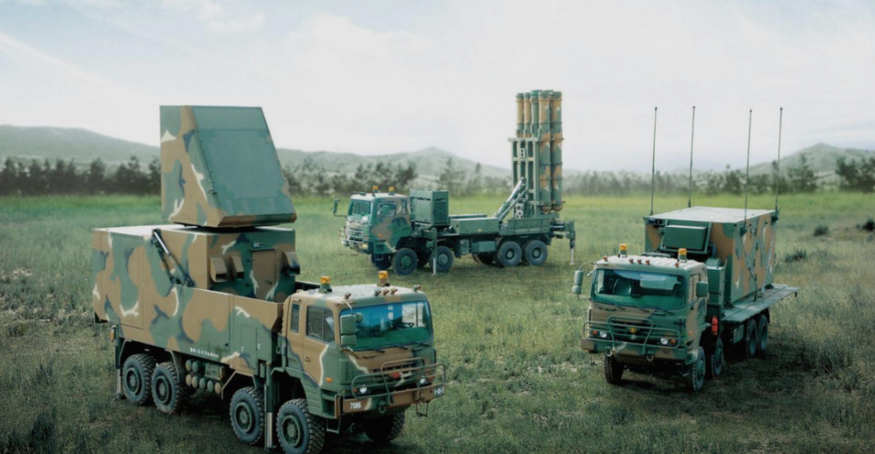
By Gil So-yeon — A U.S. think tank that focuses on U.S.-Korea relations warned that South Korea’s medium-range surface-to-air missile, the M-SAM Cheongung-II, which has been promoted as a cost-effective alternative to the Patriot PAC-3, faces production limits that could hinder its ability to meet global demand.
On May 28, Ukraine military outlet Defense Express reported that the Korea Economic Institute (KEI) provided figures on production capacity at Cheongung’s final-assembly firm, LIG Defense & Aerospace (LIG D&A, formerly LIG Nex1), and launcher manufacturer Hanwha, and raised doubts about Cheongung-II’s role as a Patriot substitute.
KEI’s analysis estimates Cheongung-II missile production at just over 300 rounds per year, with output expected to rise gradually. It said launcher production is capped at about eight per year. KEI put the unit price at roughly $1.6 million (approximately 2.13 billion KRW)—about one-third the cost of a U.S. Patriot (PAC-3 MSE)—but warned that Cheongung’s missile output is roughly half that of Patriot production and would not match Patriot consumption rates.
Because U.S.-made systems often carry higher prices and longer lead times, Cheongung-II has emerged as an attractive, lower-cost option with faster delivery. Still, analysts say production and supply-chain constraints mean Cheongung-II cannot fully plug the capability gaps left by Patriot shortfalls.
Reporting from the Middle East conflict shows that forces expended more than three times the U.S.’s annual Patriot production—roughly 600 missiles—in just a few months.
The U.S. foreign and security think tank CSIS recently reported that the United States used between about 1,060 and 1,430 Patriot interceptors during the first roughly seven weeks of the Middle East (Iran) war. That represents roughly 61% of the U.S. Patriot stockpile of 2,330 missiles.
Bahrain and Kuwait also operated Patriot batteries, and analysts estimate combined Patriot missile inventories across operators during the 39-day operation totaled between 4,500 and 5,000 rounds.
KEI said current Cheongung-II production—around 300 missiles per year—falls far short of the quantities needed to match Patriot consumption and would not meet operational demand in a crisis.
KEI concluded that, as more countries field Cheongung-II, South Korea would need to rapidly scale up missile production. Even with a significant increase in output, the institute said, Cheongung-II would only partially reduce some nations’ reliance on Patriot systems, and the overall effect would be limited.












Most Commented