
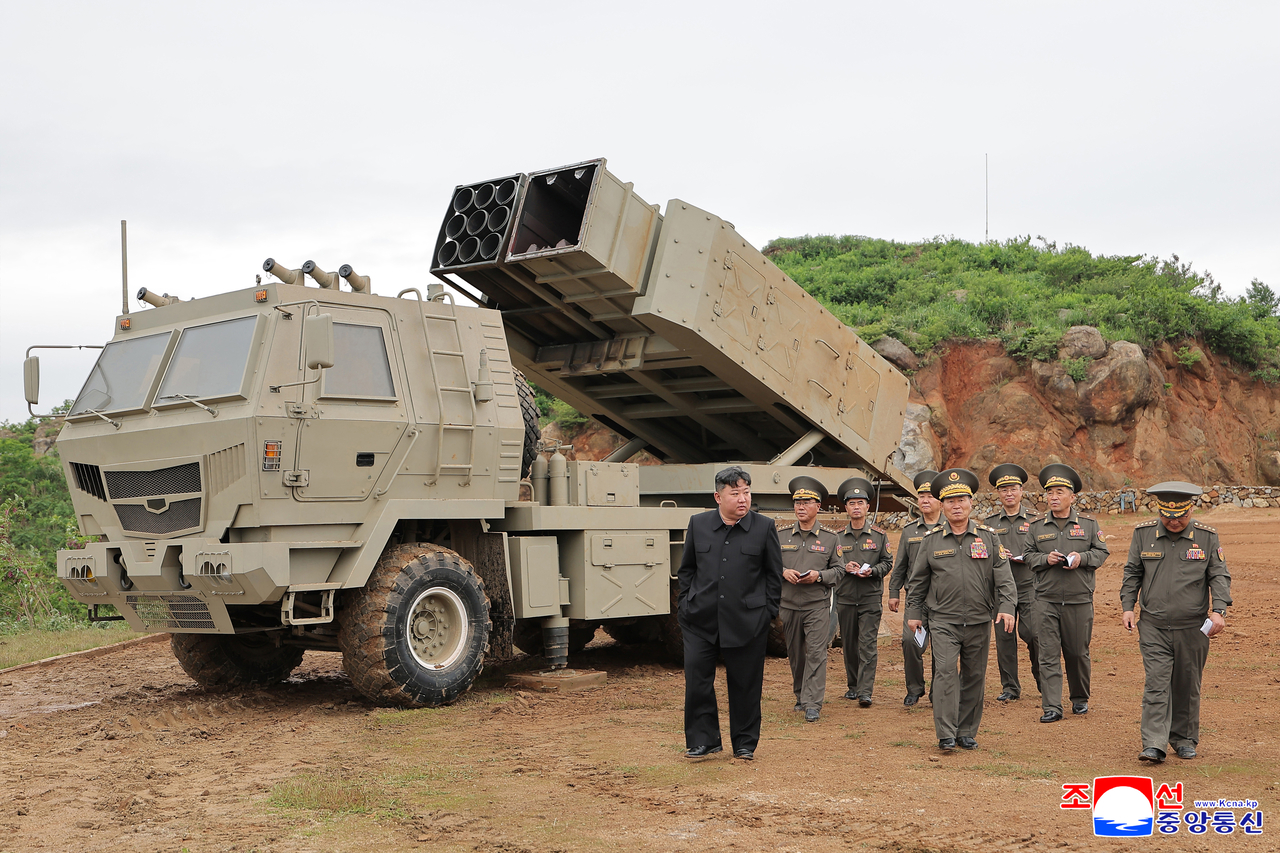
 North Korea said on May 27 that it tested a newly developed lightweight multipurpose missile-launch system and a multiple-launch tactical cruise missile weapons system the day before. Analysts say the tests were likely a provocation tied to Seoul’s announcement of a basic plan to develop nuclear-powered submarines.
The Korean Central News Agency (KCNA) reported that, with Kim Jong Un in attendance, the DPRK Missile General Bureau and the National Defense Science Institute conducted major weapons-launch tests. KCNA said officials evaluated the effectiveness of a tactical ballistic missile’s “special mission warhead,” the reliability of an ultra-precision autonomous guidance-and-navigation system for a range-extended 240㎜ guided rocket artillery round, and the AI-driven terminal guidance accuracy of a tactical cruise missile.
Analysts say the simultaneous firing of multiple missile types and rocket artillery appears intended to demonstrate the ability to evade air defenses and strike targets using a “mixed-launch” tactic.
KCNA described the “tactical cruise gliding munition” as a weapon system that combines an ultra-precision autonomous navigation system with terrain-referenced navigation and AI terminal guidance. It said the munition employs a combined glide-and-thrust flight mode to strike targets along a 100 km axis (about 62 miles) with extreme precision. KCNA added that the tactical cruise missiles will be deployed to long-range artillery brigades in the southern border region.
Kim told officials, “The current situation urges continuous military renewal,” and said building the most modern and powerful artillery force—one that no one can match—remains the top priority in military development.
Hong Min, a senior researcher at the Korea Institute for National Unification, said North Korea appears to be trying to fix the military demarcation line as an international border and to neutralize U.S.-ROK rear assets early in a conflict through preemptive, rapid precision fires.
Yu Ji-hoon, a researcher at the Korea Institute for Defense Analyses, described the launches as a low-intensity provocation that combines a response to Seoul’s nuclear-submarine plan, a probe of the new administration’s security policy direction, and a display of tactical missile capability—rather than a simple weapons-performance test. He added that because South Korea linked the need for nuclear-powered submarines to counter the DPRK’s submarine-based nuclear and missile threats, North Korea appears intent on underscoring that its nuclear and missile threat remains credible and on retaining strategic initiative on the peninsula.
President Lee Jae-myung said at a cabinet meeting the day before, “Only with a self-reliant defense will friends respect us, and alliances remain strong,” reaffirming his commitment to autonomous national defense. Reporter Yoon Hon











Most Commented