
Translation result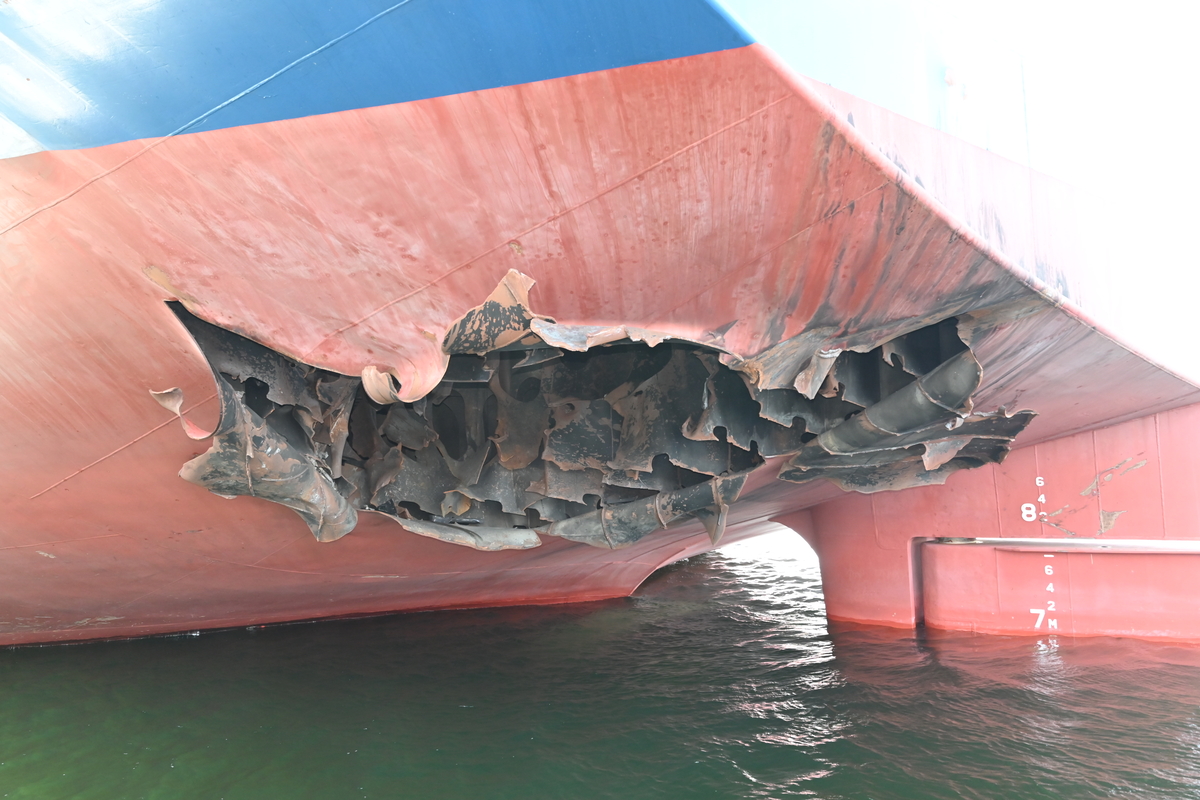
Seoul to Summon Iranian Ambassador and Lodge Strong Protest
The Ministry of Foreign Affairs said investigators believe the projectile used in the attack on the HMM Namu in the Strait of Hormuz was likely an Iranian anti‑ship missile.
First Vice Foreign Minister Park Yun‑joo told reporters at the Government Complex Seoul on May 27 that recovered engine components displayed characteristics consistent with Iranian turbojet engines and that some parts bore markings believed to be from Iranian manufacturers.
Park said the recovered warhead appears to be unexploded ordnance that did not fully detonate and that its shape matches warheads used on Iran’s Noor or Qader family anti‑ship missiles. He added that investigators cannot yet definitively identify the attacker, but the evidence points toward Iran.
Authorities also said the debris’ appearance and paint scheme were consistent with Iranian weapons.
Park noted the airframe fragments were painted sky blue, the same color used on Noor‑series missiles, and that circuit‑board fragments date roughly 20–30 years old, suggesting the wreckage likely came from an older Noor‑class missile.
He said explosive residue indicated a high‑explosive charge that had not fully detonated. Investigators concluded the Namu was struck twice at roughly one‑minute intervals: the first warhead failed to detonate, while the second exploded.
The government plans to summon Iran’s ambassador to South Korea, Saeed Kujechi, that evening to present the investigation’s findings and lodge a strong protest. It said it will demand measures to prevent a recurrence and that Iran assume responsibility.
On May 4, the Namu was anchored near the Strait of Hormuz when two unidentified aerial vehicles struck the ship, igniting a fire.
The government’s inspection found the port‑side stern outer hull suffered a hole roughly 5 meters across and about 7 meters deep; internal frames were bent inward, and some hull plating showed signs of being forced outward.
South Korean authorities conducted an on‑site investigation from May 13 to 15 led by the Agency for Defense Development and other agencies.
Investigators collected debris at the scene and transported it to South Korea for detailed technical analysis of the engine, warhead, explosives and airframe fragments.















Most Commented