
Translation result
Seemingly mixed salvo of CRBMs with new 240mm rocket artillery upgraded to ranges of 100 km or more
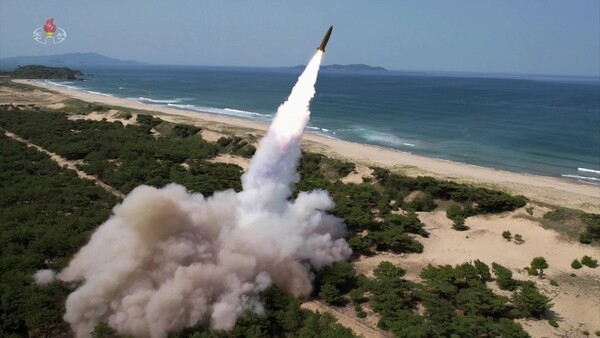 North Korea launched four to six projectiles — believed to include short-range ballistic missiles (CRBMs) and a new 240 mm rocket artillery system — into the Yellow Sea around 1 p.m. on the 26th, resuming missile activity after roughly a month.
The Joint Chiefs of Staff said, “Our military detected multiple types of projectiles, including short-range ballistic missiles, launched from the Jeongju area in North Pyongan Province into the Yellow Sea at about 1 p.m.” They added that the detected missiles flew about 80 km and that South Korean and U.S. intelligence agencies are conducting detailed analyses of their exact specifications.
The Joint Chiefs said ROK and U.S. intelligence tracked and shared developments from the outset of the launches and passed related information to Japan. They emphasized that, under a robust ROK-U.S. combined defense posture, the ROK military is closely monitoring North Korea’s activities and maintains the capability and readiness to respond decisively to any provocation.
Military sources told reporters that North Korea fired two or three different types of projectiles, totaling four to six rounds.
Analysts say the roughly 80 km flight distance suggests a mixed salvo of CRBMs and modified 240 mm rocket artillery rounds — upgraded to at least a 70 km range — which would effectively classify those artillery rounds as ballistic missiles.
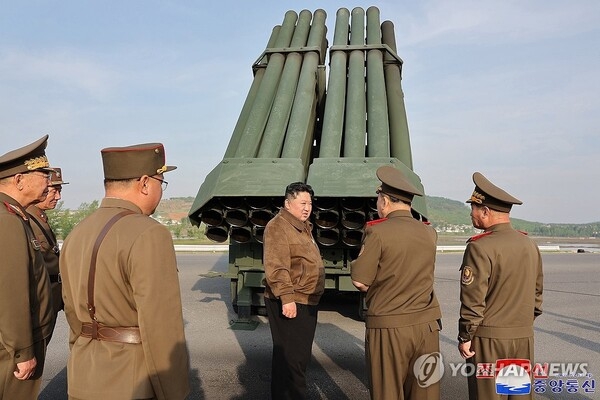 Kwon Yong-su, professor emeritus at the National Defense University, said North Korea has been upgrading its 240 mm rockets by adding guidance to rounds that previously had ranges of 40–60 km, improving their accuracy. “The new 240 mm rockets now reach 70–80 km or more, increasing both range and precision,” he said.
This was Pyongyang’s first missile launch in 37 days since the April 19 salvo, when it fired short-range ballistic missiles into the East Sea that flew about 140 km. It was the eighth ballistic missile provocation this year.
The launch followed a Cabinet meeting that began at 10 a.m., during which President Lee Jae-myung discussed plans to acquire nuclear-powered submarines. The president said, “We must hasten the transition to a future-oriented advanced military,” and urged accelerating the adoption of artificial intelligence and drone technologies and speeding up the acquisition of nuclear-powered submarines as core strategic defense assets.
The Joint Chiefs said the ROK military has stepped up surveillance and vigilance to guard against further launches, and that South Korea, the United States and Japan are closely sharing missile-related information while maintaining full readiness.
Seoul’s government called on North Korea to cooperate with efforts to secure peace and reduce tensions on the Korean Peninsula following the Yellow Sea launches.
At a briefing, Foreign Ministry spokesman Park Il urged Pyongyang to respond to Seoul’s peace and tension-reduction initiatives. Park said, “As a government firmly committed to non-proliferation, we will continue, in close cooperation with the international community, to pursue a phased and practical approach to make tangible progress on the North Korean nuclear issue while maintaining our goal of complete denuclearization of the Korean Peninsula.”
According to the Joint Chiefs of Staff, the launches from the Jeongju area into the Yellow Sea around 1 p.m. marked the eighth such incident this year.












Most Commented