
Sea-skimming flight reduces radar detectability
Capable of surveillance, reconnaissance, search-and-rescue and anti-submarine support
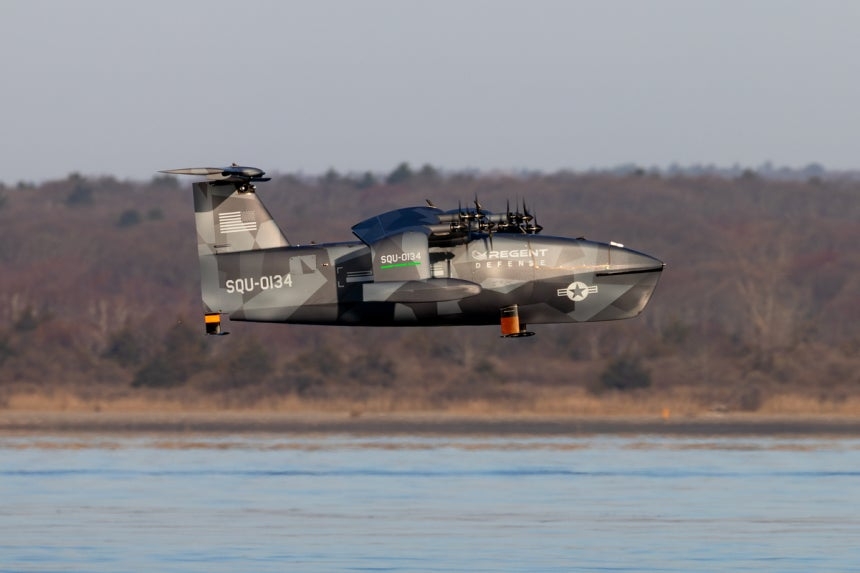 The small unmanned vessel known as a wing-in-ground (WIG) craft rides only a few meters above the water and can carry out military tasks without a crew aboard. That crewless design reduces the risk to personnel and makes the platform useful for resupply missions, target surveillance and reconnaissance. U.S. startup Regent recently unveiled a prototype of its small autonomous unmanned WIG craft, the Squire.
A WIG craft stays aloft on wings attached to the hull and travels just over the surface. It looks like an airplane, but instead of submerged screws it uses propellers that operate above the water, which lets the hull avoid hydrodynamic drag. That arrangement yields far higher speeds than conventional ships. With roughly 5 m (about 16 ft) wings, the Squire reaches around 70 knots (≈130 km/h; ≈81 mph).
Given that most naval ships struggle to exceed about 50 km/h (≈31 mph), the Squire qualifies as a high-speed maritime platform. Its small size also allows for electric propulsion. In Regent’s video, propellers on the Squire’s wings spin while the hull remains on the water; the hull then lifts 2–3 m (roughly 7–10 ft) above the surface and accelerates, effectively flying low over the sea.
The unmanned Squire represents a WIG variant not previously fielded at this scale. It’s not an entirely new idea for Regent: the company introduced a manned WIG, the Viceroy, last year. The Viceroy can carry 12 people and reach a top speed of 290 km/h (≈180 mph); the Squire is essentially a scaled-down, unmanned derivative.
With a compact hull and high speed, commanders can surge a Squire quickly to inspect suspected incursions. Crucially, those missions can be carried out without putting crews at risk. The Squire’s endurance exceeds 100 nautical miles (≈185 km; ≈115 mi). Flying at very low altitude over the sea also makes radar detection and tracking more difficult.
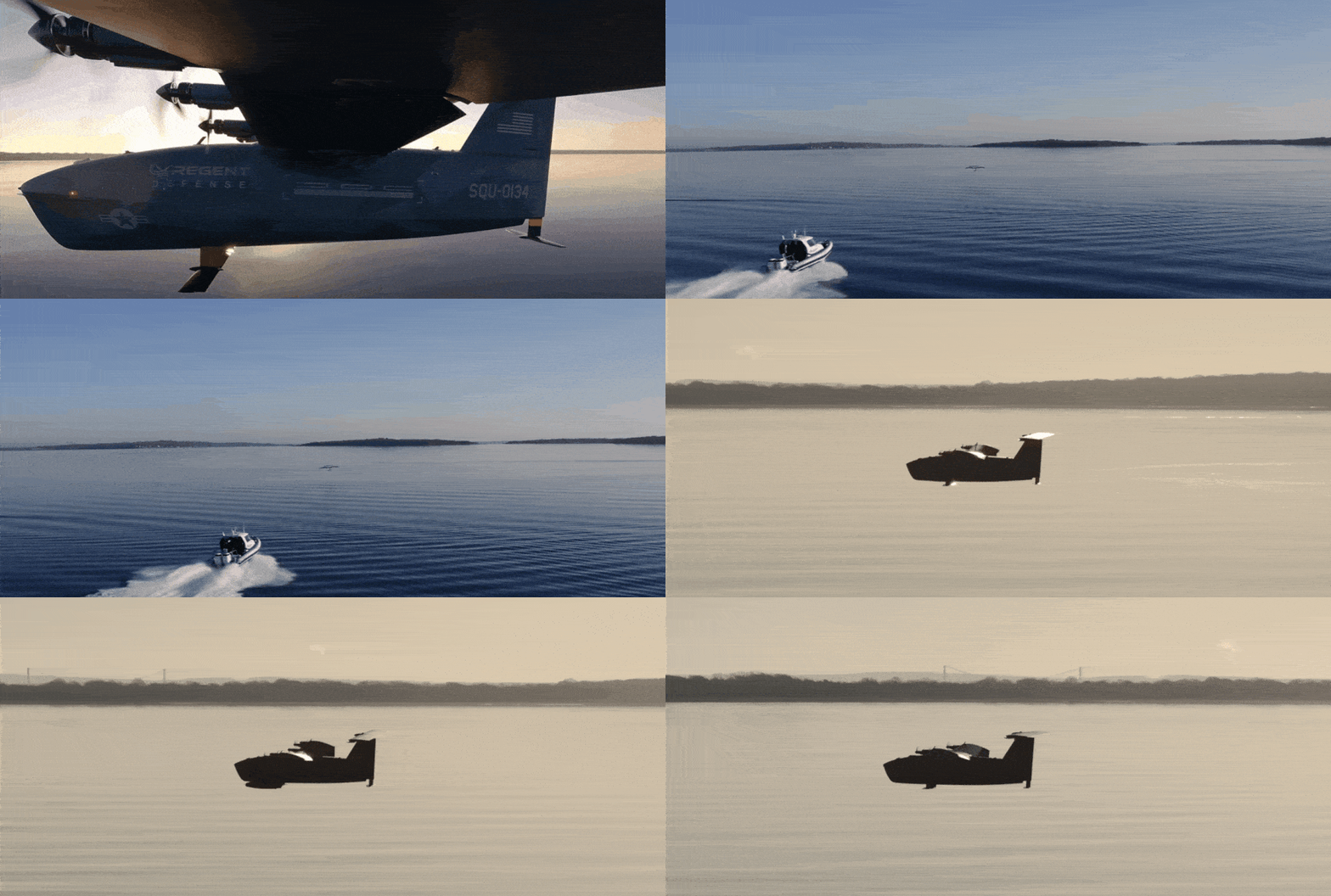 By exploiting the air cushion created between the wings and the water surface (ground effect), a WIG craft moves far faster and more efficiently than a conventional hull. Operated without a runway, it functions like a small unmanned aircraft. That combination of speed and sea-based operation has led analysts to flag it as well suited for fast landing craft roles in amphibious forces. Its speed also supports rapid casualty evacuation or extraction of isolated personnel from contested areas.
During the Cold War, Germany under the Nazis, the Soviet Union and the United States all pursued military WIG development. The Soviets deployed the Lun-class missile WIG to the Black Sea Fleet in 1987. That large craft carried 15 crew, had a wingspan of about 44 m (≈144 ft) and a displacement near 286 metric tons. It mounted six P-270 Moskit anti-ship missiles and drew U.S. descriptions that dubbed it a “sea monster.”
Today, the United States is reportedly pursuing larger military WIG programs, and China, Japan and European countries are also researching the concept as they bolster maritime capabilities. Still, private-sector efforts to field small military and commercial WIGs — exemplified by Regent — have moved ahead of many state programs. In 2012, South Korea’s Korea Institute of Machinery and Materials reportedly explored WIG development in a technical partnership with Russia.
Regent is pushing to supply the Squire to the U.S. military. The Defense Department expects unmanned WIGs to expand operational options at sea, particularly for logistics. The craft can carry up to 23 kg (about 51 lbs) of cargo; operating multiple units in concert could deliver substantial supplies to forces stranded along a coastline, while also performing surveillance and reconnaissance, search-and-rescue, and anti-submarine support.
Regent has signed a contract with the U.S. Marine Corps worth ₩22.2 billion (about $16.65 million). The company said earlier this year it provided the U.S. Department of Defense with official materials outlining the Squire’s capabilities and roles. “The U.S. military needs a flexible platform that can operate across wide maritime areas,” Regent said. “The Squire can meet that need.”

- South Korea’s real economy reflects the Middle East war… U.S., Japan and the Eurozone face a ‘rate week’ [Han Dong-hoon’s Weekly Outlook]
- [Trump Stock Tracker] A rate hold looks set; whether AI generates profits is the wildcard
- Shooting at banquet attended by Trump… suspect targeted the U.S. administration [Global Morning Briefing]
- From fair-value ratios to transfer and holding taxes… Is a comprehensive tax package targeting housing prices coming? [Pickconomy]
- [Exclusive] KF-21 operational deployment pushed back four years to 2036 [Lee Hyun-ho’s Military Talk]
- Members who left Coupang lost money… Fair Trade Commission overhauled abusive contract terms [Pickconomy]
- South Korea slipping into depression and anxiety… spent over ₩1 trillion (about $750 million) on mental health treatment
- New credit loans without annual income limits to ease pressure on vulnerable borrowers
- Will KOSPI and KOSDAQ keep rallying? South Korea’s markets face a ‘super week’ [Weekly Market Outlook]
- Despite the Hormuz blockade, Iran plays a ‘three-stage card’… Trump: “No meeting without nuclear abandonment” [Global Morning Briefing]












Most Commented