
Unlocking the Future: A Guide to South Korea’s Submarine Bid in Canada’s CPSP Project
Daniel Kim Views
Translation result
After the navy chief, DAPA chief heads to Canada
All-out push ahead of final CPSP decision worth up to 60 trillion KRW (about $45 billion)
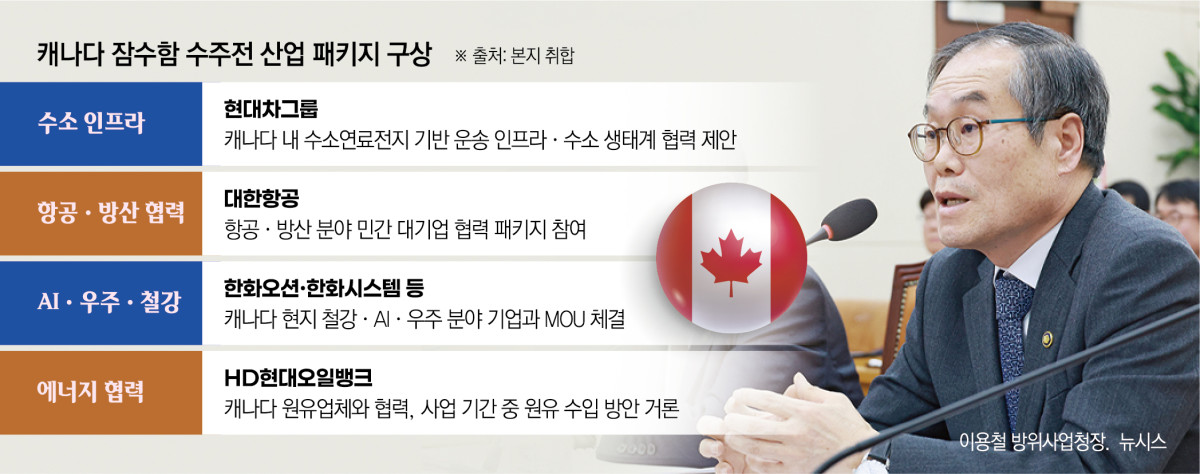
Lee Yong-cheol, director of the Defense Acquisition Program Administration (DAPA), is traveling to Canada to promote South Korean defense exports. The government and military are mounting a final push ahead of a decision on Canada’s next-generation submarine project (CPSP), a program estimated at up to 60 trillion KRW (about $45 billion). Seoul hopes a high-level government presence will bolster the credibility of Korea’s bid.
Defense industry sources said on the 21st that Lee will attend an arrival ceremony in Victoria, Canada, on the 24th (local time) for the Dasan Ahn Chang-ho submarine and the frigate Daejeon. The Dasan Ahn Chang-ho is a 3,000-ton submarine built with indigenous South Korean technology. The Daejeon is a 3,100-ton frigate. Both ships will call in Canada as part of combined Korea-Canada exercises.
Lee departs on the 24th to attend the arrival ceremony, then plans to visit CANSEC 2026 — Canada’s largest defense and security trade show in Ottawa — before returning to South Korea. Last year, DAPA Deputy Director Kang Hwan-seok attended CANSEC 2025 and met senior Canadian government and naval officials; this year, Lee will lead the engagement in person.
The Dasan Ahn Chang-ho’s visit doubles as a live demonstration in the submarine competition rather than a routine military exchange. In March, the submarine left Jinhae Naval Port on a roughly 14,000-kilometer transit to Victoria on Canada’s west coast — the first time a South Korean submarine has crossed the Pacific. DAPA and the navy intend to showcase the platform’s operational capabilities and reliability through the long-range voyage and joint operations.
Senior military leaders are also pitching in. The navy said Admiral Kim Kyung-ryul, the Republic of Korea Navy chief, will visit Canada from the 21st to the 29th for bilateral talks with senior Canadian naval officials to discuss military cooperation and defense-industry support. Admiral Kim is scheduled to attend the arrival ceremony for the Dasan Ahn Chang-ho and the Daejeon to meet and encourage the crews.
Canada’s CPSP is a massive program to replace aging submarines, with a potential price tag up to 60 trillion KRW (about $45 billion). A consortium led by South Korea’s Hanwha Ocean and HD Hyundai Heavy Industries is competing against Germany’s Thyssenkrupp Marine Systems (TKMS). Evaluators will weigh performance, price and delivery timelines, as well as local industrial participation, technology transfer, and operational and maintenance support capabilities. The final award is expected around the end of June.
DAPA has already mobilized an interagency support framework. On Feb. 20, the government hosted a signing ceremony for a government support pledge tied to the Hanwha Ocean–HD Hyundai One Team bid, affirming their commitment to win the Canadian submarine contract and fulfill industrial cooperation commitments. Director Lee attended that ceremony and framed the CPSP as more than an arms sale — as an industrial cooperation package that demands government-level credibility and the ability to deliver.
At a Defense Press Corps briefing in March, Director Lee assessed Korea’s chances in the CPSP contest as roughly even, calling it “50-50.” He said a win would be a landmark achievement for South Korea’s defense industry — one that could justify claiming a place among the world’s top defense exporters. Lee also noted Canada’s specific demands for support in submarine operations, maintenance and technology transfer. In January, he joined a defense delegation that included Chief Presidential Secretary Kang Hoon-sik and Trade Minister Kim Jeong-gwan to Ottawa to back the CPSP bid.
The final decision will test Seoul’s ability to pair advanced platforms with credible, long-term industrial and operational commitments — exactly the kind of package Canada is signaling it wants.















Most Commented