
Translation result.
Since late last year, North Korea has mobilized 3,000–5,000 personnel per day.
Japanese media: “North Korean forces expanding tactical roads near the Military Demarcation Line”
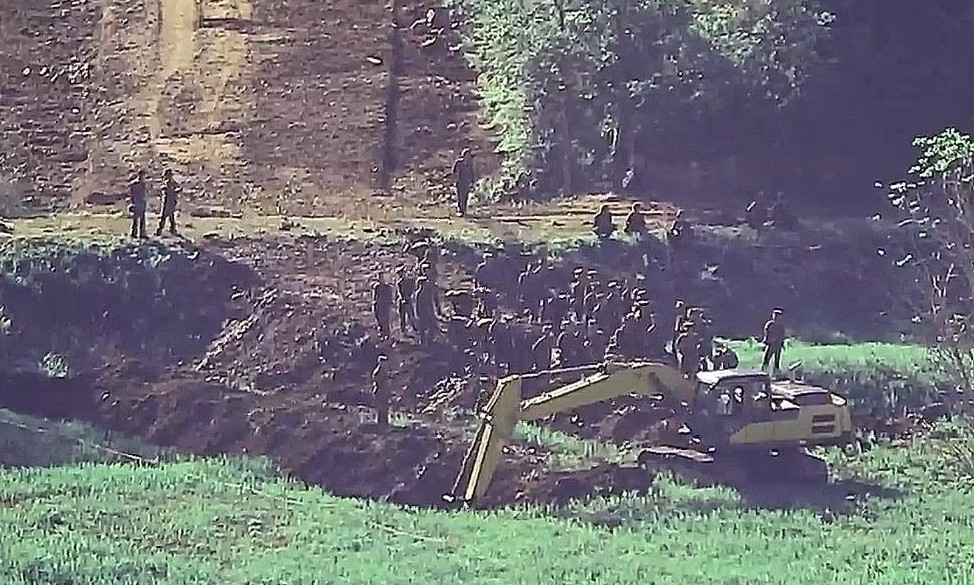 Last year, North Korean forces crossed the Military Demarcation Line (MDL) and moved south a total of 17 times. So far this year, they have not crossed the MDL even once.
North Korea has been mobilizing roughly 3,000–5,000 personnel a day and has accelerated its borderization effort, entering the final stages of no-man’s-land clearing near the MDL while expanding tactical roads and installing barriers and fencing.
Since Kim Jong Un declared the two Koreas to be “two hostile states” at the end of 2023, Pyongyang has pursued borderization around the MDL—clearing no-man’s-land at forward positions and building out tactical roads and defenses.
Multiple military sources told reporters on the 19th that there have been no MDL crossings by North Korean forces this year. Last year’s 17 crossings occurred mainly in areas where borderization was concentrated: Goseong, Hwacheon and Cheorwon in Gangwon Province, and Yeoncheon in Gyeonggi Province.
The South Korean military responded to last year’s incursions with warning broadcasts and warning shots under its rules of engagement to compel withdrawal. This year, with no MDL crossings reported, such warning fire was not required.
Military officials described the absence of incursions as unexpected. In February, Joint Chiefs Chairman Jin Yeong-seung visited the Army Ground Operations Command and warned that provocations, including MDL crossings, could increase after the spring thaw, urging higher readiness.
After Kim’s December 2023 declaration, North Korea has, since April 2024, been conducting no-man’s-land clearing, constructing tactical roads and installing barbed wire and mines in areas adjacent to the MDL.
Japanese outlets reported on the 18th that North Korea appears to be extending tactical roads near the MDL around Kaesong.
The Mainichi Shimbun, citing observers at a Gimpo, Gyeonggi Province, vantage point on the morning of the 16th, reported North Korean soldiers north of the MDL erecting posts at regular intervals along an unpaved road and conducting blasts that appear to remove rock. Jeong Seong-hak, head of the Satellite Analysis Center at the Korea Peninsula Security Strategy Institute, reviewed Mainichi’s photos and told the paper the activity looks like tactical road construction.
The first step in turning MDL areas inside the densely vegetated DMZ into a border has been clearing no-man’s-land. North Korea removes brush to open lines of sight, levels the ground, then lays tactical roads and barbed wire on the cleared terrain and emplaces mines in the surrounding area.
During 2024–2025, North Korean forces periodically crossed the MDL while conducting this work. Analysts say the DMZ’s dense vegetation and complex terrain make the MDL hard to discern by eye, and many boundary markers have been lost.
Most of the North Korean personnel who crossed the MDL were workers assigned to the projects and were often seen carrying tools such as pickaxes used for no-man’s-land clearing. Most withdrew after South Korean warning broadcasts and warning shots.
Multiple military sources say no-man’s-land clearing reached its final stages by the end of last year, though some work continues.
Analysts say that as clearing progressed and lines of sight improved, opportunities for North Korean units to approach the MDL forward line declined, contributing to fewer incursions.
North Korean forces are now concentrating on paving tactical roads and installing fencing in areas where no-man’s-land clearing is complete.
The operation has involved about 3,000–5,000 personnel per day since late last year, roughly the same tempo as in the latter half of last year.
The Joint Chiefs said, “Our military is closely monitoring North Korean activity around the MDL,” and added, “We are maintaining firm readiness while managing the military situation in a stable manner.”













Most Commented