
Future Combat Systems: How Korea’s K9 and K2 Tanks Are Leading the Charge in NATO’s Shift to Unmanned Technology
Daniel Kim Views
Translation result
NATO shifts to unmanned, counter‑drone battlefields since the Russia‑Ukraine war
Hanwha, Hyundai Rotem and LIG unveil next‑generation combat systems at trade show
“Buy European” push drives local production and technology‑transfer demands
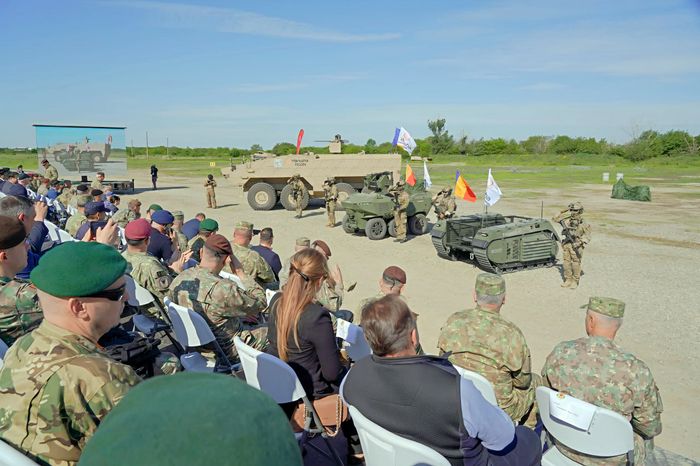
NATO members have accelerated rearmament under a growing “Buy European” policy, and South Korean defense firms are adapting fast. Beyond the export successes of K9 howitzers, K2 tanks and the K239 Chunmoo rocket system, companies are positioning unmanned platforms, manned‑unmanned teaming (MUM‑T) and counter‑drone systems as the next wave of growth.
At the BSDA 2026 defense expo in Romania, Hanwha Aerospace, Hyundai Rotem and LIG D&A rolled out a range of unmanned and networked technologies aimed at penetrating more deeply into European markets, industry officials said.
The Russia‑Ukraine conflict has reshaped European procurement priorities. Militaries now emphasize unmanned systems and layered drone defenses that reduce force exposure, along with real‑time battlefield information sharing. NATO members are increasingly sending unmanned vehicles into high‑risk areas first and controlling them from manned platforms in the rear — expanding MUM‑T concepts across the alliance.
That shift creates a new opening for K‑defense in Europe. Building on established firepower exports, Korean firms are expanding into unmanned platforms and networked combat systems to meet changing requirements.
Hanwha Aerospace has supplied K9s to Poland, Finland, Norway and Estonia and clinched a K239 Chunmoo deal with Poland in 2022. Hyundai Rotem boosted its footprint with a major K2 tank contract with Poland that same year. LIG D&A introduced Korea’s air‑defense solutions to NATO markets through Romania’s procurement of the SHINGUNG portable air‑defense guided weapon.
But Europe is also reworking its defense supply chains to prioritize in‑region production. The European Union has stepped up demands for local manufacturing and technology transfer, meaning straight exports are no longer enough. Korean firms are responding with future technologies and localization strategies.
Hanwha is targeting Romania’s next‑generation unmanned ground vehicle (UGV) programs with multipurpose UGVs such as the ArionSmet, the upgraded Grunt, and Themis‑K — a tracked UGV developed with Estonia’s Milrem Robotics.
The company has signed a cooperation agreement with Milrem and is moving toward local production. Hanwha also staged MUM‑T demonstrations for Romanian military officials, pitching operational concepts as well as hardware.
Hanwha Systems emphasized networked battlefield capabilities, showcasing AI‑based satellite imagery analysis, its Smart Battleship (SBS) solution, and an autonomous‑navigation mine‑countermeasure system.
Hyundai Rotem demonstrated reconnaissance and fire‑support concepts using its multipurpose HR‑Sherpa unmanned vehicle and multi‑legged walking robots, alongside counter‑drone defenses. The company promoted a future‑war concept that prioritizes robotic platforms over personnel in high‑risk zones.
If unmanned systems form one pillar of future combat, integrated air‑defense networks to counter drone swarms represent another. Drawing on its SHINGUNG experience, LIG D&A presented layered air‑and‑missile defense options — including Cheongung‑II, L‑SAM and Haegung — tailored for European needs.
Firms are pushing localization as a competitive edge. LIG D&A is using its German office as a European hub to strengthen partnerships and follow‑on logistics, and it is weighing a Romanian office as its activities expand. NATO customers now prize not only system performance but also reliable supply chains and maintenance, making local bases a key factor in winning contracts.
Industry executives say success in Europe will depend more on connectivity and localization than on raw firepower. As the battlefield environment normalizes live data sharing between unmanned and manned systems, the speed with which companies integrate advanced technologies into existing platforms will determine competitiveness.
A representative from a South Korean defense firm said, “With Buy‑European momentum, European buyers demand not just capable weapons but production links and technology transfers to domestic industry. Ultimately, the companies that rapidly layer new capabilities — like unmanned platforms and manned‑unmanned interoperability — on top of established export experience will gain the advantage.”
©DAILIAN Co. — Reproduction and redistribution prohibited
- Another Pyeongtaek semiconductor plant proposed at 45 trillion KRW — converting the Samsung union’s bonus demand into value① (45 trillion KRW — about $33.75 billion)
- Second application period begins tomorrow for high‑fuel‑price relief payments — who qualifies?
- In 63 years the emergency card has been used only four times — Samsung faces total strike as emergency mediation looms
- [June 3 report] Ha Jung‑woo leads; Park Min‑sik and Han Dong‑hoon face complicated calculations — unity looks unlikely
- Jung Won‑oh 40% vs. Oh Se‑hoon 37%… Jeon Jae‑su 44% vs. Park Hyeong‑jun 35% [METRIX]















Most Commented