Quick access to main page (top) Direct access to main contents Quick access to main page (bottom)

How South Korea Can Achieve Defense Semiconductor Self-Sufficiency: A Comprehensive Guide

Daniel Kim Views  

Translation result

[iNews24 Reporter Choi Ran] As modern warfare shifts toward energy- and information-centered operations, experts say South Korea must secure self-reliance in defense semiconductors.

Defense semiconductors are chips used in military equipment, modules and components for operational purposes.
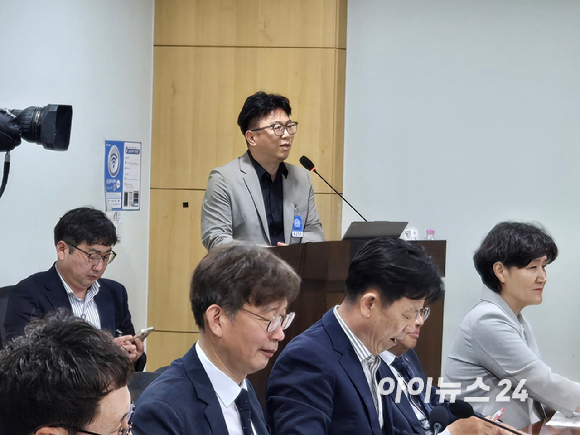
Joo Jin-woo, director of the Korea Photonics Technology Institute, speaks at the “Photonics Semiconductors: Core Technologies for the Advanced Defense Industry” seminar held at the National Assembly on the 15th. [Photo by Reporter Choi Ran]

Joo Jin-woo told the seminar on the 15th that South Korea currently depends on foreign suppliers for about 99% of its defense semiconductors, and that RF semiconductors used in radar systems are entirely imported.

Using the Russia-Ukraine war as an example, Joo said the conflict highlights a change in modern warfare: energy and information operations have become more central than manpower, and electromagnetic effects can be more decisive than traditional firepower. In short, sensors and semiconductors now shape the battlefield.

He added that compound semiconductors are essential across domains — from guided munitions and surveillance to electronic warfare and command, control and communications. These are small but indispensable components, so achieving supply-chain independence is critical.

Joo also pointed to structural barriers that keep private firms out of the defense market. He said the military’s reliability evaluations take too long, development timelines are extended, the market is small, and programs demand low-volume, high-mix production.

He argued that to attract capable companies into the defense sector, those firms first need to build sufficient capacity in civilian markets so they can survive commercially.

Joo noted an advantage of compound semiconductors: building their production lines can cost less than silicon fabs. Still, different product types require separate process equipment, and private companies struggle to shoulder those costs alone.

He proposed that capital-intensive foundries be built by the public sector, allowing firms to use those facilities to supply system integrators.
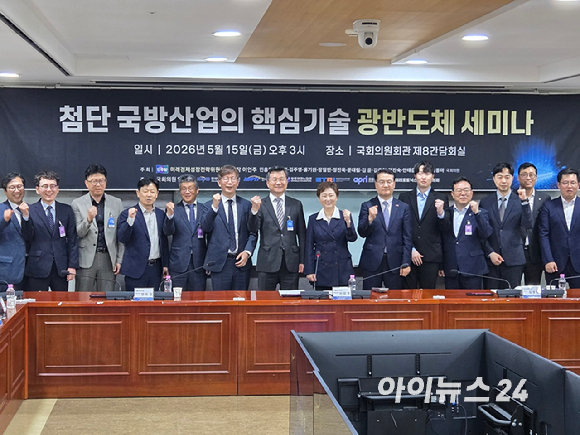
Defense industry representatives attend the “Photonics Semiconductors: Core Technologies for the Advanced Defense Industry” seminar at the National Assembly on the 15th. [Photo by Reporter Choi Ran]

Representatives from defense contractors at the discussion described operational challenges and agreed on the need for semiconductor self-reliance.

Cho Su-hyung, director of the Electro-Optics Research Lab at Hanwha Systems, said high-performance optical sensors still rely heavily on foreign suppliers. If those supplies are cut off in a crisis, domestic mass production would be impossible.

He pointed to quantum cascade laser (QCL) semiconductors — compound devices used in laser weapons — noting they cost tens of millions of KRW (approximately tens of thousands of USD) apiece and are all imported.

Cho said he always tells defense companies to prioritize domestically produced items when they exist. But he warned that high development costs deter firms from taking on those projects and called for initial development funding to reduce that barrier.

Jung Seong-mook, director of the Optical Information Convergence Research Lab at LIG Defense & Aerospace, echoed field frustrations.

Jung said attempts to localize during the system acquisition phase can stretch projects over many years — in some cases nearly a decade — and by the time a product is ready, higher-spec foreign alternatives are already on the market, widening the technology gap.

He added that there’s insufficient information on domestic firms’ technical capabilities and how their work can be integrated into ongoing research. He called for better information sharing and the creation of industry clusters.

Jung also urged that localization budgets be allocated from the initial research stage rather than after a system program begins, so technology development aligns with actual program needs. He asked the Defense Acquisition Program Administration to reform relevant policies.

Daniel Kim
content@tenbizt.com

Comments0

300

Comments0

[Military] Latest Stories

  • 30 of 33 Iran Missile Bases Still Active: Intelligence Defies Trump Claims
    30 of 33 Iran Missile Bases Still Active: Intelligence Defies Trump Claims
  • US Javelin Missiles Deployed in Taiwan’s High-Stakes Live-Fire Drill
    US Javelin Missiles Deployed in Taiwan's High-Stakes Live-Fire Drill
  • North Korea’s 10-Year Nuclear Threat: Is a Limited Strike Imminent?
    North Korea's 10-Year Nuclear Threat: Is a Limited Strike Imminent?
  • AI vs. Video Compression: How RMX is Redefining Tactical Edge Tech
    AI vs. Video Compression: How RMX is Redefining Tactical Edge Tech
  • US-South Korea Security Meeting Sparks Tension Over Military Control
    US-South Korea Security Meeting Sparks Tension Over Military Control
  • Iran Claims Missile Strikes on U.S. Military Bases: Did They Hit?
    Iran Claims Missile Strikes on U.S. Military Bases: Did They Hit?

Weekly Best Articles

  • Choi Dong-seok’s Family Bond: How a Simple Engraving Reveals Deep Love for His Children
  • Kwak Sun-hee’s Stunning Wedding Photos: A Celebration of Love and Courage
  • Is ‘I Am a Natural Person’ Just a Big Lie? Comedian Yoon-taek Reveals Shocking Secrets!
  • Health Scare: Why Fans Are Worried About Go Ji Yong’s Dramatic Weight Loss
  • Discover the Winter Gongju Chestnut Festival: A Taste of Korea at H-Mart in the USA!
  • 2026 Spring Wildfire Prevention: How Gyeryong City is Cutting Response Time to 30 Minutes!

You May Also Like

  • 1
    Trump Slashes AI Review Window to 30 Days Amid National Security Debate

    Politics 

    Trump Slashes AI Review Window to 30 Days Amid National Security Debate
  • 2
    Ukraine’s EU Bid Surges as Hungary Drops Opposition Amid Russian Attacks

    Politics 

    Ukraine’s EU Bid Surges as Hungary Drops Opposition Amid Russian Attacks
  • 3
    Trump Backs Colombia's 'El Tigre' — What It Means for U.S. Relations

    Politics 

    Trump Backs Colombia’s ‘El Tigre’ — What It Means for U.S. Relations
  • 4
    Trump Backs Colombia's Far-Right Outsider—What's at Stake?

    Politics 

    Trump Backs Colombia’s Far-Right Outsider—What’s at Stake?
  • 5
    12.5% Tariff Hit: South Korea Faces New U.S. Trade Penalties

    Politics 

    12.5% Tariff Hit: South Korea Faces New U.S. Trade Penalties

Popular Now

  • 1
    12.5% Tariff Alert: Why the U.S. Is Targeting South Korean Imports

    Politics 

  • 2
    Marta Kostyuk Makes History at French Open Amid Ukraine Crisis

    Politics 

  • 3
    37 Years in Exile: The Tiananmen Leader Who Just Wants to Go Home

    Politics 

  • 4
    South Korea's Cheongju Airport Faces Crisis as Passenger Numbers Explode

    Politics 

  • 5
    Nuclear Submarine Race: South Korea's High-Stakes Bid for U.S. Fuel

    Politics 

Weekly Best Articles

  • Choi Dong-seok’s Family Bond: How a Simple Engraving Reveals Deep Love for His Children
  • Kwak Sun-hee’s Stunning Wedding Photos: A Celebration of Love and Courage
  • Is ‘I Am a Natural Person’ Just a Big Lie? Comedian Yoon-taek Reveals Shocking Secrets!
  • Health Scare: Why Fans Are Worried About Go Ji Yong’s Dramatic Weight Loss
  • Discover the Winter Gongju Chestnut Festival: A Taste of Korea at H-Mart in the USA!
  • 2026 Spring Wildfire Prevention: How Gyeryong City is Cutting Response Time to 30 Minutes!

Must-Reads

  • 1
    Trump Slashes AI Review Window to 30 Days Amid National Security Debate

    Politics 

    Trump Slashes AI Review Window to 30 Days Amid National Security Debate
  • 2
    Ukraine’s EU Bid Surges as Hungary Drops Opposition Amid Russian Attacks

    Politics 

    Ukraine’s EU Bid Surges as Hungary Drops Opposition Amid Russian Attacks
  • 3
    Trump Backs Colombia's 'El Tigre' — What It Means for U.S. Relations

    Politics 

    Trump Backs Colombia’s ‘El Tigre’ — What It Means for U.S. Relations
  • 4
    Trump Backs Colombia's Far-Right Outsider—What's at Stake?

    Politics 

    Trump Backs Colombia’s Far-Right Outsider—What’s at Stake?
  • 5
    12.5% Tariff Hit: South Korea Faces New U.S. Trade Penalties

    Politics 

    12.5% Tariff Hit: South Korea Faces New U.S. Trade Penalties

Popular Now

  • 1
    12.5% Tariff Alert: Why the U.S. Is Targeting South Korean Imports

    Politics 

  • 2
    Marta Kostyuk Makes History at French Open Amid Ukraine Crisis

    Politics 

  • 3
    37 Years in Exile: The Tiananmen Leader Who Just Wants to Go Home

    Politics 

  • 4
    South Korea's Cheongju Airport Faces Crisis as Passenger Numbers Explode

    Politics 

  • 5
    Nuclear Submarine Race: South Korea's High-Stakes Bid for U.S. Fuel

    Politics 

Share it on...