
AI in Warfare: How Iran Conflict Highlights the Need for Ethical Military Innovations
Daniel Kim Views
Translation result.
Seeking innovation as future-warfare paradigms shift…discussing institutional support for bioethics
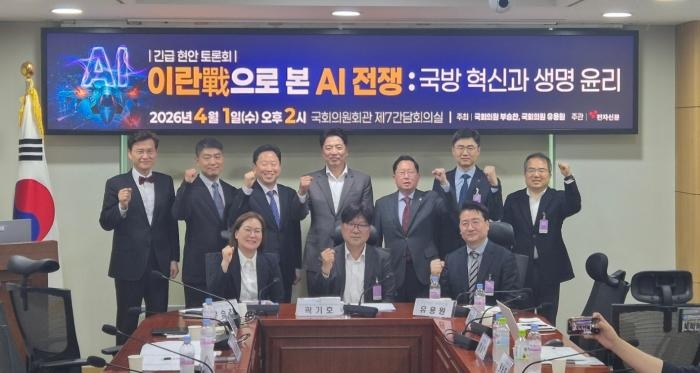
A forum convened to analyze recent Middle East conflicts, evaluate the battlefield effectiveness of defense artificial intelligence (AI), and review the direction of the military’s innovation efforts.
On April 1, at Meeting Room No. 7 of the National Assembly Members’ Office Building in Yeouido, Seoul, participants at the emergency forum titled AI Warfare Seen Through the Iran War: Defense Innovation and Bioethics reflected on ethical issues arising from the military use of AI and explored legal and institutional strategies to address them.
Co-hosted by Reps. Bu Seung-chan and Yoo Yong-won, the forum featured a keynote by Kim Deuk-hwa, CEO of Funjin, followed by a panel that included Jeon Jun-beom, director of the Defense AI Planning Bureau at the Ministry of National Defense; Moon O-seon, researcher for the Air Power Development Committee; Ha Yoon-cheol, executive director at Hanwha Systems; Yang Seung-hyun, vice president at Conan Technology; Hwang Seung-hee, senior vice president at Cisco Korea; and Kim Myung-ju, director of the AI Safety Institute.
Kim outlined the current status and vision for the “AI Staff”—an AI software weapons system intended to help commanders make decisions within one minute—in a presentation titled “K-AI Staff and Defense Innovation.” The panel, chaired by Kwak Ki-ho, director of the Defense AI Technology Research Institute at the Agency for Defense Development (ADD), debated the future of defense AI from multiple perspectives.
Rep. Bu said the Iran conflict has highlighted AI’s operational value and urged the military to rethink its innovation strategy to align with shifting future-warfare paradigms.
He emphasized that because military use of AI directly involves human dignity and life, ethical reflection must come first. That should be followed by the establishment of legal and institutional safeguards to ensure “responsible AI use.”
Rep. Yoo noted that the U.S. was able to strike more than 1,000 targets within 24 hours of the Iran conflict’s outbreak in part because of an AI-based battlefield analysis and decision-support system known as the Maven Smart System.
He added that, as AI has emerged as a decisive factor in modern warfare, the military must accelerate innovations to secure technological superiority while simultaneously pursuing ethical and institutional frameworks for military AI.










Most Commented