
Translation result
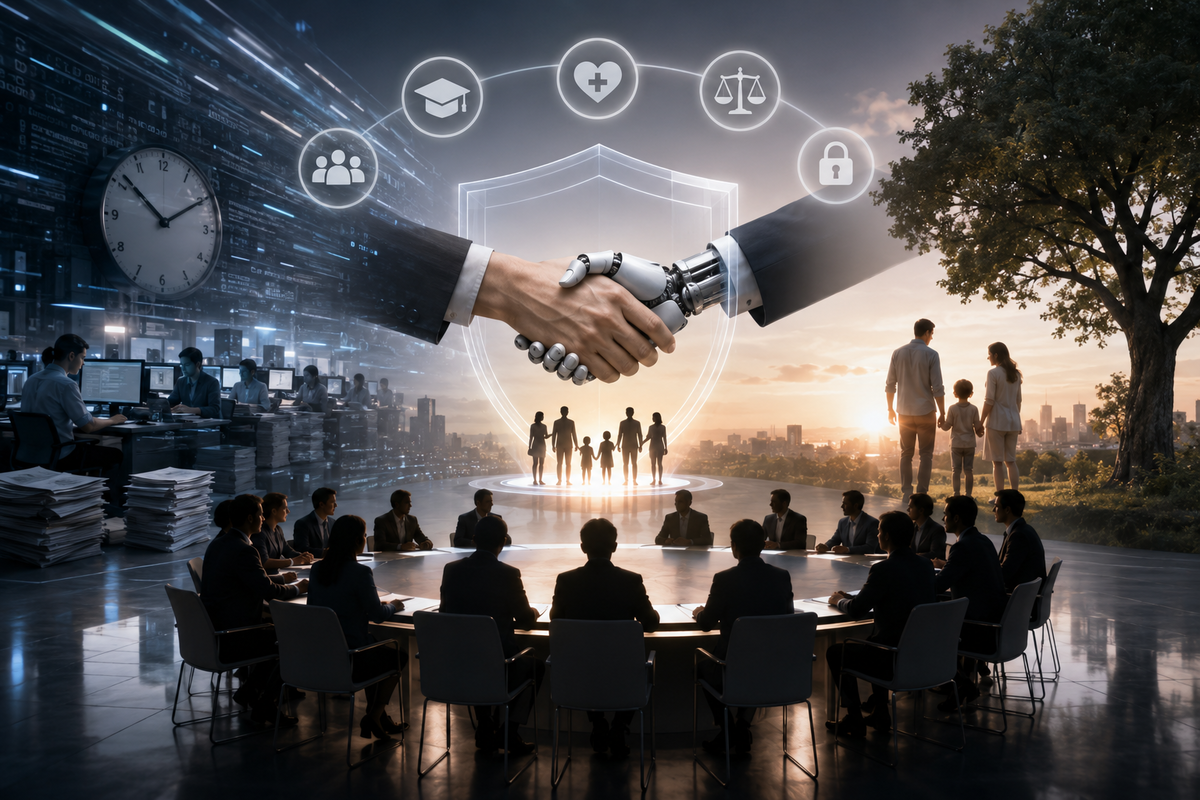 The world is talking about artificial intelligence (AI). Governments discuss national competitiveness. Companies emphasize productivity. Schools focus on AI education. Lawmakers have only recently begun to discuss regulation alongside promotion. Yet one crucial question remains insufficiently examined.
“Will AI make people freer, or will it make them more exhausted?”
On the 25th, Pope Leo XIV raised the question of human dignity in the AI era. Just as labor became a central social issue during the Industrial Revolution, so too are human time, judgment, work, and dignity emerging as core societal concerns in the AI age. AI is not merely a tool; it has the capacity to reshape society’s operating system. Whether it becomes an instrument that augments human agency or a mechanism that subordinates people to ever-faster systems is still undecided.
In The Burnout Society, Byung-Chul Han describes modern people not as subjects who obediently follow orders but as agents driven to produce results on their own. He calls this an achievement society because the veneer of freedom can lead to self-exploitation. AI risks becoming the most powerful amplifier of that dynamic. Where once “I don’t have enough time” offered at least a minimal defense, that defense may collapse. “You had AI—why isn’t it done yet?” could become the new workplace mandate.
Saying AI reduces work is only half true. In real organizations, AI-generated drafts often trigger more revision requests. Faster reporting is demanded. Performance measurement becomes more granular. The volume of tasks a single person must handle does not necessarily shrink; expectations rise. In that scenario, AI is not a technology that gives people rest—it automates the burnout society.
For that reason, AI debates cannot be limited to industrial policy. Semiconductors, data centers, and talent development matter, but they are not sufficient. AI transforms hiring and evaluation; it alters education and healthcare; it reshapes finance and welfare; it affects administration and public opinion formation. AI policy is simultaneously industrial, labor, education, and welfare policy — indeed, it is policy for the social system as a whole.
Read Prime Minister Kim Min-seok’s recent calls for “AI for all” and “human-centered, inclusive AI” in this context. He urged that we not view AI solely as a growth engine but as a social transition that transforms people’s lives. Responsible AI use, reliable norms and standards, and control mechanisms that protect human safety must be part of the discussion.
What we need now is broad social dialogue. But that conversation cannot be left only to existing bodies like the Economic, Social and Labor Council. AI-driven change does not stop at labor—it touches consumer protection, personal data, copyright, fair competition, medical judgment, financial screening, content trust, and national security. The range of participants must widen: we should expand engagement beyond the usual organizations so that the voices of those who will actually be affected are heard.
The starting point matters. Companies are where AI is implemented, applied to employees, and experienced by consumers. The AI people encounter appears in corporate hiring systems, customer service centers, financial screenings, performance evaluations, content recommendations, and health and welfare services. Therefore, discussion about an AI social contract should begin in the workplace.
This movement has already begun abroad. The Business Software Alliance (BSA), which includes Microsoft, Oracle, IBM, and SAP, published Policy Solutions for Building Responsible AI in 2024. It urged policymakers to adopt a risk-based approach, strengthen corporate governance, require high-risk AI impact assessments and testing, and protect creators’ rights. Notably, this was an industry proposal, not a government report: companies were not trying to evade regulation but to propose AI rules society could accept.
Japan’s Keidanren offers another instructive example. In 2019 it proposed AI Utilization Strategy: Toward Realizing an AI-Ready Society. In 2023 it expanded the discussion with Realizing Society 5.0 for SDGs through AI and AI Utilization Strategy II. The core message is clear: preparation cannot rest with companies alone. Businesses, individuals, and social institutions must prepare together. Keidanren linked AI to Japan’s Society 5.0—a human-centered, ultra-smart society—framing it as a question of social design, not merely technology adoption.
These cases offer a clear lesson. Industry groups can set the agenda for social dialogue; we do not need to wait for the government to issue definitive answers. Industry can propose principles, experts can vet them, and politics and civil society can debate them. Government should then steer social consensus and institutionalize it. In fast-moving areas like AI, this approach is more practical: regulation inevitably lags technology, so social debate should begin where the technology is used.
AI competition is unavoidable. But speed alone should not be the measure of success. The country that survives will not necessarily be the one that adopts technology fastest but the one that prevents technology from devouring people’s time—a country capable of social design. The same applies to corporate strategy. How quickly a company adopts technology matters, but who first proposes an AI operating order that society can accept matters more. That is what makes firms sustainable.
AI can replace humans. More importantly, AI can also exhaust them. When the burnout society meets AI, fatigue becomes more refined and more silent. What we need now is not politics that blocks AI but social dialogue that places AI within a human-centered order. That conversation should not be confined to government committees; it should start with companies—the actors who best understand the technology, actually use it, and see its effects first. Now is the time for companies to propose the social contract for the AI era.














Most Commented