
Translation result
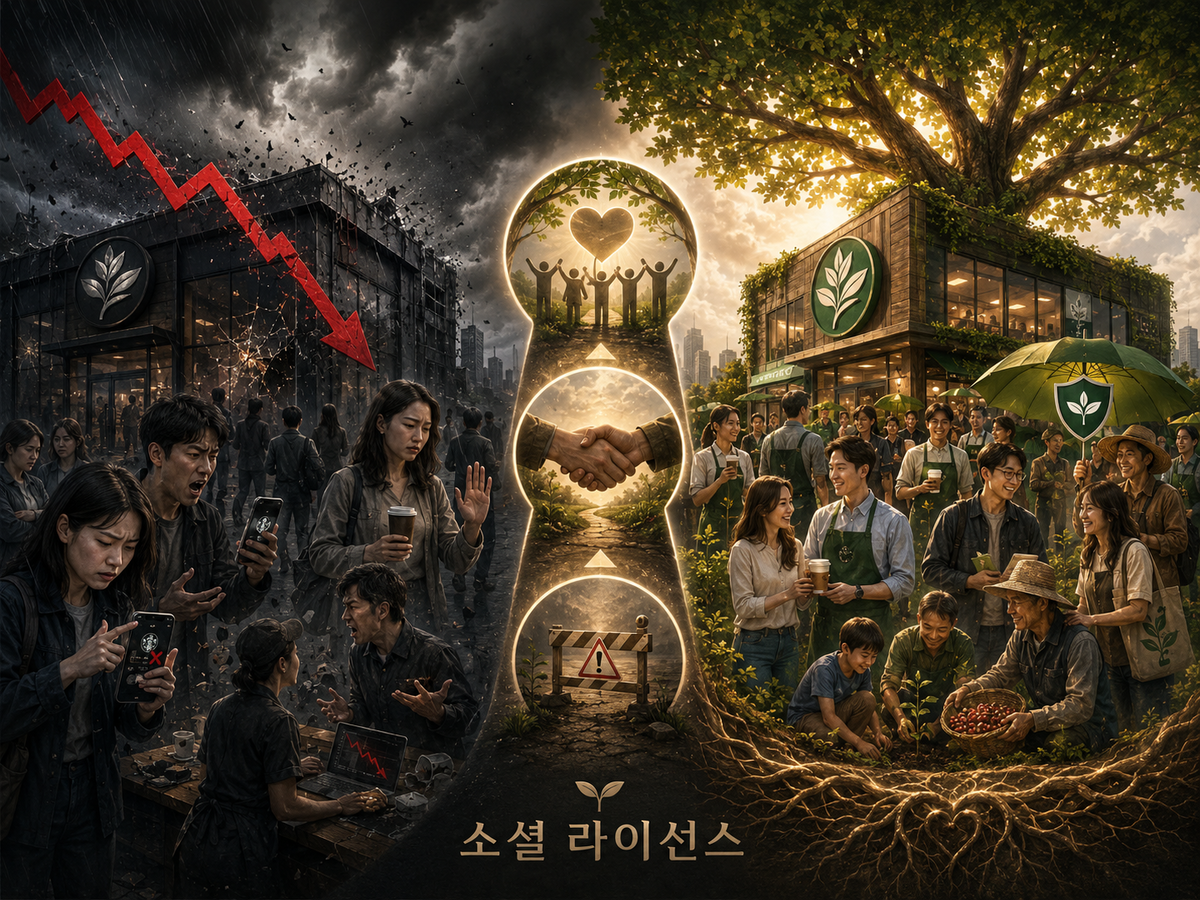 Why do companies fail? Not because their products are bad. Not because they run out of money. They fail because society withdraws its permission. Even if courts find a company acted lawfully and regulators sign off, the business can grind to a halt when people turn away. Beyond government permits, society grants its own authorization — what we call a social license.
A social license isn’t documented on paper. It’s visible in relationships. Last May, Starbucks Korea learned that lesson the hard way. The chain led domestic coffee-brand rankings, boasted millions of loyal customers, and even earned a commendation from the chair of the Korea Fair Trade Commission for its consumer-centered management. Internal failures shook all of that. Weekly payment volumes dropped by more than 25%. Market capitalization fell by 400 billion KRW (300 million USD). Loyal customers deleted the app, demanded refunds for prepaid balances, and canceled memberships. The company apologized and its CEO was dismissed, but it has not yet regained the trust of key stakeholders.
Social license operates like this: it takes years to build and only a day to lose. Trust can flip to anger almost overnight. The deeper the attachment, the deeper the wound. Starbucks Korea’s customers reacted so strongly because they cared deeply about the brand. The thicker the social license, the greater the shock when it’s damaged. It’s the paradox of trust. This is not mere dissatisfaction — it is betrayal. Betrayal endures far longer than indifference. Stakeholders who feel betrayed cease being passive consumers and become active critics. Those who stayed silent raise their voices; observers move to action. The collapse of social license triggers a cascade.
Once a company loses social license, the crisis moves into a new phase. It doesn’t end with a simple apology. Regardless of legal outcomes, public opinion continues to retry the case. Even if regulators clear the company, consumers may close their wallets. A crisis for a company without social license cannot be neatly sealed; efforts to act as if everything is resolved often reignite the issue.
Social license can be understood in three stages: society grudgingly tolerates the company; society conditionally accepts it; and society treats the company’s success as its own. Most firms linger in the second stage and mistake it for safety. That stage is inherently unstable. One small incident or a single news item can plunge a company back to the first stage. The difference between the second and third stages is decisive. Companies stuck in stage two fight crises alone; those in stage three have stakeholders who will fight alongside them. That distinction determines whether a company survives a crisis.
Companies in the third stage face crises of a different magnitude. Stakeholders step forward first to defend the company. Their initial reaction is often, “This was probably not intentional — let’s wait and see.” Public opinion defaults to trust rather than suspicion. That single predisposition can shape the scale of the crisis.
Building social license isn’t complicated. It requires action, not rhetoric. It must happen in calm times, not only during emergencies. Treat stakeholders as dialogue partners, not as management targets. And above all, invest over the long term. Trying to build trust after a crisis is too late — it’s like building a fire station after the blaze. Leaders should ask themselves: what stage is our social license in today? When a crisis hits, will stakeholders stand with us?
Crisis preparedness doesn’t start when the crisis erupts; it starts on peaceful days. Social license is the cumulative result of those everyday moments. A tree doesn’t grow overnight, but once its roots are established, a storm won’t easily uproot it. When society withdraws its permission, official permits become scraps of paper. Companies that earn society’s trust stand firm even in the storm. Social license is the difference.










Most Commented