
Translation result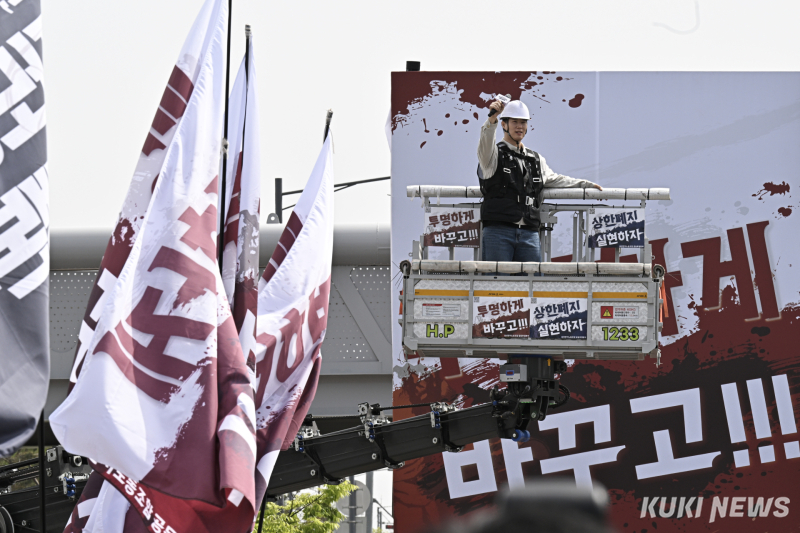
Samsung Electronics’ Donghaeng union formally withdrew from the Joint Struggle Headquarters, bringing internal union tensions into the open. Resistance from members in the non‑semiconductor (DX) division to bonus demands and a strike posture centered on the semiconductor (DS) business has increased, threatening to fracture momentum for the full strike scheduled for the 21st.
On the 6th, Lee Song‑yi, vice chair of the cross‑company union, told Kukinews that “the Joint Struggle Headquarters’ core demands—greater transparency in performance bonuses and institutionalizing the removal of the cap—aren’t proposals only for the semiconductor division,” rebutting Donghaeng Union’s critique. He added that only about 60 of roughly 2,300 Donghaeng members voted in the strike referendum, and fewer than half of those voters supported the strike, arguing the union demonstrated little will to strike.
Last November, the cross‑company union, the National Samsung Electronics Labor Union and the Donghaeng Union formed a joint bargaining team to coordinate wage and performance‑bonus negotiations. They later converted that team into the Joint Struggle Headquarters and escalated pressure on management by demanding transparency and permanent rules for performance bonuses, dedicating 15% of operating profit as bonus funds, and removing the cap that limited bonuses to 50% of annual salary.
The split deepened on the 4th when Donghaeng Union announced it was ending participation in the joint bargaining team. In a letter titled “On the End of the 2026 Joint Bargaining Team for Wage Talks,” the union said it had found serious violations of Articles 1 (Purpose) and 6 (Mutual Trust) of the memorandum of understanding and therefore immediately terminated its participation.
Donghaeng Union said its proposals and requests—aimed at protecting the rights of all members rather than those of a single division—had gone unanswered and that other parties showed no willingness even to consult, leaving the union’s views unreflected. It also accused counterparts of ongoing attacks and derogatory behavior, including repeatedly labeling it a company‑friendly union, which it called a malicious and excessive charge. The union said these repeated actions damaged mutual trust and made pursuing the collaborative bargaining relationship envisioned by the memorandum impossible.
The cross‑company union says it has continuously sought dialogue with Donghaeng Union.
Because a large share of Donghaeng members work in the Device Experience (DX) division, some observers interpret the split as non‑semiconductor workers’ backlash against a semiconductor‑centered strategy. Inside the cross‑company union and on internal company forums, DX members have posted “withdrawal confirmation” notices.
In addition to the DS‑centered bonus demands, the decision to raise monthly dues during disputes from 10,000 KRW (≈ $7.50) to 50,000 KRW (≈ $37.50) appears to have amplified the backlash.
The cross‑company union argues that sustaining a prolonged strike requires a baseline membership and financial resources. But because the union operates autonomously, it finds it difficult to prevent members from leaving and considers it impractical at this stage to revise bargaining items already decided.
The split is visible in the numbers: cross‑company union membership fell from 76,270 on the 29th of last month to 74,215 as of 8 a.m. today, a decline of 2,055 members (2.7%). With DX‑centered withdrawals continuing ahead of the general strike, analysts say the joint front Samsung’s unions built is likely to suffer significant damage.












Most Commented