
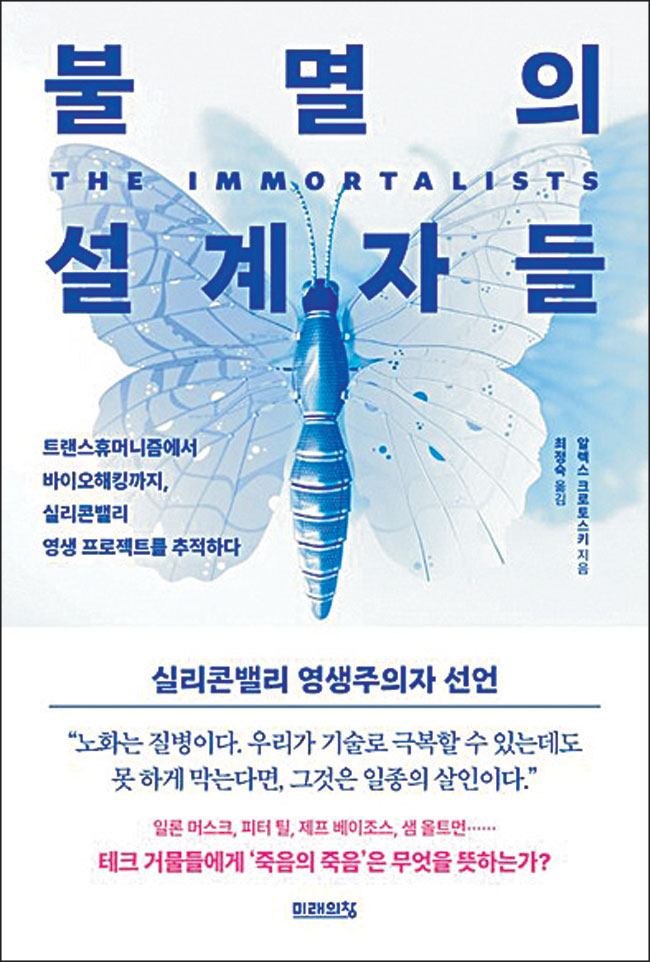
Alex Krotoski │ Translated by Choi Jeong-sook │ Mirae’s Chang
Like Qin Shi Huang, who spent his life chasing the elixir of immortality,
tens of billions of dollars of investment by billionaires such as Elon Musk and Mark Zuckerberg are going into life extension.
Brian Johnson received a plasma transfusion from his son in a bid to slow aging,
doctors concluded it produced no rejuvenating effect.
Radical life extension will be restricted to the powerful;
the answer lies not in technology but in people.

 China’s first emperor, Qin Shi Huang, never found the elixir of life. In the 21st century, however, Silicon Valley titans who believe in eternal life and immortality are trying to make his dream real.
Amazon founder Jeff Bezos has poured tens of billions of dollars into Altos Labs, a company researching cellular reprogramming to return cells to a more youthful state. Larry Page, former CEO of Alphabet and Google, launched Calico, a biotech subsidiary aimed at solving aging, and has even claimed that, in the grand scheme, curing cancer would not represent an extraordinary advance. Sam Altman invested $180 million in life-extension startup Retro Biosciences and backed its proprietary machine-learning model.
Nick Bostrom, Ray Kurzweil, Eliezer Yudkowsky, Peter Thiel, Mark Zuckerberg, Elon Musk, Vitalik Buterin — these tech figures believe that technological progress can halt or slow human aging and eventually enable lives approaching immortality. For them, artificial intelligence is the accelerator. They are not pursuing “well‑aging” or gradual healthy aging; they treat aging as a disease to be cured and then prevented, extending lifespan and ultimately pursuing immortality. The exchange between Vladimir Putin and Xi Jinping — Putin suggesting that continued organ transplants could let people live longer, stay younger, and even reach immortality, and Xi replying that some forecasts predict living to 150 — starkly illustrates how obsessed some of the world’s most powerful people are with life extension.
Broadcaster and author Alex Krotoski calls these tech-driven advocates \”The Immortalists,\” the book’s original title. The book escorts readers to the front lines of life-extension research and investment, showing how these players pour astronomical sums into a race to become the winners in the immortality business.
 A prominent example is radical life-extension advocate and biohacker Brian Johnson. He funded a program called Project Blueprint with $5,000,000, follows a daily regimen of 35 exercises, takes 61 supplements, and undergoes periodic MRIs under the supervision of a 30-member expert team. Although fresh markets and acclaimed restaurants are within walking distance, he adheres to a strictly controlled diet. Every biological metric is converted into data, and he lives according to the algorithm the data produces. In 2023, at age 45, he received a plasma transfusion from his 17-year-old son and donated his own plasma to his father — a procedure inspired by animal studies suggesting that young blood can rejuvenate older bodies. The widely reported procedure was ultimately judged ineffective. Still, Johnson’s Blueprint algorithm calculated that while 365 calendar days passed, his biological aging proceeded at the pace of 277 days.
Behind these disruptive experiments and technological advances lie shadows. Life‑extension technologies will not be distributed evenly. Yu Hua’s Chronicle of a Blood Merchant depicts Xu Sanguan selling his blood to survive China’s extreme poverty in the 1960s — and there are Xu Sanguans in 21st‑century America, too. The United States supplies roughly 70 percent of the world’s plasma, much of it sourced from people in poor U.S. communities who sell blood to make ends meet. That is only one inequity: health insurance coverage, living conditions, and access to medical care — all factors that shape life expectancy — are not equally available across populations.
The author warns that these Immortalists already exert influence over state systems. Experiments once confined to the margins have reached the corridors of power in Washington. He cautions that while Immortalists might continue living as kingmakers, global power brokers, or even as bits of computer code carrying their essence across the cosmos, such radical life extension will remain confined to a small, well‑funded network. Having lost both parents, the author became obsessed with death and pursued similar lines of inquiry as the Immortalists, but he arrived at a different conclusion: seek answers in people rather than in technology, and choose to live for the present rather than for eternity. 368 pages, 22,000 KRW (about $16.50 USD).















Most Commented