
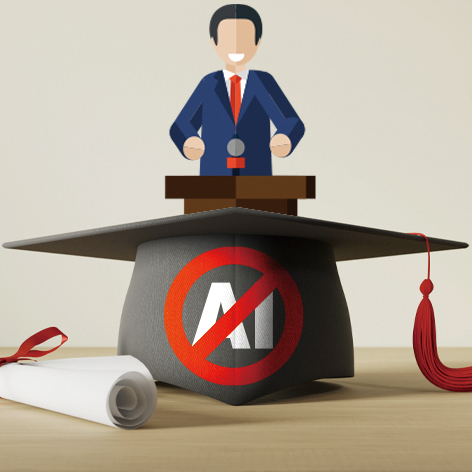
 On June 7, 2007, Harvard invited Bill Gates, the founder of Microsoft, to deliver its commencement address—32 years after he left the university. He emphasized the role information technology can play in addressing social problems, arguing, “We can use the power of the internet to access information and break down the world’s barriers.” His remarks received widespread praise.
In the United States, graduation season in May and June puts invited speakers and their remarks in the spotlight. Since 1642, when the governor of Massachusetts addressed nine Harvard graduates, politicians, jurists, writers, business leaders and entertainers have used commencement stages to send messages to new graduates and to the wider public. In 1947, Secretary of State George Marshall used his Harvard commencement address to unveil the Marshall Plan, the post–World War II program to rebuild Western Europe. And Steve Jobs’s 2005 Stanford speech—urging graduates to “Stay hungry. Stay foolish.”—remains a modern classic.
This year, invited speakers were met with jeers on multiple campuses. Former Google CEO Eric Schmidt was heckled at the University of Arizona after likening advances in artificial intelligence to earlier developments in computing. At the University of Central Florida, students booed a speaker who called AI’s rise “the next industrial revolution.” The Wall Street Journal reports that this year’s graduates enrolled just before generative AI tools like ChatGPT emerged, making them the first “AI generation” and among the first likely to face job displacement from automation. Confronted with a tough job market and uncertainty about the future, many graduates have turned the word “AI” into a taboo.
The employment challenges facing young people amid the AI transition are global. Last month, South Korea’s population of 25- to 29-year-olds classified as “inactive” increased by 31,000 compared with a year earlier. If boos reflect an unavoidable reality, policymakers must respond proactively. We can no longer postpone education reform and measures to increase labor-market flexibility that will cultivate the talent and expand employment needed for the AI era.














Most Commented