
Translation result
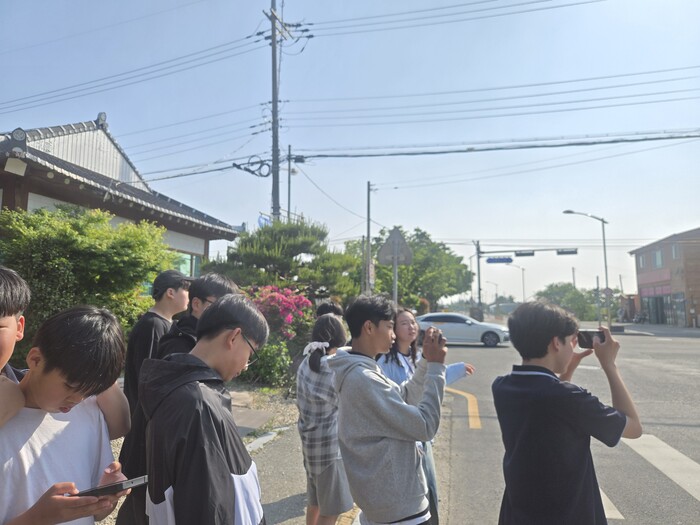
Youth at the Wanju County Youth Culture Center are attracting attention for a forward-looking project that goes beyond traditional hands-on lessons. Participants identify local safety gaps and design solutions using physical AI. Whereas conventional youth volunteer work often focuses on cleanups or awareness campaigns, this initiative functions as a practical AI civic-education model that pairs digital technology with community problem-solving.
On the 27th, the Wanju County Youth Culture Center’s After-School Academy said it has launched a self-directed volunteer group called the “Physical AI-Based Smart Safety Guardians Volunteer Corps” and begun full-scale efforts to address local safety blind spots.
The program asks students to survey everyday places they routinely use—school routes, parks and alleyways—and then apply physical AI tools to design concrete safety measures. The curriculum runs across six sessions through June.
During a field survey on the 26th, participants identified pedestrian accident hotspots, poorly lit stretches at night, illegally dumped materials and CCTV blind spots, and analyzed these everyday safety risks. They then combined physical-AI object-recognition techniques with basic data-analysis concepts to propose locally tailored smart-safety systems.
Key proposals from the students include a smart warning system that detects vehicle and pedestrian movements and issues danger alerts; AI-driven smart lighting that automatically activates when it senses motion in dark alleys; and a safety-monitoring platform that immediately notifies managers when hazardous situations are detected.
Observers say the program stands apart from simple coding classes or theoretical lessons because it centers on the students’ process of uncovering local problems and designing tech-based solutions. By using AI as a tool to address community issues—rather than just as a subject to be learned—the initiative also serves as a local model for future-focused education.
“I realized how many hazards exist even on routes I normally pass without thinking,” one participating youth said. “Working through solutions with physical AI made me feel proud to be contributing to a safer community.”
Director Choi Jeong-seon said, “The Smart Safety Guardians volunteer corps is a future-oriented growth program that enables young people to identify community problems and use AI to develop solutions. We will continue expanding tailored programs so youth can strengthen practical skills grounded in digital technology and creative thinking.”
The After-School Academy, run jointly by the Ministry of Gender Equality and Family and Wanju County, is a national support program providing after-school care, experiential activities and life-support services for first- and second-year middle school students. Recently, the program has increased emphasis on community problem-solving projects and digital-based experiences, expanding its role as a future-oriented platform for youth development.














Most Commented