
Samsung Electronics and unions reach tentative agreement on performance bonuses
Multiple unions deepen internal splits over bargaining rights
Union-on-union conflict threatens to sap bargaining momentum
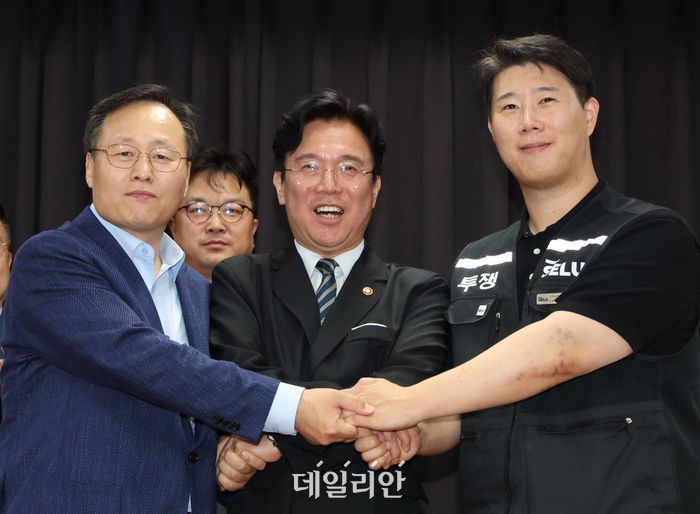
Samsung Electronics and management reached a tentative settlement after six months of negotiations over performance bonuses, but the episode exposed structural problems that have deepened since the company allowed multiple unions. The emergence of several unions at the same workplace has fueled internal divisions as they compete for bargaining rights.
Union-on-union conflict weakened the unions’ bargaining leverage in this round of talks.
When the cross-company union centered on Samsung’s semiconductor (DS) division demanded institutionalizing performance bonuses at 15% of operating profit, members in the home appliances and mobile (DX) divisions pushed back. With the DS unit accounting for more than 90% of the company’s operating profit in the first quarter, allocating bonuses based on operating profit would inevitably favor DS. The DX-centered Donghaeng union withdrew from the joint action committee, and DX member resignations followed.
Lee Byung-hoon, a sociology professor at Chung-Ang University, said the Samsung union showed inexperience in uniting differing interests across divisions. He added that aligning diverse constituencies and interests depends on union leadership.
Union-on-union conflict stemming from multiple unions within a workplace is not unique to Samsung Electronics.
At LG Electronics in 2021, office workers unhappy with divisional disparities in performance bonuses formed a separate \”People-Centered Labor Union\” and pursued separate bargaining from the production-worker–centered union. At the time, the TV division received bonuses equal to 200% of base pay, the smartphone division received only consolation payments with no performance bonus, while other divisions received 600–750%, which fueled resentment.
That same year at Hyundai Motor, office and research staff in their 20s and 30s formed an independent union, saying they had been marginalized by production-worker–focused collective bargaining. They complained the production-focused union prioritized issues for older production workers—such as extending the retirement age and lengthening senior contract terms.
Competition among large-company unions over performance bonuses is also spreading. With SK Hynix seeking bonuses equal to 10% of operating profit, Samsung 15%, and Hyundai pushing for 30% of net profit, clashes of interest recur depending on which division a worker belongs to.
The original aim of permitting multiple unions was to guarantee workers’ right to organize and raise unionization rates. But critics say intensified competition over bargaining rights and majority status within the same workplace has deepened divisions within the labor movement.
The current single bargaining-channel system is also identified as a source of conflict. In a structure where a majority union monopolizes bargaining rights, minority unions or sidelined division members find it difficult to bring their demands to the negotiating table.
In the Samsung talks, DX division members filed an injunction to halt collective bargaining, arguing that union leadership was negotiating unilaterally without the consent of the full membership—an expression of that structural frustration.
Professor Lee explained that minority unions are effectively excluded from bargaining in practice, and calls for legal and institutional reform persist.
He added that fully guaranteeing autonomous bargaining would impose a year-round negotiation burden on employers, prompting them to push for mandatory single bargaining channels to avoid that burden. The challenge, he said, is finding a balance between ensuring minority-union participation and preventing employer bargaining fatigue.
©Dailian Co., Ltd. Unauthorized reproduction and redistribution prohibited
- Jeong Jeom-sik: Samsung’s bonus dispute ‘just beginning’… Lee administration should re-amend the Yellow Envelope Act
- Memory 600 million KRW (450,000 USD)? Loss-making division 160 million KRW (120,000 USD)? Examining Samsung’s performance bonus calculations
- Samsung avoided a company-wide strike, but 5 million shareholders remain sidelined amid labor-management strife
- [June 3 pick] Han Dong-hoon: In Park Min-sik’s ‘traitor’ attack, are you responding? Perhaps you should have stayed quiet
- In Ulsan’s multi-candidate race, Kim Sang-wook 37.3%, Kim Du-gyeom 35.9%…a narrow margin within the poll’s margin of error [Realmeter]













Most Commented