
Why Are Korean Teens Less Engaged with Traditional Culture? Insights from a Cross-Cultural Study
Daniel Kim Views
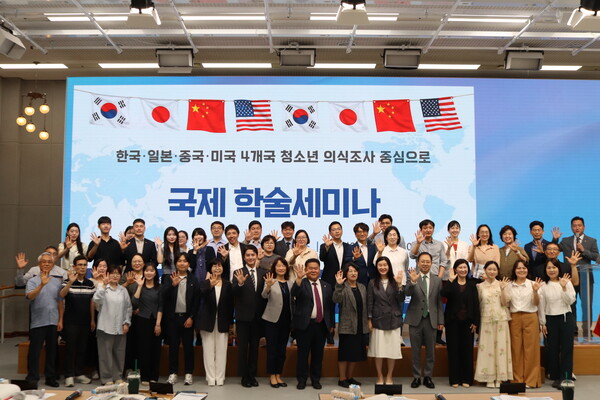
[The Public=Oh Doo-hwan] A survey found that South Korean adolescents are active users of cultural facilities and generative AI, yet they show less interest in—and place lower value on—traditional culture than teenagers in other major countries.
Researchers noted that while South Korean youth score highly on cultural consumption and digital proficiency, education has not effectively linked those behaviors to cultural identity or to a deeper understanding of other cultures.
On May 18, the Seoul YMCA, the Korea Multicultural Youth Association, the Global Youth Studies Association and the graduate school of Seoul Cyber University hosted an international academic seminar titled “A Comparative Survey of Youth Attitudes in South Korea, Japan, China and the United States.”
At the seminar, researchers presented a comparative survey of cultural attitudes among 13,118 high school students across the four countries. The sample comprised 1,753 students from South Korea, 4,821 from Japan, 5,043 from China and 1,501 from the United States.
The study found that just 57% of South Korean respondents expressed interest in traditional culture—the lowest rate among the four countries. China registered 85%, Japan 76% and the United States 74%. South Korea also scored relatively low on recognizing the importance of traditional cultural values and on willingness to participate in related activities.
The research team concluded that South Korean youths’ cultural experiences are not sufficiently translating into deeper cultural understanding or the formation of cultural identity.
By contrast, South Korean youth showed strong cultural accessibility. Forty-seven percent had visited cultural facilities in the past year—the highest rate among the four countries. Some 54.9% said they frequently use generative AI, higher than Japan’s 53.1%, China’s 42.5% and the United States’ 14.3%. The findings suggest South Korean adolescents are adept at consuming cultural content and using digital tools.
The concern, researchers said, is the depth of those cultural experiences. The survey found South Korean young people were more likely to participate in hands-on traditional activities—making traditional food, attending traditional performances, and visiting museums and heritage sites. However, learning opportunities through local cultural institutions and out-of-school cultural programs remain limited.
Cross-cultural understanding and international exchange also emerged as challenges. While 71.8% of South Korean respondents agreed that understanding other cultures is important, 63.4% reported no experience learning about foreign cultures. In other words, despite high rates of cultural-facility visits over the past year, opportunities to interact with foreigners or to study other cultures in depth are lacking.
The seminar also discussed the future direction of youth cultural education. Researchers recommended moving traditional-culture education beyond basic experiential activities and linking it to digital- and AI-based creative projects. They called for a cultural education system that involves schools, families and communities, so young people become creators and active participants in cultural exchange rather than passive consumers.
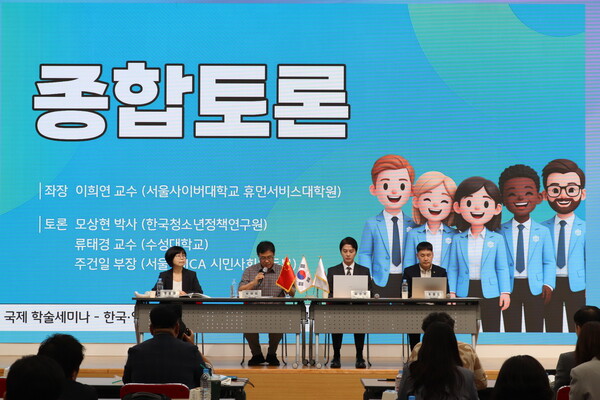
Lee Eun-joo, president of Seoul Cyber University, said in her remarks that the seminar “carries great significance for comparing youth cultural perceptions and social environments and for discussing directions for international cooperation.”
Cho Gyu-tae, president of the Seoul YMCA, said, “Building a foundation for youths from South Korea, China and Japan to understand each other more deeply and to grow together is crucial for peace in Northeast Asia and for shared global prosperity.”
Experts say the survey delivers a clear message for youth policy in South Korea: constructing more cultural facilities alone is not enough. They urge changes in educational approaches so young people do not dismiss traditional culture as outdated, and they call for expanding creative cultural education that integrates AI and digital tools.
The seminar outlined a roadmap: in the short term, assess the current state of traditional-culture education; in the medium term, develop an education system that integrates traditional culture with AI; and in the long term, establish a national support system to cultivate and manage youth cultural competencies. Helping a generation that experiences culture widely to also gain a deeper understanding of its meaning is the next imperative.









Most Commented