
Hanwha Ocean’s Labor Turmoil: What Does the New Labor Law Mean for Subcontractors in 2026?
Daniel Kim Views
Translation result.
|
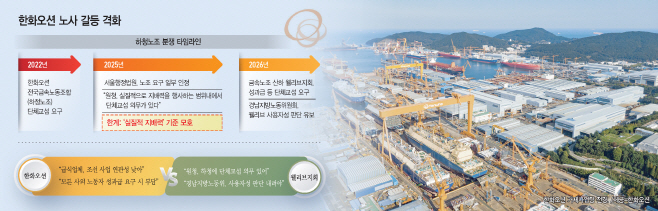
Confusion over labor relations at Hanwha Ocean is deepening. Since the enactment of the so-called \”Yellow Envelope\” law, which amends Articles 2 and 3 of the Trade Union Act, outside subcontractor unions have pushed more forcefully for bargaining rights. At the workplace level, managers and unions disagree about whether auxiliary services that are not directly part of manufacturing should fall within collective bargaining. Industry observers say the government needs to issue clear guidance urgently.
According to industry sources on the 19th, Hanwha Ocean has been struggling to define the scope of collective bargaining for subcontractor unions. The Welliv branch, an external subcontractor union, demanded to join negotiations after the Yellow Envelope law took effect. Last year, Hanwha Ocean eased tensions by awarding both prime-contractor and subcontractor employees a 400% performance bonus at the same rate, but relations have become strained again this year.
The Welliv branch represents workers at a contractor that provides on-site food services, commuter buses and facility maintenance at Hanwha Ocean. Welliv operated like a subsidiary during the Daewoo Shipbuilding & Marine Engineering era, but it was sold during the company’s financial difficulties and is now classified as a subcontractor. In March, immediately after the Yellow Envelope law took effect, the Hanwha Ocean chapter of the Metalworkers’ Union covering Geoje–Tongyeong–Goseong shipyard subcontractors — which includes the Welliv branch — requested collective bargaining, arguing that Hanwha Ocean exerts practical control and therefore should negotiate directly.
Hanwha Ocean, however, excluded Welliv from bargaining on the grounds that it is not a subcontractor dependent on the prime contractor. The company says it will negotiate with partners that are directly tied to shipbuilding operations, but maintains that meal-service firms like Welliv are only tenuously related to its core business. Management warns that if subcontractors with low dependency are included, external workers more broadly could cite employer responsibility to press similar demands. According to the Financial Supervisory Service, the number of non-regular workers tied to Hanwha Ocean — including service, contract and dispatched workers — totaled 17,804 at year-end.
As the dispute has grown more complex, the government has taken a cautious stance. The Metalworkers’ Union asked the Gyeongnam Regional Labor Commission under the Ministry of Employment and Labor to intervene, but the commission declined to make an immediate determination on whether Hanwha Ocean qualifies as the employer. Officials said that a direct ruling on employer status could prolong the conflict and impede collective bargaining.
Experts say the lack of clear national guidelines has fueled confusion on the ground. The Yellow Envelope law broadly assigns employer responsibility when a prime contractor’s substantive control is recognized. Last July, the Seoul Administrative Court ruled that Hanwha Ocean has an obligation to engage in collective bargaining where it substantively controls or determines subcontractors’ employment conditions. But the standard for \”substantive control\” remains vague, and competing interpretations have emerged.
Seong-hee Kim, a professor at Korea University’s Graduate School of Labor Studies, said, \”To reduce confusion in the field, we need clearer criteria for determining when a prime contractor should be treated as the employer.\” She added, \”There is a tendency to recognize employer status when manufacturing processes are involved, but standards for auxiliary services such as food service and facility management are still unclear. Without coherent, nationwide guidance, each case is judged individually, which also places a burden on companies.\”
Meanwhile, industry experts warn that broadening the scope of performance bonuses could strain Hanwha Ocean’s finances, given the shipbuilding sector’s cyclical nature and the firm’s obligations to invest in defense projects.
An industry source said, \”Shipbuilding is highly cyclical, so companies need to build reserves during boom periods to prepare for downturns. With pressing investments required to expand defense projects, it will be difficult to justify large performance bonuses for subcontractor workers whose duties are only loosely connected to the core business.\”













Most Commented