
Translation result
Cross-company union vice chair’s “We should get rid of the company” remark fuels controversy
JeonSamno lashes out: “Are you Samsung’s spokesman?” after government mentions emergency mediation review
Controversies over leadership allowances and the union chair’s vacation add to internal fatigue
Are organizational survival and hard-line protest taking precedence over members’ interests? Critics ask
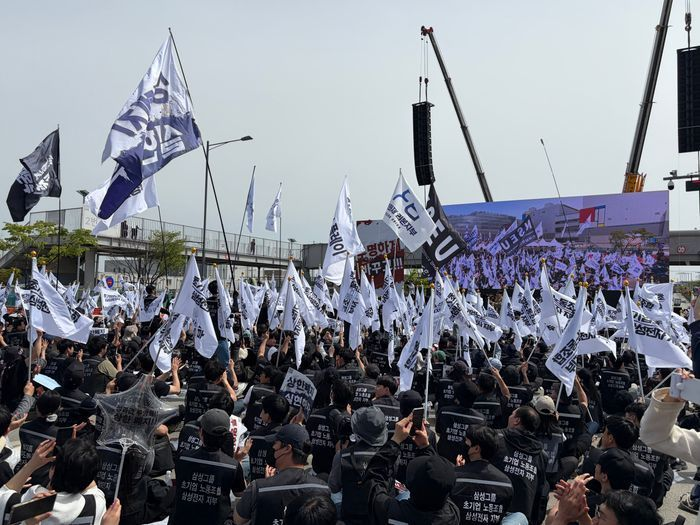
As the phase of an all-out strike at Samsung Electronics shows signs of lengthening, internal fatigue is mounting and members are increasingly asking whom the struggle truly serves. Even after government officials mentioned a possible review of emergency mediation powers and a court issued a partial injunction restraining unlawful strike actions, unions have maintained a hard-line stance. Debates over rolling strikes, leadership allowances and the union chair’s vacation have fueled criticism that the union may be prioritizing organizational survival and confrontation over tangible benefits for rank-and-file members.
On the 18th, industry sources said Samsung Group’s cross-company union — the Samsung Electronics branch (the cross-company union) — and the National Samsung Electronics Labor Union (JeonSamno) have reaffirmed plans to press ahead with an all-out strike despite the government’s mention of possible emergency mediation and the court ruling partially prohibiting unlawful industrial action.
Tensions escalated after JeonSamno publicly responded with a sharp rebuke, asking, “Are you Samsung’s spokesman?” Observers say that rhetoric raises pressure both inside and outside the company. Given the semiconductor sector’s central role in the national economy and global supply chains, critics argue the unions are framing the dispute too narrowly as confrontation, risking broader economic fallout.
We should get rid of the company — union leadership remark draws attention
It recently emerged that Lee Song-yi, the cross-company union’s vice chair, wrote in the union’s Telegram channel, “We should get rid of the company” and “I’ll go to prison,” sparking wider controversy. Lee later told a media outlet the comment was intended to signal a break with entrenched practices, but public sentiment has remained largely negative.
Critics said the remarks were overly emotional and extreme, especially given the semiconductor industry’s outsized impact on national output and supply chains. Industry analysts warn that the longer the all-out strike continues, the harder it will be for unions to formulate an exit strategy: in a multi-union environment, yielding first could weaken organizational control and leadership credibility.
Position allowances from dues — controversy over opaque leadership payments
Members have also voiced complaints about leadership position allowances. The issue surfaced after the cross-company union established a new allowance provision at its March general meeting. Under the rule, the chair may allocate officer and department position allowances up to 10% of union dues; if the executive team has eight or fewer members, allocation may be limited to 5%.
With roughly 70,000 union members each paying about 10,000 KRW per month (≈ $7.50), the rule could allow up to roughly 35,000,000 KRW per month (≈ $26,250) to be distributed as executive position allowances. Industry chatter and internal message boards even suggest Chair Choi Seung-ho could receive around 10,000,000 KRW per month (≈ $7,500) in such allowances.
The crux of the controversy is that senior executives can collect company salaries under the time-off exemption system while also receiving separate position allowances funded by dues. Critics note the allowance rule was adopted alongside the strike authorization vote, and some members say it passed without their full awareness.
Questions about union governance have followed. Under labor law, major budgetary decisions and bylaw changes are typically subject to oversight by a delegates’ council, but critics say the cross-company union’s decision-making is currently concentrated in a small operations committee. Delays in financial disclosure and the absence of detailed allowance payment records have led some members to complain that dues management lacks transparency.
One union member posted on the union website: “Given that the executive team receives time-off exemptions and company pay, what justifies a chair allowance of 15,000,000 KRW (≈ $11,250) and a vice chair allowance of 5,000,000 KRW (≈ $3,750)? If these figures are public, please provide a clear explanation.” The member added, “We’re pressing the company for bonus transparency, yet the chair and executives’ allowance details remain as opaque as EVA.” Earlier, Chair Choi also faced criticism over an allegedly lavish vacation.
A Samsung employee — aren't they among society's 'powerful'?
Unlike past Samsung union disputes that centered on labor rights or the right to organize, this conflict is heavily focused on DS (Device Solutions, i.e., semiconductor) division bonuses and excess-profit sharing, which has weakened its broader public case. The union is demanding that 15% of DS operating profit be used for bonuses and calls for removing the cap on OPI (excess profit performance pay). Given the high compensation levels of many Samsung employees, these demands have struggled to attract widespread public sympathy.
Signs of intra-union friction have also emerged. The Donghaeng Union, based in the DX (Device Experience) division, left the joint bargaining body earlier. A Samsung insider said, “At the moment, this looks less like negotiations centered on members’ practical interests and more like a leadership and organizational posture that is hard to retreat from.” The longer the standoff continues without an exit strategy, the greater the risk of mounting internal fatigue and public backlash, the source added.
© Dailian Co., Ltd. Unauthorized reproduction and redistribution prohibited
- Samsung labor and management return to the table… union hardline sentiment persists despite presidential and owner-level efforts
- “She’s probably mortified” — revealing leggings drew attention, but the core issue was different
- Samsung Electronics union: Management’s stance shifted after emergency mediation mention… no agreement on a withdrawal proposal
- Second round of ‘high fuel price relief’ applications starts tomorrow… who qualifies?
- ‘Busan Buk-gap’ poll: Ha Jung-woo 41.7%, Han Dong-hoon 32.2%, Park Min-sik 21.1% [Opinion poll]










Most Commented