
Translation result.

On May 7, media reports revealed that an account using the nickname ‘OOjoa’—which had posted pro-former president Yoon Seok-yeol messages such as “Yoon Again!”—was operated by a man, not a woman. The account posted several videos purporting to show a woman in her 20s; the profile was fabricated. When users raised suspicions that AI was behind the account, the operator issued an apology, acknowledging, “OOjoa is a man.”
In its May 7 article titled “’Yoon Again’ woman’s SNS turned out to be AI/identity theft… ‘Far-right political phishing’ goes global,” Hankyoreh cited experts who characterized the episode as a form of “political phishing,” a convergence of gendered distortions about women and technological manipulation. The paper reported that promoters are increasingly deploying “virtual young women” to expand the reach of extreme political claims by exploiting biased perceptions of women.
On May 9, Pressian published a column titled What the AI videos of the ‘beautiful Yoon Again woman’ tell us, arguing that the material objectifies attractive women to insert far-right worldviews and thus “phish” the public.
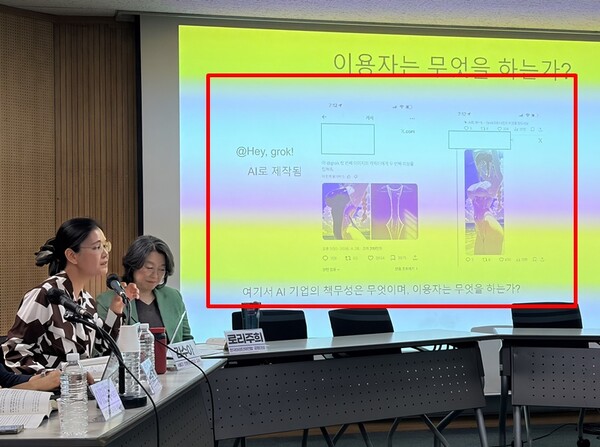
Concerns about the intersection of distorted gendered perceptions and technology have intensified. The issue was raised at a May 6 roundtable, “AI-driven social change, asked through gender,” held at Seoul Women’s Plaza. In her presentation, Kim Su-a warned that users have been using X’s in-house AI, Grok, to generate nude images of women.
That same day, Lee Min-ju, an activist with the Korean Women’s Association United, cited a French nonprofit analysis of 10,000 Grok-tagged posts and 10,000 images on X over a single week. The nonprofit found that more than half of the images showed subjects in underwear or bikinis, and most depicted young women.
[Related article: Is an AI bot that only comforts really good care? The problems of AI from a gender perspective]
In her remarks, Jo Kyung-sook, CEO of Dotori Labs, pointed to ZETA, an interactive AI content platform, and its most popular character, Iljin-nyeo Suhyun. She cautioned that although the Iruda incident once exposed sexual harassment directed at female AI chatbots, similar patterns continue to recur.
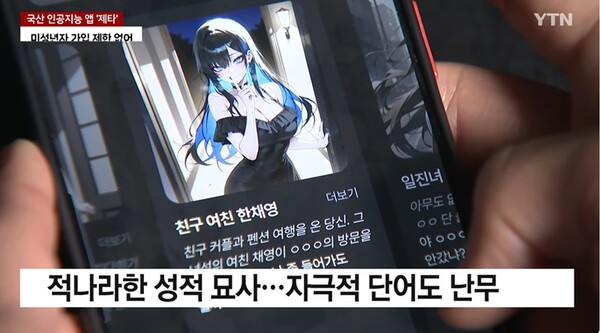
Earlier, YTN reported on Oct. 10, 2025, that ZETA, a domestic AI app popular among teenagers and people in their 20s, exposes minors to sexual content and explicit conversations. The report said the app displays graphic descriptions on its main page, fills character bios with provocative and crude language to attract attention, and that the AI sometimes initiates sexual conversations.
Jo warned, “The problem is not that gender exists outside technology; the problem is that technology lacks a gender perspective. We must integrate gender considerations into the fundamental design principles of technology. Unless women’s organizations are included in technology governance, this problem will persist.”














Most Commented