
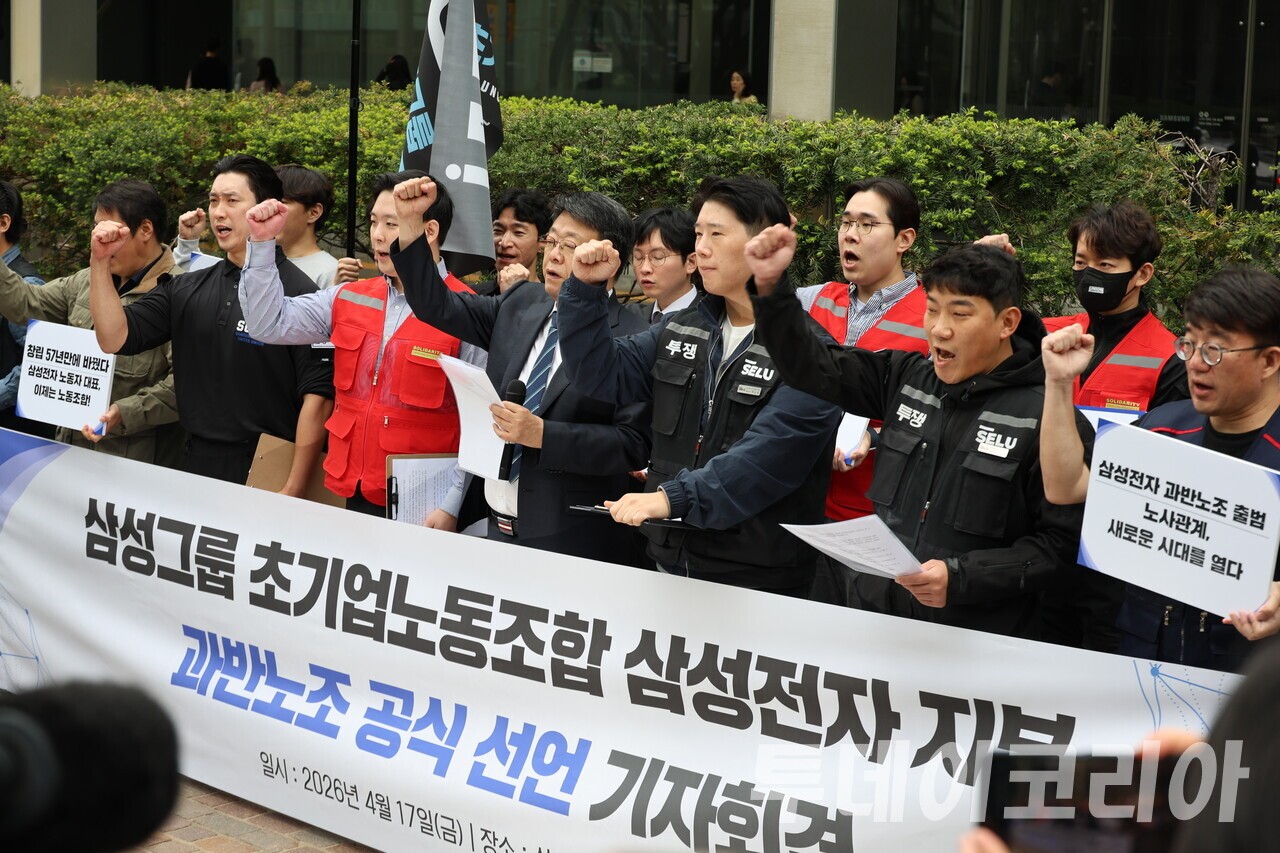
Today Korea — Reporter Lee Gibong | Samsung Electronics’ union announced a planned general strike demanding the removal of caps on performance bonuses, but analysts say internal divisions have deepened and the union’s cohesion is fraying. The controversy intensified after the Donghaeng union withdrew, with non‑semiconductor employees increasingly calling on the National Samsung Electronics Labor Union (JeonSamNo) to reclaim the bargaining rights it had delegated to the cross‑company Samsung Electronics branch (the cross‑company union).
According to industry sources on the 9th, employees in Samsung Electronics’ Device Experience division (mobile and home appliances, DX) have been criticizing cross‑company union Chair Choi Seung‑ho on forums such as Blind. Those criticisms have produced calls for JeonSamNo to take back the bargaining authority it previously handed to the cross‑company union.
One DX employee said, “From DX’s perspective, negotiations have already collapsed and moved to post‑mediation. What justification remains for the cross‑company union to continue representing us at the table? I’m tired of the cross‑company union’s self‑interest. If JeonSamNo led talks, everyone would reach a better outcome.”
Another employee asked, “By law, the representative union is JeonSamNo. Is it appropriate for the cross‑company union to lead post‑mediation proceedings?”
Industry observers say the cross‑company union has concentrated almost exclusively on the DS (semiconductor) division’s fight over performance bonuses while effectively sidelining DX members’ demands, which has amplified internal criticism.
An industry insider pointed to the performance‑bonus demands focused on semiconductor roles as a primary cause of the intra‑union conflict.
The source added, “Within the company there is a sense that the DX division helped steady the business before the AI boom. When some DS personnel tried to exclude DX employees from the process, DX staff withdrew their support for the strike.”
Some observers also note the split deepened when the Donghaeng union, rooted in the DX division, recently left the joint action headquarters.
In fact, Donghaeng recently sent an official letter to the cross‑company union alleging that the majority‑union authority was abused—accusing the cross‑company union of intentionally ignoring and excluding Donghaeng’s positions and of repeatedly making derogatory remarks that could amount to insults (labeling them a company‑friendly union). The letter demanded transparency on negotiation progress, disclosure of the employer’s proposals, sharing of future schedules and dispute points, an official apology, and a cessation of derogatory remarks.
Amid this, tensions also surfaced while JeonSamNo sought to gather input from DX members.
In a letter to the cross‑company union, JeonSamNo stated, “Branch head Lee Ho‑seok, who represents DX members’ voices, has listened to on‑site members through channels such as the ‘Samsung Electronics Labor‑Management DX discussion room’ and has conducted legitimate communications to collect those views. Chair Choi Seung‑ho criticized that communication process and reportedly said he would ‘exclude [those voices] from negotiations’ if an apology was not issued.”
JeonSamNo continued, “This goes beyond a personal attack—it is an attempt to erase DX members’ voices from the bargaining table. Following prior reckless remarks about other unions that damaged external trust, we strongly object to efforts to silence legitimate internal voices through threats of negotiation exclusion. We express deep concern and regret.”
Against this backdrop, some argue that biased leadership by Chair Choi has prompted large‑scale departures of DX members from the cross‑company union.
An industry source said, “On the cross‑company union’s bulletin board alone, more than 1,000 withdrawal posts are appearing each day. Membership, which once exceeded 77,000, has recently fallen to roughly 73,000.”
Experts warn this dispute could escalate beyond a policy disagreement into an existential crisis for the cross‑company union. Although the union nominally represents both DX and DS divisions, its structure has tended to privilege DS voices.
Experts also note that certain actions by union leaders—such as the cross‑company union chair traveling to Southeast Asia while JeonSamNo was intensifying its campaign—sapped momentum from the movement.
External public opinion has become an additional burden. In a poll Realmeter conducted for the Energy Daily on April 27–28, 69.3% of respondents said the union’s strike demands were “excessive and inappropriate.”
Analysts attribute the public’s disappointment in part to unguarded remarks by the union chair and inappropriate actions by some union members, which amplified controversy.
One source told this paper, “Some union members posted on the company bulletin board that the company’s matching‑grant program for vulnerable groups, such as children with rare diseases, was a waste of funds. Similar cancellation posts followed. Although those posts were not led by the union, they nonetheless sparked internal and external backlash.”
The source added, “The union chair also inflamed tensions by dismissing President Lee Jae‑myung’s comment—that the union’s demands were excessive—as if it referred to another company’s union. That remark provoked a backlash from that company’s union and forced an apology. Such unfiltered comments have only intensified the controversy.”












Most Commented