
Translation result
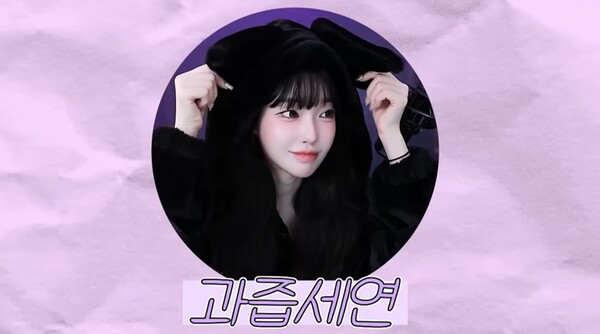
Sidmool withdrew its advertising contract with streamer BJ GwajupSeyeon after an online backlash. The Korea Cyber Sexual Violence Response Center issued a statement titled “We reject the public/underground distinction,” directed at those who criticized the streamer. But commentators quickly debated whether the center’s reasoning actually applies to this case.
The controversy began when Sidmool tapped BJ GwajupSeyeon as a model for a cosmetics campaign and then abruptly canceled the contract. Critics flooded the streamer’s YouTube channel immediately after she posted the Sidmool ad on April 20. For more than a decade Sidmool had avoided celebrity endorsements, relying on product quality and affordability to build consumer trust. The brand’s decision to work with GwajupSeyeon prompted boycott calls; the company ultimately apologized and terminated the deal. Critics said the choice ran counter to the brand image Sidmool had cultivated and to its customer base’s expectations.
On April 21, Sidmool apologized: “Regarding the set composition for this campaign, we made a poor judgment that betrayed the values Sidmool upholds and the trust of our customers. We apologize for acting inconsistently with our brand values during the planning stage and for failing to properly verify details.”
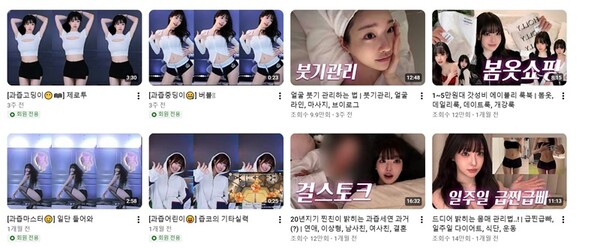
GwajupSeyeon has been criticized for producing dual-track content: public-facing videos—cosmetics reviews and vlogs—target general female viewers, while members-only uploads feature revealing outfits and sexually suggestive dances aimed at male subscribers. In 2024, her appearance on comedian Lee Suji’s YouTube channel drew protests and was later set to private. A planned collaboration last year with a photo-booth brand was also canceled after backlash.
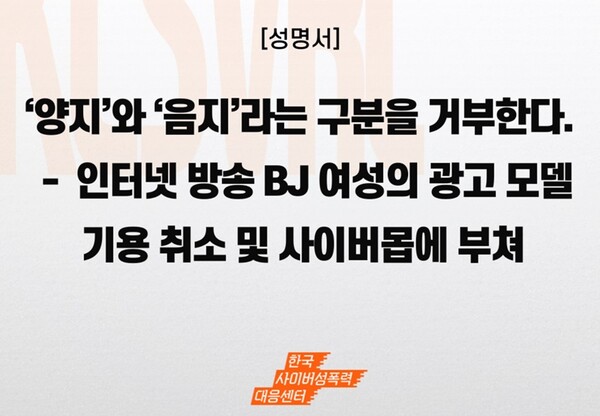
Korea Cyber Sexual Violence Response Center: “We reject the public/underground distinction”
On April 23, the Korea Cyber Sexual Violence Response Center released a statement titled “We reject the public/underground distinction.” The center argued much of the criticism framed the streamer as someone who commodifies women’s sexuality because she earns income by producing content that sexually satisfies a male audience. The backlash, the center said, objected to figures it viewed as belonging to the “underground” stepping into the “public” sphere. “This criticism implies that women from the ‘underground’ lack the qualifications to appear in mainstream society,” the center wrote. “It argues that women have social ‘ranks’ determined by sexual hierarchy, so women who behave promiscuously, sexualize themselves, or make money from their sexuality do not deserve to come into the public sphere.”
The center added that distinguishing between “qualified” and “unqualified” women also affects victims of sexual violence. Society often blames victims—saying they experienced assault because they were promiscuous—and that stigma keeps victims relegated to the ‘underground.’ “We do not ask victims to prove how ‘pure’ they were,” the center said. “Anti-violence movements have long resisted this unjust judgment.”
The statement argued that society demands those living in the ‘underground’ return to ‘normalcy’: earn honest money through respectable labor, while simultaneously resisting their attempts to exist publicly. “Denying a person’s right to exist is hatred,” it said. “Condemning women who sexualize themselves and stripping them of social standing is a persistent form of violence. We must dismantle the stigma that labels people as immoral or harmful. We will take the hands of those who face the finger-pointing and help them step into the light.”
Can the ‘victim-purity’ critique be applied directly to GwajupSeyeon?
Still, critics questioned whether the center’s logic fits GwajupSeyeon’s case. After the statement went up, most responses on the center’s official Instagram were critical. Commenters argued the center conflated sexual-violence victims with a controversial streamer, effectively treating the streamer like a victim. Others wrote that the objection wasn’t to sex workers entering public life but to someone who had actively embraced sexual commodification and then moved into the mainstream without shedding that label. Some asked whether normalizing this culture sends the wrong message to minors—that they, too, could become influencers by broadcasting nude or semi-nude content.
Reactions also revealed divisions within feminist circles. The center has built credibility by supporting deepfake victims and others, so some users questioned whether the statement accurately reflected the organization’s stance. These responses show that even within feminist movements there is a range of views. Many critics did not reject the statement’s underlying logic outright; they questioned whether it should be applied to GwajupSeyeon.
This debate echoes long-standing splits within feminism over prostitution and sex work. Advocates for sex-worker rights emphasize voluntariness and agency, and they push to dismantle stigma. Others argue that genuine voluntariness is rare within capitalist and gendered power structures and therefore remain critical of the sex trade itself. Most would agree that if someone entered the industry out of economic necessity or lacked viable alternatives, they should not be blamed. But with GwajupSeyeon, it is difficult to assign that position, which helps explain the persistent controversy.
One illustrative comparison is U.S. rapper Cardi B, who has openly acknowledged her past as a stripper. When critics attacked her history, she pushed back and turned that confrontation into prominent content. Cardi B has worked to build a distinct identity as a rapper and has expressed pride in her journey. If people continued to police her past and insist on a public/underground divide, that policing could become a form of hatred. By contrast, critics of GwajupSeyeon often point to her present behavior: she continues to produce revealing, paid content for subscribers while also creating mainstream-facing videos for general female viewers. For many observers, that combination felt deceptive rather than a matter of past stigma.
Even if the Korea Cyber Sexual Violence Response Center raises valid concerns, its statement does not resolve every question. The center’s framework fits cases of structural coercion—women who entered the sex industry out of economic necessity. But other questions remain: as sex work moves online, can streamers who earn money through revealing content be classified as sexual sellers? Where does someone like GwajupSeyeon stand if she claims to earn several billion KRW annually from exposure and paid content (several million USD)? Is a streamer who appears on a major Netflix variety show and maintains an active YouTube presence operating in the ‘underground’ or the ‘public’? At what point does criticism of revealing streamers cross the line into prejudice? These questions call for careful, nuanced debate going forward.












Most Commented