
Experts argued that funding for public broadcasters should not be reduced to a simple binary of “public” versus “commercial.” They urged policymakers to recast funding around sustainability and stability, distinguishing “permanent income” from “temporary income.” As the media landscape reorganizes around OTT platforms and market-driven perspectives expand, some participants insisted that discussions about public broadcasting must be approached from a non-market viewpoint.
The Korean Society for Broadcasting (President Kang Jae-won) held a seminar on April 18 at Pukyong National University in Busan under the theme “Public Service Media (PSM) Era: Exploring Sustainable Funding Models for the Future.” Lee Jong-gwan, senior specialist at Sejong Law Firm, proposed evaluating EBS funding not simply as license fees or advertising revenue but by its “sustainability” and “stability”—categorizing revenue as either “permanent income” or “temporary income.” He defined “permanent income” as revenue expected to recur consistently, while “temporary income” is irregular revenue that appears only at certain times.
Lee said government subsidies should be considered “temporary income” because they can disappear when circumstances change or when the implementing body changes. He noted that TV license fees account for only about 5.7% of EBS’s total funding, which makes it difficult for EBS to preserve its public mission and independence based on that source alone. While advertising and program sales are commercial sources, Lee argued they can be seen as “permanent income” so long as markets for ads and program sales continue to exist. He emphasized that public service media must be built on permanent, not temporary, funding because they provide universal services.
Lee also argued that Ministry of Education grants fund education-related projects rather than core broadcasting functions. He urged EBS to decide whether it will prioritize its role as a public service media organization or focus primarily on supplementing public education when determining future funding models. With the broadcast advertising market contracting rapidly, he said guaranteeing sustainable revenue has become difficult and that society must now seriously debate realizing the TV license fee—meaning raising the fee and increasing EBS’s share.
To expand permanent funding, Lee called for institutional reforms that reflect EBS’s distinctive public value and role. He proposed establishing a separate fee-calculation and collection body—such as a “Public Broadcasting License Fee Committee”—and reinvigorating the advertising market through measures like improving bundled ad-sale rules and creating support programs for regional small broadcasters.
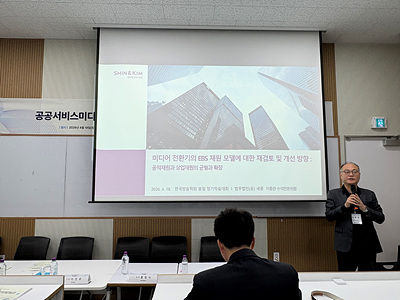
We must view public broadcasting issues from a non-market perspective
Kim Dae-sik, director of the Sustainability Research Institute, said the question of what kinds of funding are appropriate for public broadcasters is directly tied to restoring their role in defending universal values such as diversity, citizenship and democracy. He called for KBS and EBS to coordinate in restoring public broadcasters’ responsibilities, and argued that realizing a fair TV license fee should underpin that effort.
Yun Jang-yeol, a professor at Sungkonghoe University, argued that platforms like YouTube and Netflix have heavily marketized the media environment. That market-oriented view—where only those who watch public broadcasting should pay the license fee—now pervades the media landscape. He said the media sector needs a balance between public and commercial spheres, and that public broadcasting funding should be approached from a non-market perspective.
Yun added that debates about EBS’s paid content subscription service must proceed alongside funding discussions. He called for public debate on why a public broadcaster charges for content and whether EBS is producing the kinds of content society needs from a public broadcaster.
Hong Won-sik, a professor at Dongduk Women’s University, warned that Ministry of Education funding risks narrowing EBS’s role to strictly educational tasks, such as supplementing public schooling. He said funding should be examined through the question: Why should EBS exist as public service media? Shin Sam-su, head of EBS’s Fee Normalization Task Force, said that as media technology advances, a public discussion about permanent funding is urgently needed so producers can plan more creative, in-depth content.












Most Commented