
What Happened in Lebanon? Israeli Soldier’s Hammer Attack on Jesus Statue Raises Tensions
Daniel Kim Views
Translation result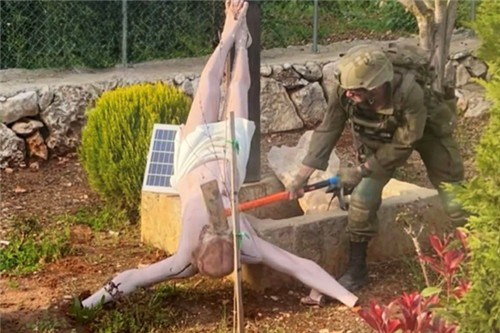 [Herald Economy reporter Yoo Dong-hyun] A photo showing an Israeli soldier striking the head off a statue of Jesus with a hammer has circulated online, sparking widespread outrage.
Israeli Prime Minister Benjamin Netanyahu condemned the desecration in strong terms, and Foreign Minister Gideon Saar issued an official apology as officials moved to contain the fallout.
On April 20 (local time), AFP reported that the Israeli military had confirmed the photo circulating on social media was authentic and said it would take appropriate action.
The image shows an Israeli soldier repeatedly striking the head of a statue of Jesus — which had fallen from a cross to the ground — with a large hammer.
Local outlets, including the Lebanese news portal Lebanon Debate, say the incident occurred in Debel, a prominent Maronite Christian village in southern Lebanon. Municipal officials confirmed that an Israeli soldier operating in southern Lebanon repeatedly smashed a statue housed in an auxiliary church building with a large hammer, causing significant damage.
Palestinian independent journalist Younis Tirawi, who works in Lebanon, posted the images to social media, bringing the incident to global attention.
Maroun Nassif, a resident of the village, condemned the act, calling it “a disgraceful behavior that deeply insulted our religious sentiments and constitutes a direct attack on our sacred beliefs.”
Pro‑Hezbollah outlets in Lebanon, such as Al‑Mayadeen, escalated their criticism, accusing Israel of denying religious values after destroying Islamic sites in Gaza and now targeting Christian holy places in Lebanon.
The Israeli military said on its official X (formerly Twitter) account that it is treating the incident seriously and that such conduct does not reflect the army’s values.
The military added that its Northern Command is investigating the matter through the chain of command and that it will take appropriate measures against those involved.
It also said it is cooperating with the local community to restore the statue.
Israeli leaders moved quickly to limit the incident’s political and diplomatic fallout.
On X, Prime Minister Netanyahu wrote that, upon learning an Israeli soldier had damaged a Catholic relic, he — like the overwhelming majority of Israelis — felt “great shock and sorrow.”
He said Israel, as a Jewish state, values tolerance and mutual respect and views members of all faiths as equal partners in building society and communities.
Netanyahu condemned the act in the strongest terms and said military authorities are conducting a criminal investigation and will impose appropriate and severe disciplinary measures on the perpetrator.
Foreign Minister Gideon Saar also issued an apology.
Saar described the destruction of Christian religious items by an Israeli soldier in southern Lebanon as “a very serious and shameful incident.”
He said he was confident authorities would take stern action against those responsible and added, “Israel respects diverse religions and their relics and defends tolerance and respect among faiths. We apologize for this incident and offer our consolation to all Christians who were hurt by it.”
Israeli media have connected the case to an increase in extremist Jewish discrimination and violence against Christians in recent incidents in and around Jerusalem.
The Religious Freedom Data Center (RFDC) reported 181 incidents last year of spitting directed at Christian clergy, and 60 incidents of direct violence, including tear‑gas deployment, physical assaults, and stone‑throwing. Through March of this year, authorities recorded 33 similar cases near Jerusalem’s Old City.
The RFDC also logged 52 cases of vandalism against churches and Christian cemeteries. In March, suspected Jewish settlers were accused of setting fire to a vehicle in Taybeh, a prominent Christian village in the West Bank.















Most Commented