
The Struggle for Mobility: How a Landmark Lawsuit is Changing Transportation Rights for Disabled People in Asia
Daniel Kim Views
Translation result.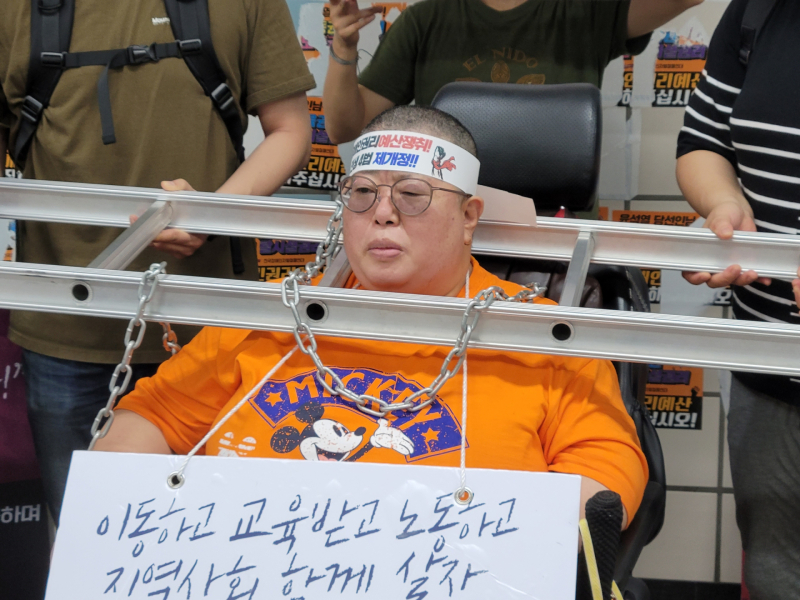
“Is it acceptable that citizens have to file lawsuits just to ride a city bus?”
In a phone interview on the 20th, for Disabled Persons’ Day, Cho Hyo-young, head of the Gyeongnam branch of the National Coalition for Disability Mobility Rights (the Mobility Rights Coalition), posed that question. On the 31st of last month, the coalition announced nationwide, simultaneous discrimination-relief lawsuits demanding guaranteed boarding rights on intercity and express buses for wheelchair users. Cho is one of the plaintiffs.
Disabled Persons’ Day is a legally designated commemoration intended to raise public awareness and encourage rehabilitation. Cho, a wheelchair user living in Gimhae, Gyeongnam, has run the Gimhae Center for Independent Living since 2007 and has led the coalition’s Gyeongnam branch for two years. She is a longtime grassroots activist who has pushed for improved transportation access across the region.
“We’ve asked for decades to be allowed on buses, but the situation hasn’t changed,” Cho said. “I joined the lawsuit because we need legal rulings to compel change.” She noted that court decisions in Seoul in 2014 and Gwangju in 2017 recognized boarding rights, but those rulings have not produced meaningful improvements in practice.
“I wanted to make clear that people with disabilities are citizens with the right to move,” she said. “We filed this so the next generation won’t have to fight the same fight.” The coalition plans to file complaints across the country in stages—starting in Jeonbuk and Gyeongnam on the 15th, then Gangwon on the 16th, Daegu on the 20th, Jeonnam on the 21st, Busan on the 23rd, and Seoul and Gyeonggi on the 30th.
Cho described the problem as more than an inconvenience: for many, travel is simply impossible. There are effectively no intercity or express buses that accommodate wheelchair users, and alternative options are limited. She noted that the KTX provides only about two powered wheelchair spaces and one manual space, so travelers must reserve in advance and often plan their trips around train schedules.
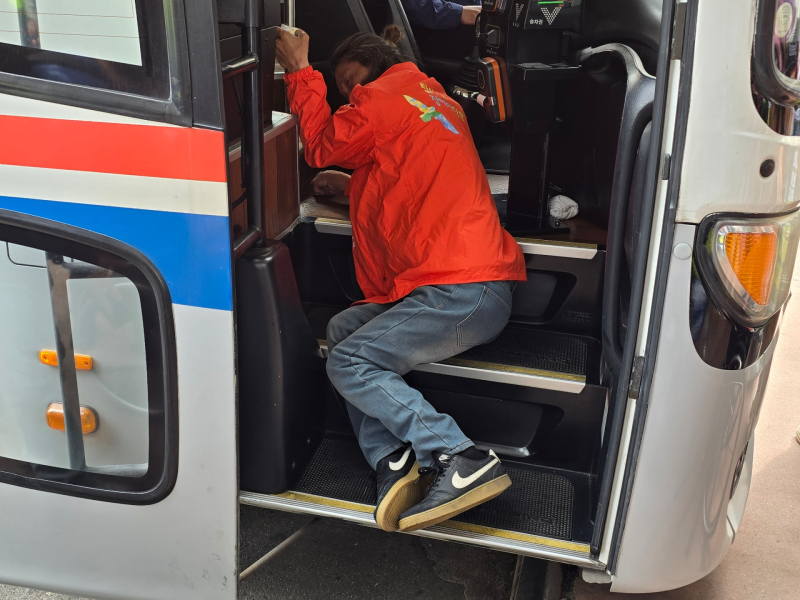
Accessible call taxis also restrict interregional travel and are impractical for long distances. Cho said that even air travel can be restrictive: trips that last an hour often require passengers to arrive hours early, face rules such as disembarking last, and complete extra procedures like removing wheelchair batteries. “In short, there is no truly free and accessible public transportation,” she said.
Cho placed significant responsibility on the government. Although mobility is a fundamental right, she said, authorities have not acted decisively. Programs exist to support bus retrofits and boarding equipment, but participation has been low. “They create policies but fail to enforce them, so nothing changes in the field,” she said.
She also criticized transport companies’ reluctance. “Operators resist installing wheelchair spaces, claiming reduced seating will cut revenue,” Cho said. “Unless the government sets clear standards and strengthens oversight, change will be difficult.” She reiterated that mobility should be treated as a public responsibility, not a matter of profitability.
Cho emphasized that mobility is not an issue confined to a single group. “Anyone—today non-disabled—can become disabled because of an accident, illness, or aging,” she said. “Designing society around the most vulnerable makes life easier for everyone.” “Mobility is not a special accommodation; it is a basic right for all,” she added.
“We want to go to work, attend school, meet friends. We want to see the seasons change and the flowers bloom,” Cho said. Through this lawsuit, she is not seeking grand gestures but the everyday freedom of movement that everyone should have. “We have endured being told to wait, but this problem can no longer be postponed,” she said.
















Most Commented