
How Han Seung-hun Shaped Korea’s Human Rights Movement: A Tribute and Awards Ceremony
Daniel Kim Views
Translation result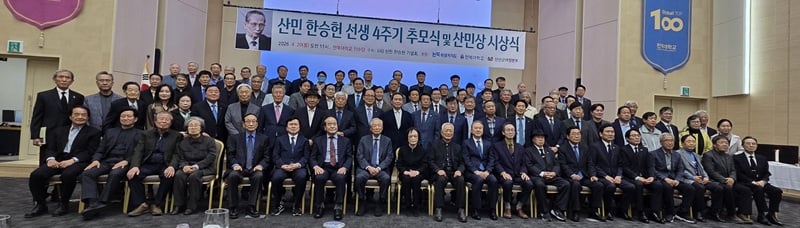
A fourth-anniversary memorial for the late former Auditor General Han Seung-heon and the second Sanmin Award ceremony were held on the 20th at Jeonbuk National University’s Jinsudang 77th Anniversary Hall.
The event, organized by the Sanmin Han Seung-heon Memorial Association—named for Han’s pen name “Sanmin”—and sponsored by North Jeolla Special Self-Governing Province, Jeonbuk National University, and the Jinan County Homeland Association, drew roughly 200 attendees, including family members, local leaders, legal professionals and civil-society representatives. The program was divided into two parts: a memorial service followed by the award ceremony.
In his opening remarks, Yoon Seok-jeong, chair of the memorial association, underscored Han’s commitment to his hometown. Yoon recalled that Han made time to attend events in Ancheon Township, Jinan County, even amid national responsibilities. He noted Han donated a hand-painted plaque inscribed with the motto “care for the country as you would your home” for Ancheon Residents’ Day and regularly gifted books to his alma mater, Ancheon Elementary School—actions that reflected a lasting bond with the community.
Yoon described Han as a true member of the Jinan community who took pleasure in meeting townspeople informally and communicating without pretense.
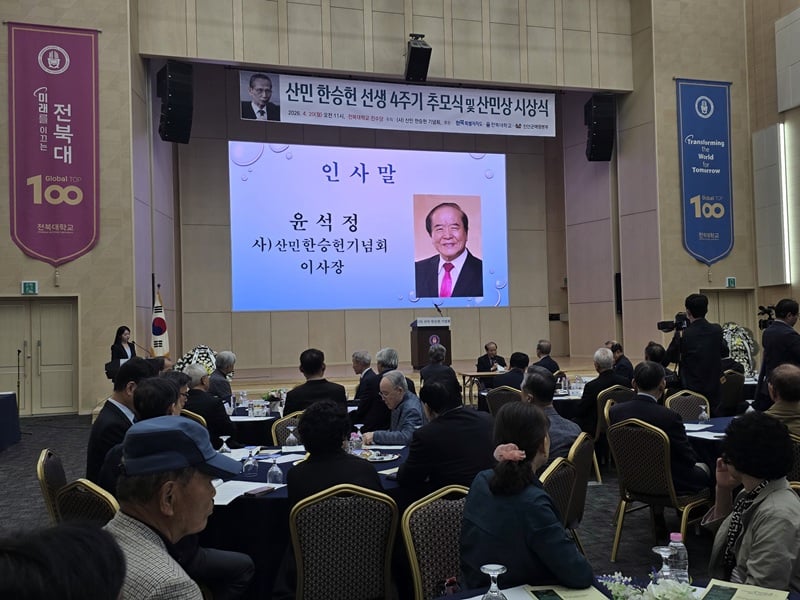
Yang O-bong, president of Jeonbuk National University, called Han one of the university’s most distinguished alumni. Yang noted that Han, a member of the class of 1953, stands among the school’s brightest graduates and that his accomplishments as a legal professional and his role as a moral conscience of his era continue to resonate with younger generations.
Yang announced plans to open a “Han Seung-heon History Hall” on campus this October to preserve and pass on Han’s legacy and achievements.
Speakers then reflected on Han’s life from multiple perspectives. Kwon No-gap, director of the Kim Dae-jung Foundation, characterized Han as a leading human-rights lawyer who defended students, dissidents and wrongfully accused victims under an oppressive military regime. Kwon added that Han combined knowledge, wit and a warm personality, earning deep trust from those around him, and that he carried those qualities into his tenure as Auditor General, serving with integrity and responsibility.
Song Gi-in, director of the Bu-Ma Democratic Uprising Memorial Association, emphasized Han’s personal qualities. Song said Han was grateful that his family never went hungry and that he could provide his children’s education, and that he maintained composure and gratitude until the end of his life. Song also recalled Han’s knack for easing tense moments with timely words and good humor.
Attorney Park Yong-il outlined Han’s historical significance in the legal profession. Park noted that in the 1970s—when the idea of a “human-rights lawyer” was virtually unknown in Korea—Han pioneered the field as a first-generation rights lawyer. He helped found Lawyers for a Democratic Society, contributing to the institutional foundations of human-rights litigation, and proposed adopting a constitutional court modeled on Germany’s system, playing a key role in South Korea’s democratic development.
Gwak Young-gil, chair of the Seoul–Gyeonggi Jeonbuk Residents Association, described Han as a moral standard for others. Gwak said Han symbolized human rights and integrity, serving as a spiritual mentor to younger lawyers and practicing values of self-reliance, autonomy and independence while upholding principle in every circumstance. He emphasized that Han’s intellect and dignity, observed in personal exchanges, remain assets local leaders must preserve.
Lee Kyung-young, acting mayor of Jinan County, delivered condolences on behalf of the local government. Lee said Han devoted his life to human rights, justice and democracy and left a profound imprint on society. He added that Han’s habit of putting the nation and community before personal interest is a model worth emulating today, and stressed that the Sanmin Award aims to continue that legacy by upholding human-rights and justice values.
The memorial included cultural tributes. Poet Jo Myeong-sun recited Han’s posthumous poem “The Roadside of History,” creating a solemn mood, while musician Jang Sa-ik performed a song set to one of Han’s poems and sang “Spring Days Are Gone,” leaving a lasting impression.
At the award ceremony, the second Sanmin Award was presented to the Jeonbuk Human Rights Council. This was the first time the prize was awarded to an organization. Yoon Seok-jeong presented a plaque and prize money of 10 million KRW (approximately $7,500). The recipient pledged to continue its work protecting human rights and advancing the rights of socially vulnerable groups.
△ The path walked by Sanmin (Han Seung-heon)
Han Seung-heon, who used the pen name Sanmin, was born in 1934 in Ancheon Township, Jinan County, North Jeolla Province. He attended Ancheon Elementary School and Jeonju High School, and graduated from the Department of Political Science at Jeonbuk National University (class of 1953). After passing the judicial track of the 8th national administrative examination in 1957, he began a legal career as a prosecutor at the Ministry of Justice and at the Busan and Seoul district prosecutors’ offices. He left public service in 1965 to open a private practice and devoted the rest of his life to defending human rights and democracy.
Under the military regime, Han defended high-profile political cases, including the Dongbaekrim incident, the National Student and Youth Federation case, the Unification Revolutionary Party case, and the libel trial over poet Kim Ji-ha’s poem “Ojeok.” He defended conscience prisoners and pro-democracy activists and is recognized as a first-generation human-rights lawyer who effectively opened the field at a time when the concept scarcely existed in Korea.
Han endured significant personal sacrifice: he was arrested twice and spent a total of 292 days in detention, and he was barred from practicing law for eight years and five months. Nonetheless, he refused to yield to political pressure and became a symbolic figure in South Korea’s human-rights movement.
He helped found Lawyers for a Democratic Society, contributing to the institutional underpinnings of human-rights lawyering, and advocated for the introduction of a Constitutional Court modeled on Germany’s system, shaping the institutional development of Korean democracy.
Han also had a notable literary career. As a member of the Association of National Literature Writers, he published volumes of poetry praised for blending traditional lyricism with modern sensibility while resisting strict alignment with any single school. In 1990, he exhibited works at a writers’ show held at Geurimmadang Min in Seoul.
He carried his principles into public office. After the Kim Dae-jung administration took office, he was appointed the 12th Auditor General in 1998, working to reform public institutions and strengthen integrity. He later served on the defense team during the 2004 impeachment trial of President Roh Moo-hyun and continued to speak out on major constitutional issues.
Throughout his life, Han practiced the values of human rights, justice and democracy as both a lawyer and a man of letters. He maintained a deep affection for his hometown of Jinan, participating in local events and making donations, and lived by the credo “care for the country as you would your home.”











Most Commented