
21,095 juveniles were arrested last year
Violent crimes, including murder and rape, are also on the rise
Even on-the-spot arrests often result only in warnings
Inefficient repeat investigations after transfer to juvenile court
“This undermines police morale… we cannot ignore it”

A patrol officer identified as A, who works at a district post under a frontline Seoul police station, recently responded to a report that elementary school students were smoking in an alley. At the scene, children who appeared to be fifth- or sixth-graders were tossing cigarette butts and spitting. Officer A tried to record their information to counsel them, but the students shouted, “What are you going to do with our names?” and insulted the police. Because the Juvenile Act does not give police explicit authority to investigate juveniles who are exempt from criminal punishment, Officer A could only warn them and leave.
Crimes involving these juveniles have risen every year, and the methods have grown more brutal. Yet the officers who encounter them first say they lack the legal authority to carry out necessary investigations, and they face persistent frustration in the field. President Lee Jae-myung recently raised the possibility of lowering the age threshold for criminal responsibility, sparking public debate; frontline officers, however, say strengthening police investigatory powers should come before any change in age limits.
On April 10, the Ministry of Justice’s monthly court statistics report showed police arrested 21,095 juveniles exempt from criminal punishment last year — roughly an 80% increase from 11,677 in 2021. Adding “at-risk juveniles” (ages 10 and older who may be inclined to offend) and “delinquent juveniles” (ages 14 to under 19 who committed offenses) brings the total number of juvenile offenders to 51,360. The number of juveniles exempt from criminal punishment accused of violent crimes — including murder, robbery, rape and sexual assault — rose from 479 in 2021 to 826 last year. Officers on the ground say offenses have expanded beyond petty misconduct into violent and more sophisticated crimes.
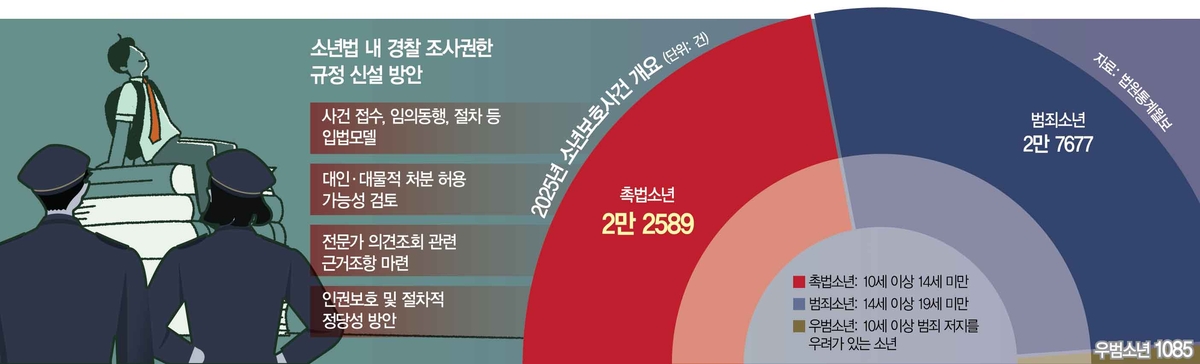
The core problem, officers say, is that police have limited options when dealing with these youths. The current Juvenile Act assigns responsibility for protection measures and criminal disposition to the juvenile courts but does not clearly define how far police can go during an incident’s initial stages. As a result, routine steps — confirming identities, requesting attendance, asking someone to accompany officers voluntarily, or collecting evidence — can be exposed to accusations of due process violations or human rights infringements. With internal oversight and complaint burdens looming, many officers say they are forced to act cautiously.
School police officers (SPOs) assigned to address school violence and youth delinquency also lack formal investigative authority. A police officer experienced with juvenile cases said, “If students refuse to cooperate, we often can’t even confirm names or contact information. Even when we make an on-the-spot arrest, procedures become onerous if the youth is later classified as exempt from criminal punishment.”
Against this backdrop, police are pushing to revise the Juvenile Act to clarify their investigative powers in juvenile cases. They argue that as juvenile crime becomes more advanced and sophisticated, officers must be able to establish facts and diagnose causes of delinquency from the outset. Police plan to gather concrete examples from frontline officers — such as refusals to comply with attendance requests, failures to secure evidence, and difficulties communicating with guardians — and to examine inefficiencies that require juvenile courts to re-investigate issues that were not fully addressed at the police stage.
Based on that work, authorities plan to design legislative models covering the entire process from case intake to voluntary accompaniment, investigative procedures, guardian notification, and expert consultation. They aim to reduce on-the-ground obstacles related to attendance requests, searches and seizures, while introducing juvenile crime expert participation and early-stage diagnostic procedures for causes of delinquency. To mitigate human rights concerns, they will require clear explanations of the investigation’s purpose and next steps and will ensure guardians and defense counsel can meaningfully participate. Parallel legislative changes for selective referrals and police-led guidance programs for juveniles exempt from criminal punishment are also under consideration.
Experts say lawmakers can no longer ignore limits on police investigations of these juveniles. Lee Yun-ho, a professor of police administration at Dongguk University, warned, “Constraints on both investigation and disposition in these cases can create a public perception that police are standing by doing nothing. That can undermine frontline officers’ morale, so we need to reform the system to reflect the realities on the ground.”













Most Commented